Tofu cat litter is often introduced as an eco-friendly alternative to clay. That description is not wrong, but it leaves out the details that determine whether the product sells well: the grade of the pea fiber, the way the strips are formed, how much dust is released, how the clumps hold together and whether the bag can survive a humid supply chain.
For a buyer, the important question is not simply whether the litter is plant-based. It is whether the formula, production process and packaging deliver the same performance from one shipment to the next. A product that absorbs well but breaks apart in the tray, arrives damp or produces excessive dust will quickly generate poor reviews.
This article looks at the product from that practical angle. It explains the formula behind tofu cat litter, what the commonly quoted figures mean, how it compares with bentonite and mineral water-soluble litter, and what to check before committing to a tofu cat litter bulk or private-label order.
What Kind of Product Tofu Litter Actually Is
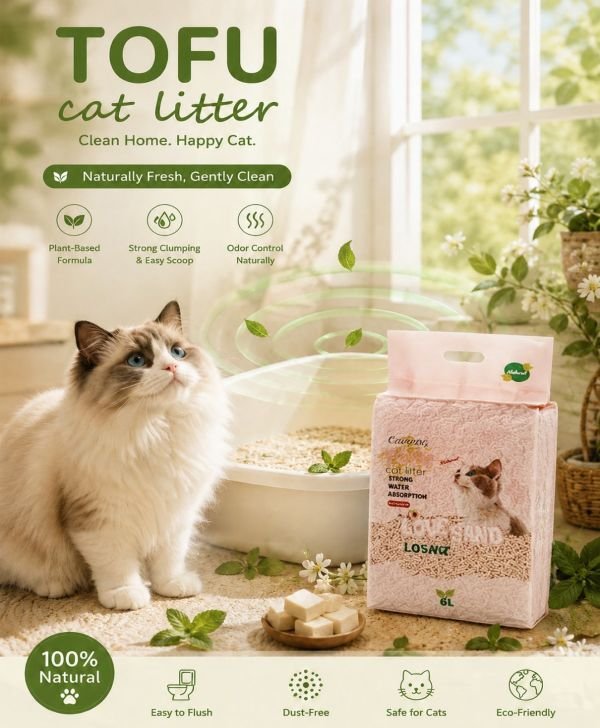
Tofu cat litter is a plant-based clumping litter made from three ingredients. Pea fiber builds the absorbent skeleton and is where the water uptake comes from. Starch binds the mix and keeps the granules in their strip shape. Guar gum, added at roughly 1 to 2%, is the accelerator that locks water into a clump fast. Put together, the granules clump quickly on contact, the clump stays firm under the scoop, and liquid does not pool at the bottom of the box.
Why call the formula the product? Because raw material grade shows up directly in the experience. We use food-grade pea fiber. It absorbs consistently and smells neutral. Industrial-grade fiber or recycled material drops absorption, gives the litter an off smell and raises dust, and the end user notices within the first week. The grade costs more on our side. It is also the reason customers reorder, which is the only vote that matters. The product name is tofu cat litter, and the spec sheet has to live up to it. You can check the full ทรายแมวจากเต้าหู้ range on our site.
The degradable label is worth more than decoration in export markets. Several European countries are tightening rules around non-degradable pet products, and end consumers increasingly treat disposal as part of the buying decision. Used tofu litter can be composted or sent with household waste, and the degradation cycle is short. If you sell into Europe or North America, put degradability on the selling-point list. It changes conversion rates in ways a fragrance or a bag design never will.
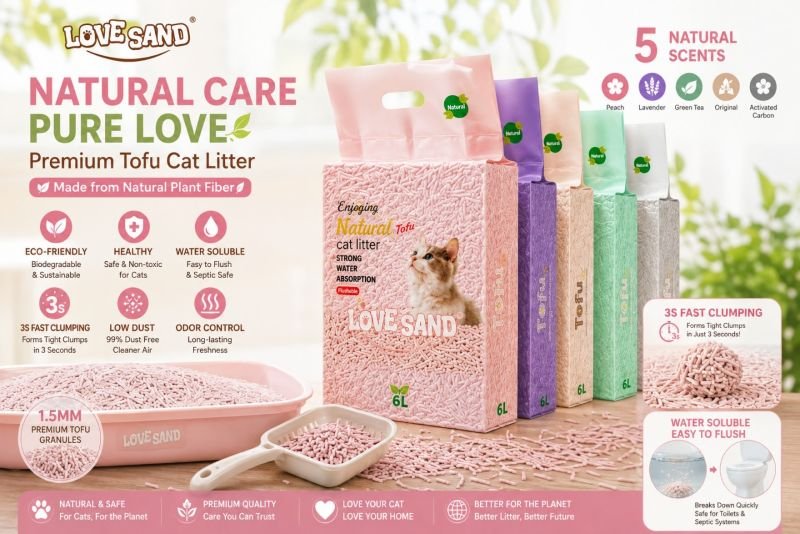
Shape is where the details hide. Ours is a strip granule, 1 to 3cm long and about 1.5mm across. Three things follow from that geometry. First, the strips leave air between granules, so the sand does not compact or re-humidify. Second, 1.5mm is a middle ground cats accept easily; granules that are too coarse make some cats refuse the box. Third, a strip absorbs and swells faster than a round granule of the same material, so urine gets wrapped sooner.
Inspect the shape when you open a sample bag. Too many short broken pieces points to an unstable forming process. Irregular thickness points to weak extrusion control. Pour a bag onto a tray and look at strip integrity. It takes ten seconds and filters out more suppliers than any price negotiation will.
Tofu vs. Bentonite vs. Mineral Water-Soluble at a Glance
| มิติ | ทรายแมวถั่วเหลือง | ทรายแมวเบนโทไนต์ | Mineral water-soluble |
| Raw material | Pea fiber + starch + guar gum | Bentonite clay | Bentonite + sepiolite |
| การจับกลุ่ม | Fast, firm, low usage per change | Fast, firm | Fast, firm (3-5s) |
| สามารถชำระล้างได้ | Yes, plant fiber breaks down | No, clogs drains | Small amounts, gradually |
| Price position | Mid to high | Low | Mid |
| Who buys it | Eco-first owners | Price-led buyers | Practical owners wanting easy disposal |
| Role in a line | Profit SKU, differentiation | Traffic SKU, volume | Differentiation addition |
The Hard Numbers, Taken Apart
Absorption of 600%: The Signature Metric
Our tofu litter absorbs above 600% of its own weight, which means one gram holds six times its weight in liquid. That number comes from two layers working together: the fiber pulls water in, and the guar gum locks it inside the clump. Single-layer plant litters cannot reach it.
For a buyer, high absorption translates into a practical benefit: the box lasts longer, changes happen less often, and the repurchase cycle stretches. For a brand, it is the strongest number for the product page and the fairest comparison point against competitors.
Absorption and clump strength must be judged together. Some litters absorb well and then fall apart under the scoop, which leaves the owner digging out broken pieces every day. Our factory tests the two as one check: first the water uptake, then a simulated digging motion against the clump. Pass both, or the batch does not ship. Do the same with samples instead of trusting a single figure.
Dust Below 3%: The QC Dividing Line for Plant Litters
Controlling dust in tofu litter is harder than in bentonite, because plant fiber sheds fine particles during processing. We hold outgoing dust under 3%, and pouring the litter raises almost no visible dust. The number depends on the dedusting and screening stages. Factories that chase output and skip fine screening ship litter that pours like lime dust, and the reviews say so within weeks.
There is a simple field check: pour the litter into a clear container, shake it hard, and watch how much powder clings to the wall. It is not lab-grade, but it is honest and fast, and you can do it during a factory visit without asking permission.
Separate dust from broken strips when you inspect. Dust is floating fines from incomplete dedusting. Broken strips are fractured granules from forming or from transport. If broken pieces run high, look at the packaging and the stacking height on the pallet, because transit damage is usually a packaging problem, not a production one.
Odor Removal of 90%: Adsorption, Not Perfume
The 90% figure is measured, not estimated. The mechanism works like bentonite in one respect: the raw material adsorbs, and the odor-control components in the formula break ammonia down rather than cover it. Perfume-based litter smells lovely for two days, then the scent evaporates and the ammonia is still there, and the customer feels misled. Adsorption-based odor control keeps working for the life of the litter.
Do not trust your nose alone when testing. Run a side-by-side: equal amounts of urine, equal resting time, several products in a row, and compare what remains. It takes time. It also tells you more than any brochure.
One honest note: tofu litter carries a faint beany smell from the pea fiber. That is normal, and plenty of owners prefer it. If a bag smells strongly perfumed right out of the box, be suspicious. Heavy fragrance usually masks something in the raw material, and it is a fair reason to question the grade.
Moisture Below 8% and an 18-24 Month Shelf Life
Moisture is the most common failure point in tofu litter, and it drives three things. Granule strength: wet granules go soft and clump poorly. Shelf life: moisture breeds mold, which is why ours holds at 18 to 24 months. Transit safety: containers get hot and humid, and a damp litter arrives re-humidified and useless. We ship at under 8% moisture. Put the number in your contract and ask for the test report with the goods.
Do the shelf-life arithmetic before you order. Eighteen to 24 months from the production date sounds generous. Subtract ocean transit, port warehousing and distribution time, and the window actually left on the retail shelf is shorter than it looks. Ask for the shelf life counted from the production date and batch-coded on the pack. Every batch we ship carries a production code, so a client can trace back to the production date and the raw-material batch. If something goes wrong at retail, the problem gets located precisely instead of the whole shipment taking the blame.
Not Every Flushable Litter Is Tofu
Flushability made tofu litter famous, and now many buyers call every flushable litter tofu. The plant-based flushable story around products like flushable tofu cat litter did a lot of that teaching. But two different technical routes sit under that one claim, and tofu is only one of them.
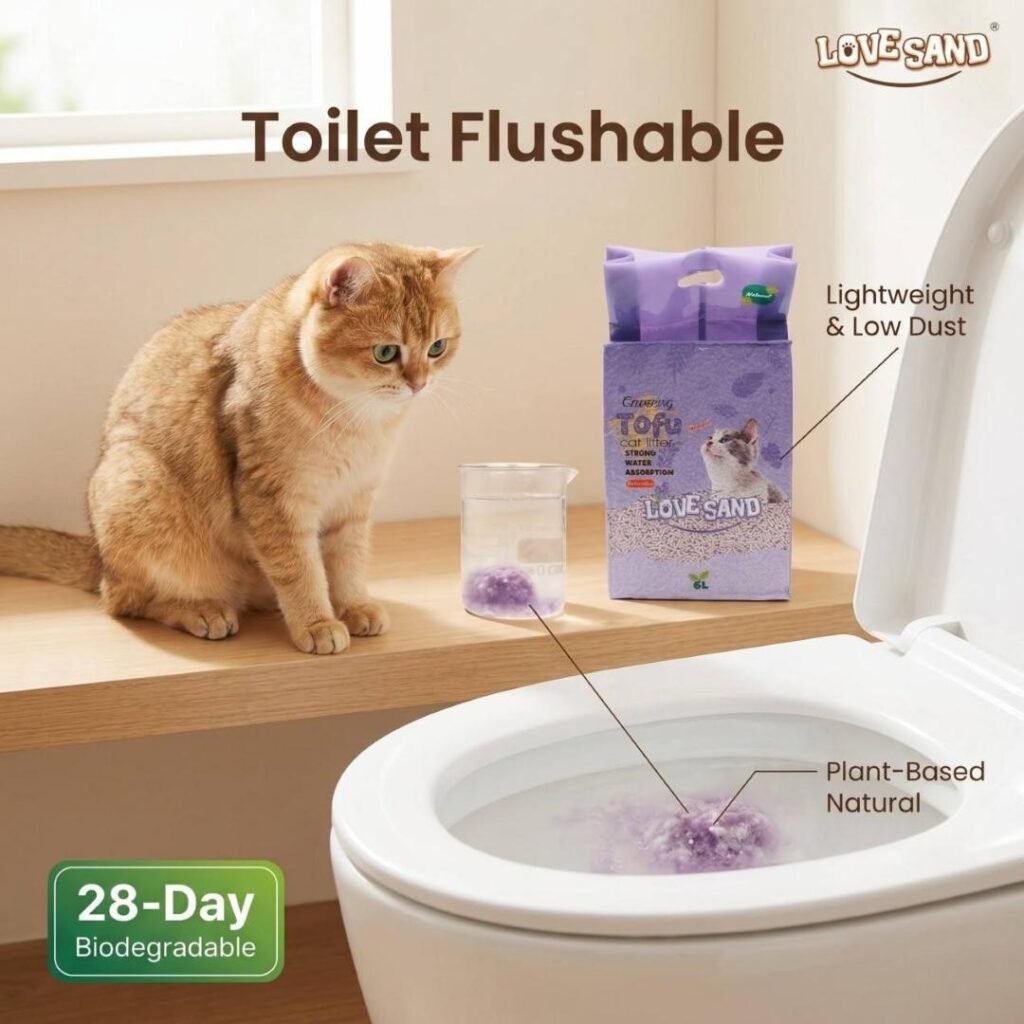
The plant-based route covers tofu and cassava litter: plant fiber plus starch binders that decompose in water. Flushability is a natural property of the material. Tofu litter lives here.
The mineral route is what the market calls water-soluble litter: bentonite blended with sepiolite. It keeps bentonite’s strong clumping and uses the porous sepiolite to let clumps loosen gradually in water, so small amounts can be flushed. Different raw materials, different production lines, different cost structure, and it does not touch the tofu line at all.
If you buy for a brand, decide the route first, then the product. The two compete on the same retail claim but serve different customers: plant-based draws the eco-first buyer, mineral draws the practical owner who wants clay clumping plus easier disposal. Both can ride in one mixed container, but their parameters and acceptance tests cannot be swapped. And on any route, flushing rules and drain standards vary by country, so confirm local policy before you put a flushable claim on the pack. For a fuller comparison of litter categories, our four-type guide goes through the main options.
Which Markets and Product Positions Fit
The customer picture is fairly clear: younger owners who buy on environmental values, apartment households, owners of dust-sensitive cats, and people willing to pay for a degradable label. By region, Europe has the highest acceptance of eco-positioned litter, Southeast Asia is price-sensitive but growing fast, and North America is where tofu branding competition is fiercest. If you sell cross-border online, price tofu litter at mid-to-high and sell the combination of eco, low dust and strong absorption. Do not fight bentonite on price per kilo; the cost structure cannot win there, and the margin lives in the brand premium.
In a product line, tofu and bentonite complement each other instead of competing. Bentonite leads on value and clumping, tofu leads on environmental story and experience. Many overseas brands run both: ทรายแมวเบนโทไนต์ as the traffic SKU, tofu as the profit SKU. We produce both, so one container and one supplier cover the pair, and you save a sourcing relationship instead of adding one. In packaging, printed bags take about 15 days and full customization 25 to 35 days. Tofu litter needs a well-sealed bag because starch absorbs humidity, so we use a thicker composite inner bag that keeps the strips intact and protects the shelf life. Private-label clients can customize the bag, the size and the print. MOQ starts at one 20-foot container with mixed loading, and a new client can run a small first order to test the market.
Six Questions to Ask Any Tofu Supplier
- What grade of pea fiber do you use, and is it food grade? The grade decides absorption, smell and dust. Ask directly.
- What is your guar gum ratio, and why that number? It should sit around 1 to 2%, and the answer should sound technical.
- What are the measured absorption, dust and odor figures, and are they from the same batch? Three numbers from three different batches prove nothing.
- What moisture do you ship at, and what shelf life do you guarantee? Under 8% moisture and 18 to 24 months is the standard to hold.
- What is your strip spec, and how high is the broken-piece rate? Ten seconds with a sample tray answers it.
- Which packaging sizes and customization options do you support? Printed, fully custom, MOQ and mixing rules belong on one page.
คำถามที่พบบ่อย
Q1. Tofu or bentonite: which should I buy for my line?
Q2. Is the 90% odor removal done with perfume? Will it smell?
Q3. How do I count the 18-24 month shelf life after shipping?
Q4. Can water-soluble litter really be flushed, and how is it related to tofu?
Q5. Do you support OEM? What are the lead times?
Q6. Will tofu litter grow mold? What should I check on arrival?
สรุป
The logic of tofu cat litter bulk sourcing is not complicated. What is hard is hitting every metric at once: raw material grade, strip control, absorption with clump strength, dust, moisture and shelf life, and odor control that does not rely on fragrance. Each one tests the factory’s foundations. We run two tofu lines with an output of two containers a day, inside a 60,000-square-meter plant with annual capacity above 100,000 tons, so order taking and quality control both have room to breathe.
Our samples, spec sheets and quality reports go out on request. Email chloe@love-sand.com or reach us on WhatsApp at +86 13052774957, and we will send the package over. Run the absorption test, check the clump, and let the numbers decide whether this product belongs in your line. Samples are free, and we cover the freight. All it costs you is ten minutes.
Reviewed by: love sand pet-litter product team (Puyuan Dalian Pet Products Co., Ltd.). Last updated: 2026-10-26.
More about the manufacturer: About love sand