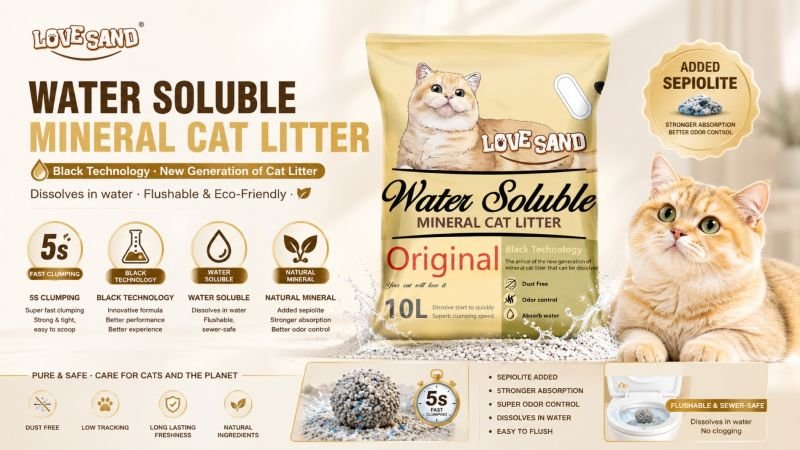
Yes, water-soluble mineral cat litter exists. It is not tofu litter, and “flushable” does not automatically mean plant-based. The mineral version is made from bentonite blended with sepiolite. Bentonite gives it the clumping performance buyers expect from clay litter; sepiolite helps the formed clump loosen in flowing water.
That distinction matters when you are choosing a product for import, distribution or private label. A buyer who treats it like tofu litter may compare the wrong costs and the wrong performance. A buyer who treats it like ordinary bentonite may miss the testing needed to support the water-soluble claim.
The practical answer is more limited than the word “flushable” suggests: the product should be flushed only in small amounts, one portion at a time, and only where local plumbing and wastewater rules allow it. It is a disposal convenience, not a permission to flush an entire tray at once.
This guide explains what the product is, how the mineral system works, which buyers may have a reason to stock it, and what to ask a supplier before placing an order.
Water-Soluble Mineral vs. Regular Bentonite vs. Plant-Based Flushable
| มิติ | Water-soluble mineral litter | Regular bentonite | Plant-based flushable litter |
| Raw material | Bentonite + sepiolite | เบนโทไนต์ | Plant fiber + starch binder |
| Clumping | Fast and firm (3–5s) | Fast and firm | Softer clumps, slightly higher usage |
| In water | Clump loosens gradually; flush in small amounts | Swells into dense mud; high clog risk | Breaks down quickly |
| Price position | Mid | Low | สูง |
| Who buys it | Practical owners who want clay feel plus easier disposal | Price- and performance-led buyers | Eco-first buyers |
First, Clear Up the Mistake: This Is Not a Plant-Based Litter
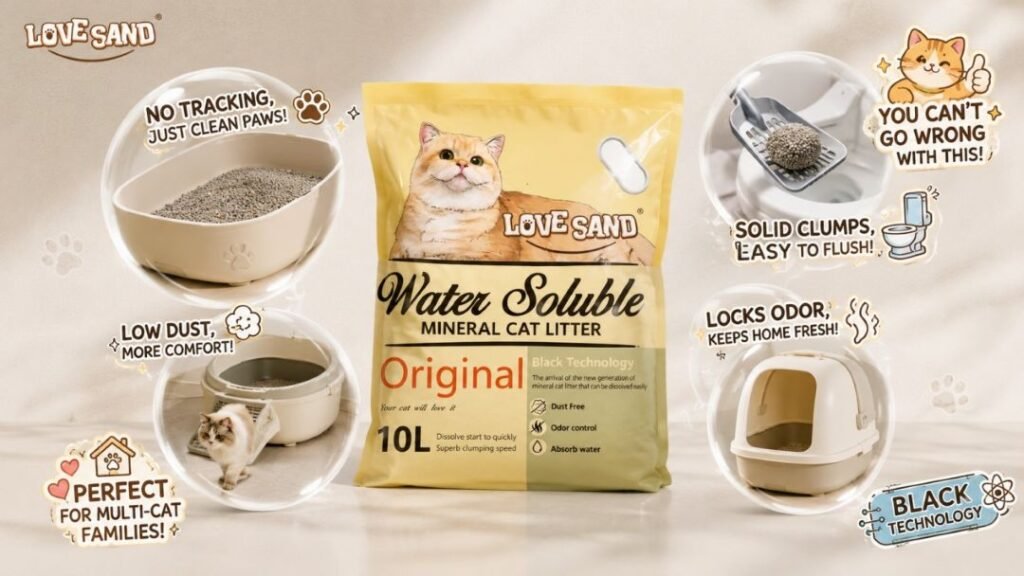
Water-soluble cat litter keeps getting filed under “plant-based flushable,” and that is wrong. Take the Water-soluble cat litter product LOVE SAND lists on its website: the raw material is defined as 100% bentonite plus sepiolite, and the company positions it as a new-generation mineral cat litter solution. The raw-material system has nothing in common with tofu or cassava litter. Plant-based flushable litter such as tofu cat litter relies on plant fiber and starch binders that decompose in water. The mineral route relies on a blend of natural minerals and a process that lets the clump disperse when it meets water. Different materials, different production lines, different cost structure. Buyers should keep the two apart from the very first inquiry.
What Bentonite Brings: the Clumping Base
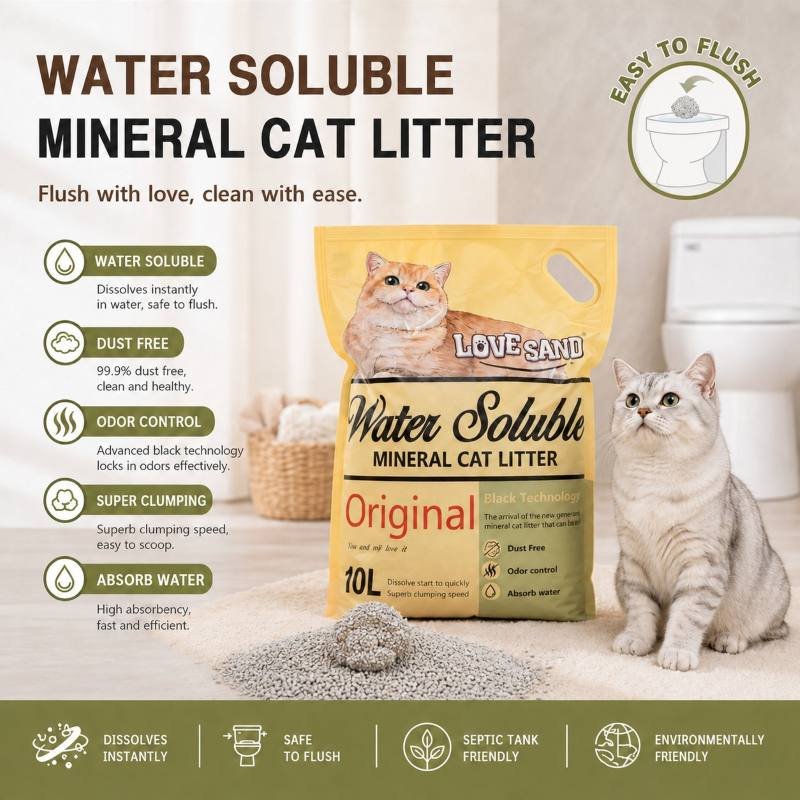
Bentonite is the body of the product. The spec sheet asks for a montmorillonite content of at least 65%, and that mineral’s nature decides the basics: it absorbs water fast, swells, and forms a firm clump in the 3 to 5 second range that lifts out cleanly. So before you get to the “flushable” selling point, this product already has to behave like a decent clumping clay litter. Absorption, clumping and odor control in daily use should not suffer. If they do, the flushable claim is not worth much, because nobody reorders a litter that fails as litter.
What Sepiolite Brings: Clumps That Loosen in Water
Sepiolite is a natural fibrous magnesium silicate with a porous structure and its own adsorption and dispersion behavior. Blended into bentonite at the right ratio, it does two jobs: it strengthens the granule’s adsorption, and it stops a clump from setting into a dense mass. Plain ทรายแมวเบนโทไนต์ flushed down a toilet swells into something like wet cement, which is exactly why clumping clay litter clogs drains. With sepiolite in the mix, the clump loosens gradually under flowing water, and flushing becomes possible in small amounts. That contrast, more than any slogan, is what separates this product from ordinary bentonite.
The Two Balances That Decide Product Quality
Judge this product by two balances, because most quality problems hide in one of them. The first is clump strength against water dispersion. Bentonite wants to swell fully, because fuller swelling means a harder clump. But a clump that is too hard and dense will not loosen in water. The sepiolite ratio and the granule-forming process decide where that balance lands. The ideal product clumps firmly in the litter box, scoops clean, then loosens gradually in pipe water. Test both sides. Testing only clumping and skipping dispersion means you never verified the feature that makes this product different, and testing only dispersion leaves you with a litter that falls apart in the box.
The second balance is compressive strength against dust after transit. Spherical granules rated above 400g of compressive strength survive daily scooping and long ocean freight without breaking down. Below that, dust climbs by the time the container reaches port, and the low-dust story on the bag starts to look weak. Ask for the post-shipping dust figure, not just the factory one.
How It Differs From Plant-Based Flushable Litter
In the store they compete, but the stories are different. Mineral water-soluble litter clumps faster and harder, and the scooping feel is close to traditional bentonite. Plant-based litter breaks down faster in water but clumps softer and uses a bit more per change. On cost, mineral raw materials run below plant-fiber systems, so both factory price and retail price leave more room. On customers, plant-based draws the eco-first buyer; the mineral route draws the practical buyer who wants bentonite behavior and an easier disposal step. If you carry both lines, keep the sales talk separate. Treating one as a cheaper version of the other confuses everyone.
Market Opportunity: Who Actually Pays for This
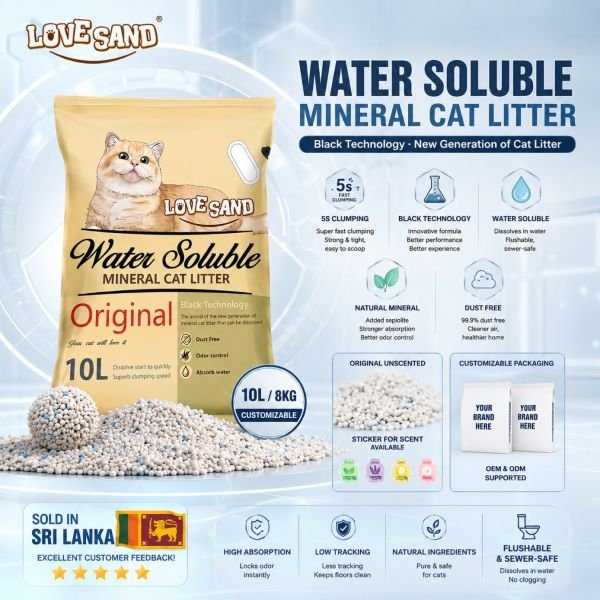
The core customer story is real. Apartment and rental households in big US and European cities face stricter waste sorting and bag fees, and multi-cat households have a genuine disposal problem. Flushing beats carrying bags downstairs, and that is the underlying demand for flushable litter in any material. Plant-based brands did the work of teaching the market that flushing is possible, but their price bands sit high. Water-soluble mineral litter fills the gap between: a bit more than regular bentonite, clearly less than plant-based flushable, with bentonite-grade clumping kept in place. Importers in southern Europe, Latin America and the Middle East, where price sensitivity is higher, have the most reason to look.
Channel-wise, e-commerce carries stable long-tail search around flushable and water-soluble litter, much of that demand built by plant-based lines such as flushable tofu cat litter, which suits cross-border sellers looking for a differentiated SKU. Offline, a message built on disposal convenience plus firm clumping persuades general retail buyers faster than an environmental story alone. One practical note for suppliers and buyers alike: the product package should spell out the flushing guidance, small amounts at a time and checking local plumbing first. That keeps a compliance margin for every channel that carries it.
Where “Flushable” Stops: Three Things to State Clearly
There Is No Mandatory Certification
No major market currently runs a mandatory certification for flushable cat litter. EU CE marking does not cover this kind of functional claim. Most “flushable” statements in the market are self-tested or based on single third-party tests. So a buyer should ask the supplier for the test method and the data behind it. A sentence that says “can be flushed” is not evidence.
Small Amounts Is a Physical Condition, Not Cautious Wording
The dispersion capacity of mineral-based litter is limited. The official guidance, small amounts at a time, is not the supplier being careful. It reflects the physics: the bentonite body still wants to swell, and the sepiolite only modifies that behavior. Packaging and instructions have to say this plainly, or after-sales complaints will all be about blocked toilets.
The Public Health Risk Is Unchanged
Cat waste can carry pathogens such as Toxoplasma, and water utilities in the US and Europe generally advise against flushing cat litter of any kind. This has nothing to do with the material route. The disposal guidance on the pack should be written conservatively and should tell the user to check local rules.
How to Evaluate a Supplier: Mineral-Product Logic
Do not evaluate a mineral water-soluble litter like a novelty product. It shares its raw-material system with bentonite, so use the same discipline.
Verify Technical Capability First
- Ask for batch test data on montmorillonite content, compressive strength and water absorption. These are hard specs for a mineral product.
- Ask where the sepiolite comes from and whether the blend ratio stays stable. Sepiolite is the functional ingredient, and an unstable source shows up as batch drift.
- Check that raw-material purchase records and factory test reports can be traced. Mineral products vary naturally between batches; archived reports are the minimum.
Run the Product Test Checklist
Clump test: pour a measured amount of water, a firm clump should form within 3 to 5 seconds, and it should lift out intact after five minutes. If the basic clump fails, stop there. Dispersion test: put the clump into running fresh water and watch whether it loosens gradually. This is the acceptance item unique to water-soluble litter and the line between it and ordinary bentonite. Compression and dust test: simulate transport, then measure dust again. Arrival data beats factory data, and granules should hold above 400g of compressive strength.
Check the Commercial Terms
Because the product shares the mineral system with bentonite, MOQ, lead times and mixed-container logic run the same way: one 20-foot container minimum, mixed loading allowed; roughly 7 days for stock products, 15 days for printed packaging, 25 to 35 days for full customization; T/T payment; free samples with the buyer covering freight, around 7 to 10 days to deliver. For a first cooperation, a small trial order to test sell-through and return rates beats a large first shipment.
A Reference Case Worth Testing Against
The framework above can be checked against a working example. LOVE SAND, the brand of Puyuan Dalian Pet Products Co., Ltd., has exported cat litter for over 20 years to 87 countries, with annual capacity above 100,000 tons across a 60,000-square-meter plant. Bentonite runs six lines at 240 tons a day, and the plant also runs tofu, wood and wood-pellet lines plus water-soluble, dust-free mineral and pet pad products, so one container can mix several categories. Water-soluble litter sits inside the mineral product system, sharing the raw-material supply with bentonite, with batch QC data, factory reports and export documents (commercial invoice, packing list, certificate of origin, MSDS) issued per order, and BSCI and CE certification in place.
Importers interested in the line can request samples and run the clump, dispersion and compression tests themselves against the checklist above. Samples are free; inquiries go to chloe@love-sand.com or WhatsApp +86 13052774957, with replies usually the same day.
Buyer Tips | Checklist Before You Order
- Clump test: firm clump in 3–5s, lifts clean after 5 minutes.
- Dispersion test: clump loosens gradually in flowing water.
- Compression and dust: granules above 400g; measure dust again after a shipping simulation.
- Batch data on montmorillonite ≥65%, absorption ~350%, moisture <8%.
- Sepiolite source and blend ratio confirmed stable and traceable.
- Packaging states “flush small amounts, check local plumbing rules.”
- First order small: trial volume before scaling.
คำถามที่พบบ่อย
Is water-soluble cat litter plant-based?
What do bentonite and sepiolite each do?
How is it different from regular bentonite cat litter?
Which specs should I verify when buying?
What are the MOQ, lead time and sample policy?
Who should put this product on the shelf?
สรุป
Water-soluble cat litter is one of those products where the opportunity and the risk sit on the same shelf. The opportunity is a flushable claim at a mineral price, aimed at buyers who want bentonite behavior with an easier disposal step. The risk is treating the product as something it is not. It is not plant-based, and it is not exempt from the flushing rules and health warnings that apply to every flushable litter. Position it as mineral, verify the two balances, put the small-amounts guidance on the pack, and the claim stays honest.
LOVE SAND built this product inside its mineral system for a reason: the same supply chain, the same testing discipline and the same export documents as its bentonite lines. For a buyer, that means the product can be validated against ordinary clay standards first and the dispersion claim second. If you want to test it yourself, request a free sample and run the clump, dispersion and compression checks from this guide. The market for flushable mineral litter is still being defined, and the buyers who check the numbers now will be the ones selling it later.
Reviewed by: love sand pet-litter product team (Puyuan Dalian Pet Products Co., Ltd.). Last updated: 2026-10-22.
More about the manufacturer: About love sand