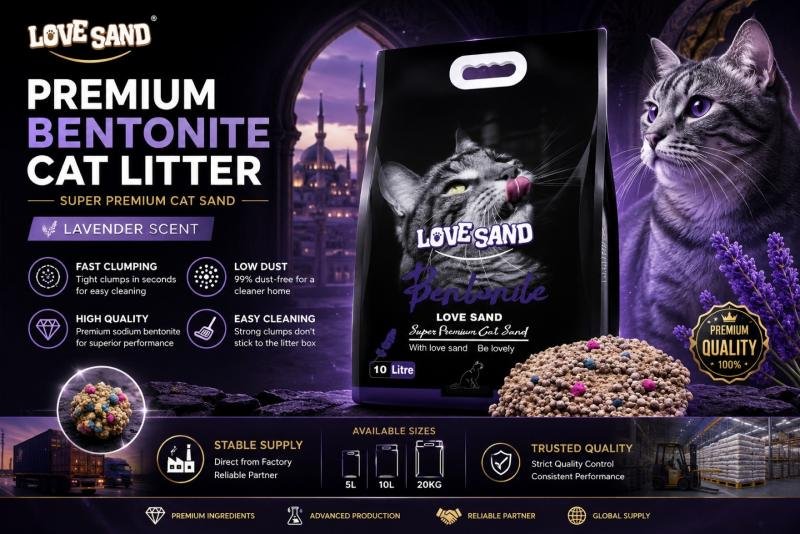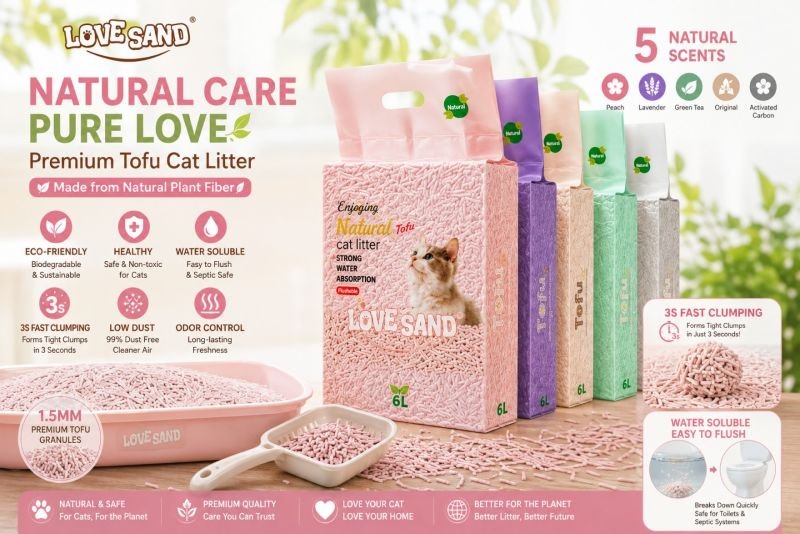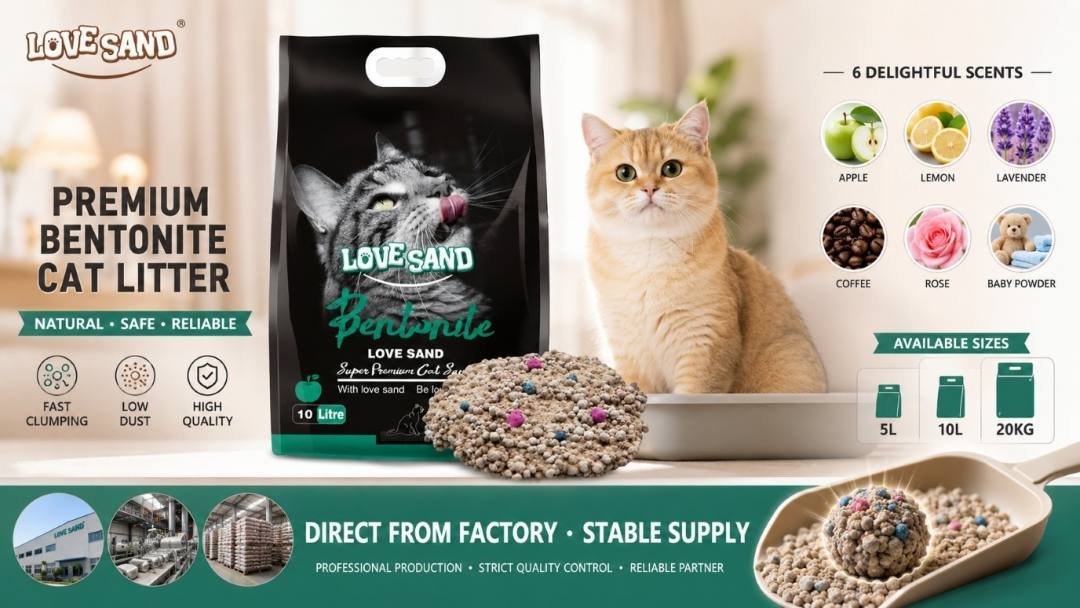
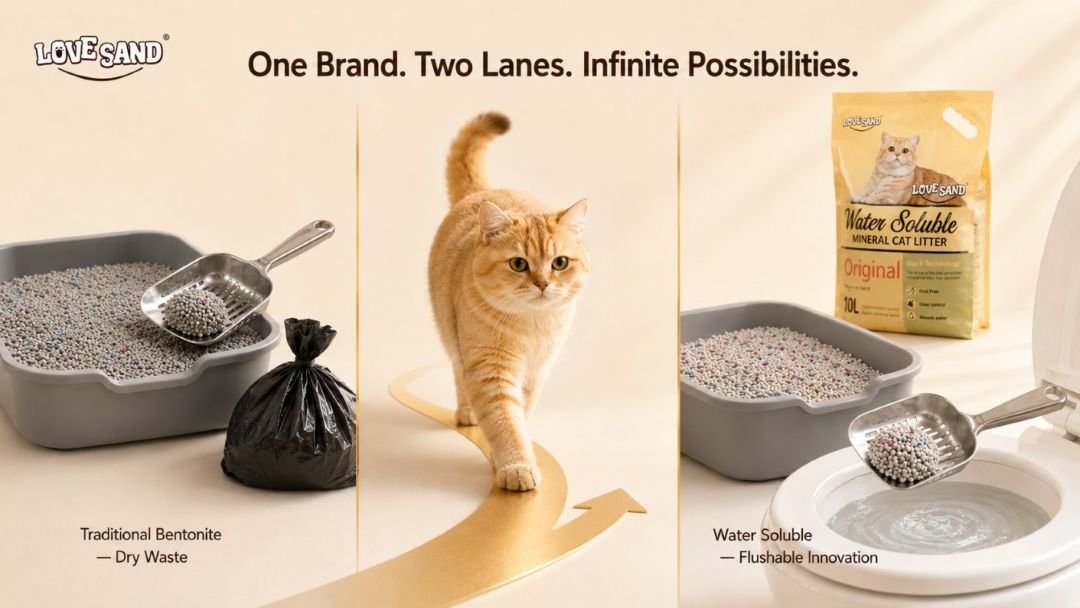
If your brand sells the same bentonite cat litter as everyone else, you are not building a brand — you are running a price comparison. That is why water soluble bentonite cat litter is gaining attention in B2B sourcing conversations. It keeps the clumping performance consumers trust while adding a convenience dimension that traditional clay products cannot claim. For distributors and wholesalers, this category represents a product innovation story that justifies premium positioning without asking consumers to adopt an entirely unfamiliar material.
Para quem é este guia?
Para você, se: you are a distributor, importer, or pet brand evaluating an innovative flushable cat litter product to differentiate your portfolio — whether as a flagship launch or a premium addition to an existing line.
Não é indicado para você se: you are an individual consumer comparing retail products for home use — this is a B2B product development and sourcing guide.
According to APPA data, cat litter is one of the pet industry’s highest-frequency repeat-purchase categories. Brands that innovate within this category capture more than shelf space — they capture consumer loyalty through a demonstrably better daily experience.
Principais conclusões
- Water soluble bentonite cat litter bridges the gap between traditional mineral performance and modern consumer demand for convenience — it clumps like standard bentonite but dissolves in water for easier disposal.
- The product is best understood as a portfolio extension, not a replacement: brands can run economy bentonite, premium dust-free mineral sand, and innovative flushable cat litter as distinct SKUs for different consumer segments.
- Market readiness varies by region — Northern Europe and parts of Asia-Pacific show strongest early-adopter demand, while price-driven markets may position the product as a premium niche.
- For B2B buyers, the critical evaluation criteria are dissolution consistency, clumping integrity after transport, and batch-to-batch formulation stability — not just whether a sample dissolves in a bowl of water.
- Product positioning drives everything downstream: the packaging language, channel strategy, and price architecture for a convenience-focused market look entirely different from a price-sensitive one.
- A water soluble bentonite cat litter OEM project requires more upfront collaboration than a standard bentonite order — market analysis, sample iteration, and packaging storytelling are part of the development process.
- Multi-category manufacturing capability matters because brands that launch with one innovative product typically expand into complementary types within 12–18 months.
Why Traditional Bentonite Needs Product Innovation
Standard bentonite cat litter is the world’s most established litter category. It clumps well. It is affordable. Consumers recognize it. But those strengths are also its limitation — when every brand in a market sells functionally identical bentonite, the only variable left to compete on is price.
This is the structural problem facing distributors in mature markets. Walk down a pet store aisle in any developed economy and the bentonite section is a wall of similar bags with similar claims at similar price points. For a new brand entering that environment, visibility is the first casualty.
Product innovation is the exit strategy. Not abandoning bentonite — consumers trust it — but evolving it. Water soluble bentonite cat litter does exactly that: it keeps the material consumers already accept and adds a capability they increasingly value. For B2B buyers, this means the product sells into existing consumer habits rather than requiring behavioral change — which is the hardest form of marketing.
The Product Value Water Soluble Bentonite Delivers
Convenience Becomes a Competitive Asset
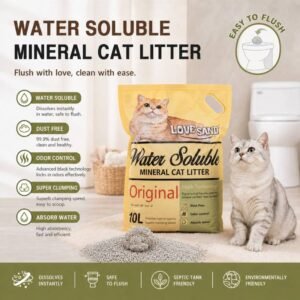
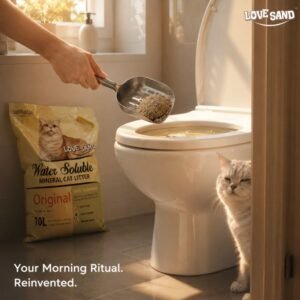
Cat litter maintenance is a daily task. Scooping, bagging, disposing — for consumers in apartments, high-rises, and compact urban homes, the disposal step is often the most friction-heavy part of the routine. A product that dissolves in water and can be flushed in small amounts eliminates a daily annoyance.
This is not a niche concern. Urbanization patterns across developed and developing markets are placing more cats — and more litter boxes — in smaller living spaces. A product that reduces the logistical burden of litter disposal speaks directly to that demographic.
For brands, the commercial translation is straightforward: convenience is a premium attribute consumers pay for. A flushable mineral cat litter SKU can command 20–40% higher retail pricing than a standard bentonite equivalent in markets where disposal convenience is a recognized pain point.
Portfolio Strategy: Three Tiers, One Supplier
The most effective product strategy for a distributor or brand entering cat litter is not one product — it is three:
| Tier | Produto | Consumer | Role |
| Economy | Standard bentonite | Price-sensitive | Volume, channel presence |
| Premium | Dust-free mineral sand | Experience-driven | Margin, brand equity |
| Innovation | Water soluble bentonite | Convenience-seeking | Differentiation, PR, category leadership |
All three tiers can be produced by a single clumping cat litter supplier with multi-category capability — keeping the supply chain simple while the product portfolio grows complex enough to capture distinct consumer wallets.
B2B Development: What Brands Must Get Right
Market Fit Before Product Fit
The most common mistake in innovative product development is building a product first and looking for a market second. Water soluble bentonite performs differently in different commercial contexts.
In Northern Europe, where environmental consciousness and convenience are established purchase drivers, the product can anchor a brand launch. In Southeast Asia, where urban density makes disposal friction acute, it can lead the value proposition. In price-driven Latin American markets, it may work best as a premium addition to a volume bentonite line — not the hero SKU.
The right OEM partner will ask about target country, channel type, and consumer profile before recommending a formulation — because the same base product positioned for a Paris pet boutique looks nothing like the same product positioned for a Jakarta supermarket chain.
Testing Beyond the Demo
A water solubility demonstration in a meeting room is not a quality assurance protocol. B2B buyers evaluating water soluble bentonite should structure testing around three real-world conditions:
Dissolution consistency across water temperatures
- Cold-water performance matters — not every consumer uses warm water for disposal.
Clumping integrity after transport simulation
- If the product degrades during shipping, neither clumping nor solubility matters.
Multi-batch formulation comparison
- Innovation products with novel formulations are more susceptible to batch variance than commoditized products — consistent solubility across production runs confirms process control.
The American Society for Testing and Materials (ASTM) provides standardized frameworks for material performance testing that professional manufacturers reference — asking a supplier which standards they test against separates marketing claims from engineering discipline.
Packaging Must Sell the Innovation
A water soluble product inside a generic bag reads as generic product to the consumer. The packaging must communicate the innovation in seconds: what makes this different, why it matters, and what the consumer gains. For distributors selling into retail, packaging performs the heavy lifting of consumer education at the point of sale — no salesperson is present to explain water solubility in the pet aisle.
OEM Development Roadmap: Four Stages
Stage 1 — Market Alignment: Define target country, consumer segment, price tier, and channel. These four variables determine formulation, packaging, and messaging. Skip this stage and downstream decisions become guesses.
Stage 2 — Sample Iteration: Test clumping speed, dissolution rate, dust level, and post-transport integrity on multiple sample rounds. One round of samples is rarely enough for an innovative formulation — plan for two to three iterations with structured feedback between each.
Stage 3 — Packaging and Branding: Design packaging that communicates the innovation in under three seconds. Water soluble claims need visual hierarchy — the consumer scanning a shelf needs to understand the benefit before they read a single sentence of body copy.
Stage 4 — Production and Supply Continuity: The first production run validates the product. The fifth production run validates the partnership. A supplier that cannot maintain formulation consistency at scale will produce a product whose reviews degrade over time — and in cat litter, review degradation directly reduces reorder rates.
Three Questions to Pressure-Test a Supplier
Does the Manufacturer Understand Innovation, or Just Production?
Many factories can produce standard bentonite. Fewer have the R&D capability to develop, test, and stabilize a water soluble formulation. Ask about their product development history: how many innovative formulations they have brought to market, for which regions, and with what commercial outcomes.
How Is Formulation Consistency Maintained?
Water soluble bentonite involves more complex material processing than standard bentonite. Ask for batch testing records, quality control checkpoints, and documentation of how formulation ratios are verified during production. A supplier that cannot produce this documentation on request is unlikely to produce consistent product at scale.
Can the Supplier Support Category Expansion?
The brand that launches with water soluble bentonite today will likely want to add tofu, cassava, or mixed formula products within two years. A single-category supplier forces you to restart the sourcing process for each new SKU — a multi-category manufacturer keeps your supply chain consolidated as your brand grows.
The Pet Food Industry Association notes that global pet care expenditure continues to rise year-over-year, with product innovation cited as a primary driver of category growth — reinforcing that brands investing in differentiated products are positioning for structural market expansion rather than zero-sum price competition.
Perguntas frequentes
Q1. What makes water-soluble bentonite different from standard bentonite cat litter?
Q2. Is water-soluble bentonite suitable for all plumbing systems?
Q3. What is the typical MOQ for water-soluble bentonite OEM?
Q4. Can water soluble bentonite be a brand's only cat litter product?
Q5. Which markets show the strongest demand for water-soluble bentonite?
Q6. How long does OEM development of water-soluble bentonite take?
Q7. What packaging formats work best for water-soluble bentonite?
Reviewed by: love sand pet-litter product team (Puyuan Dalian Pet Products Co., Ltd.). Last updated: 2026-08-24. More about the manufacturer: About love sand