Most cat litter brands still compete on one dimension: price. But a structural shift is underway — consumer expectations are climbing, and the brands that win the next five years will be the ones that compete on experience. At the center of that shift is areia para gatos sem poeira, specifically dust-free mineral sand. For distributors and wholesale buyers, this category represents the clearest path to premium positioning without reinventing the supply chain.
Para quem é este guia?
Para você, se: you are a distributor, importer, or pet brand evaluating a premium dust free clumping cat litter product for retail, e-commerce, or wholesale channels — and you want to understand what makes mineral sand genuinely low-dust, not just labeled that way.
Não é indicado para você se: you are an individual cat owner comparing retail bags at the pet store — this is a B2B sourcing and product strategy guide.
Global pet industry data from the American Pet Products Association confirms that litter remains one of the highest-frequency repeat-purchase categories in the pet sector. When dust performance drives repurchase decisions, getting the product right from the first production run is not optional — it is the foundation of customer lifetime value.
Principais conclusões
- Dust free cat litter is not a marketing claim — it requires material-grade raw inputs, controlled particle processing, multi-stage screening, and packaging that protects through export logistics.
- Consumer feedback on dust is now a top-three factor in online reviews and repurchase behavior, making low-dust performance a competitive requirement rather than a differentiator.
- Raw material stability is the first lever: inconsistent mine sources produce inconsistent dust levels regardless of downstream processing.
- Particle strength determines post-transport performance — a sample that looks dust-free at the factory can degrade through weeks of container shipping if granule integrity is weak.
- For B2B buyers, the right test protocol includes simulated transit vibration, multi-batch comparison, and real-use pour-and-scoop observation — not just a visual check of a freshly opened sample.
- A low dust cat litter product line enables brands to build a two-tier portfolio: economy for volume and dust-free mineral sand for margin and brand equity.
- Packaging engineering — bag material, seal strength, and pallet configuration — directly affects whether a low-dust product arrives at the retailer in the condition it left the factory.
Why Dust Performance Is Redefining Cat Litter Competition
For years, cat litter purchasing decisions revolved around three questions: Does it clump? How much does it cost? What size is the bag? Those questions have not disappeared, but a fourth has moved to the top of the list for a growing segment of consumers: How much dust does it produce?
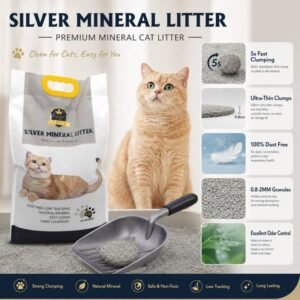
The reason is straightforward. In urban households — where litter boxes sit in living rooms, bathrooms, or laundry areas rather than garages or basements — airborne dust during pouring, digging, and scooping is immediately noticeable. A consumer who sees a dust cloud every time they refill the box assigns that experience to the brand, not to the product category.
This behavioral shift is measurable. Product reviews on major e-commerce platforms increasingly cite dust as a primary satisfaction driver or dealbreaker. For a brand selling through distributors and retailers, a dust complaint is not a one-time issue — it is a signal that can suppress reorders across an entire channel.
From a B2B perspective, the implication is clear: dust free cat litter is transitioning from a niche premium claim to a baseline expectation in developed markets. Brands that ignore this trend will find themselves competing exclusively on price in the shrinking economy segment.
What Actually Makes Mineral Sand Dust-Free
The label “dust free” is easy to print. The product is hard to deliver. For professional buyers, understanding the mechanics behind low-dust performance is the difference between a supplier that can back up its claims and one that cannot.
Raw Material Quality Sets the Ceiling
Mineral sand cat litter begins at the mine. Different deposits differ in mineral composition, particle hardness, and impurity content. A high-quality sodium bentonite deposit with uniform particle structure will inherently produce fewer fines during processing than a lower-grade calcium bentonite source with variable composition.
For OEM buyers, the practical question is: Does the manufacturer control its raw material supply chain, or does it purchase from multiple third-party sources? A factory that sources from a single stabilized deposit — or maintains rigorous incoming material testing — can deliver batch-to-batch consistency. A factory that shops for the cheapest available ore will inevitably deliver variable dust performance.
Granule Strength Determines Transport Survival
This is the most overlooked variable in B2B cat litter sourcing. A freshly produced sample examined at the factory can appear nearly dust-free. But that same product, after four to six weeks in a shipping container — vibrating across oceans, transferred at ports, stacked in warehouses — may arrive with significantly more fine particles.
The mechanism is physical: weak granules fracture under sustained vibration and compression. Every fractured granule produces dust-sized particles that were not present at the factory gate. For export brands, the performance that matters is not “dust level at production” but “dust level after a realistic supply chain journey.”
A competent dust free cat litter OEM manufacturer addresses this through granule hardening processes, multi-stage screening, and packaging designed to absorb transit stress rather than transmit it to the product.
Screening and Processing: Multiple Passes, Not One
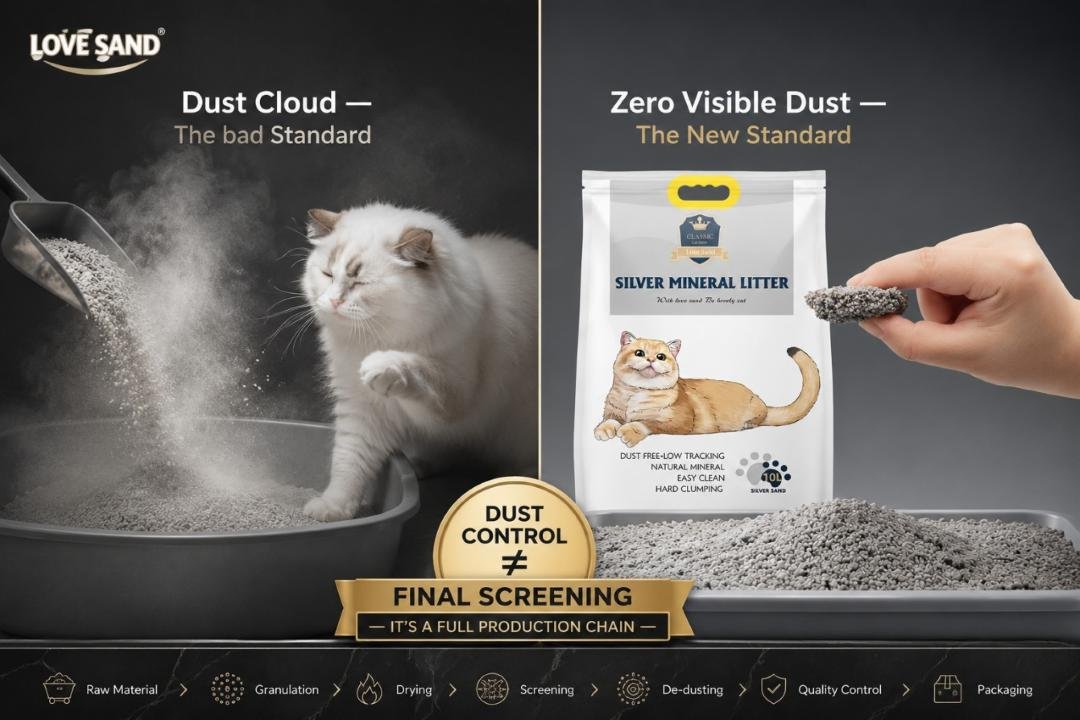
Dust control is not a single filter at the end of the production line. It is a series of interventions: pre-processing material washing and grading, controlled drying that preserves particle integrity, multi-stage mechanical screening at graduated mesh sizes, and post-screening quality sampling. Each stage removes a fraction of the dust-generating material. Skipping stages saves production cost but guarantees that dust reaches the consumer.
How to Test Dust-Free Mineral Sand as a B2B Buyer
A visual inspection of a freshly opened sample bag is the bare minimum — and it is insufficient for an export purchasing decision. A structured evaluation protocol should include these four checks:
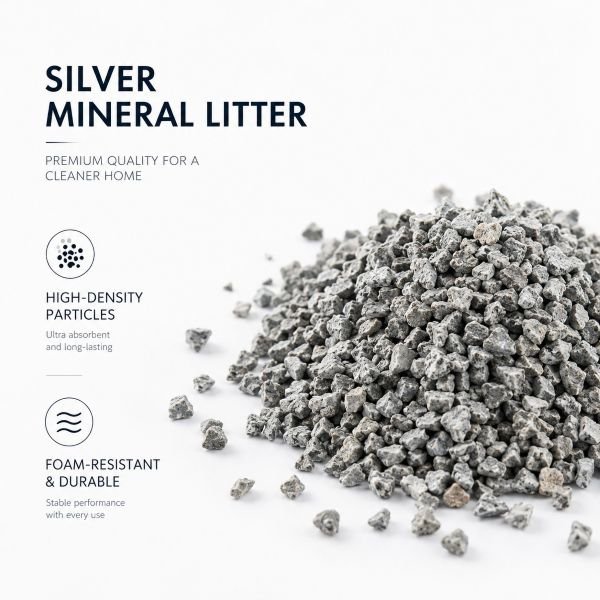
- Pour Test: Pour the litter from waist height into a litter tray in natural light. Observe the visible dust plume. A truly low-dust product should produce minimal airborne particles.
- Scoop Simulation: Repeatedly scoop and turn the litter as a cat would, then check for new fine particles generated by mechanical abrasion. This simulates daily use.
- Transit Simulation: Seal a sample in its intended export packaging, subject it to vibration (a short car ride with the package unsecured is a rough proxy), then re-open and repeat the pour test. Compare before and after.
- Multi-Batch Comparison: Request samples from two different production batches. If dust levels differ noticeably between them, batch consistency is a red flag — regardless of how good the better batch looks.
The Cornell Feline Health Center notes that long-term exposure to airborne particulate irritants can contribute to feline respiratory issues, which makes dust control not just a consumer preference issue but a genuine animal welfare consideration — and a defensible premium positioning angle for brands.
Building a Premium Product Line with Dust-Free Mineral Sand
For Established Brands: Elevate Without Disrupting
Brands with existing volume products can use dust free clumping cat litter in mineral sand format to create a two-tier structure: a value SKU that competes on accessibility and a premium dust-free SKU that competes on experience. This structure protects volume while capturing the margin opportunity in the growing premium segment — without cannibalizing the base business.
For New Brands: Enter with a Defensible Position
A new entrant selling standard bentonite enters a market where established competitors already own price-driven shelf space. A new entrant launching with a genuinely low dust clumping cat litter enters with a story — and a product attribute that cannot be matched by economy-tier competitors without fundamentally changing their cost structure.
Packaging: The Silent Performance Variable
Dust-free performance does not end at the factory door. Packaging choices — bag material gauge, seal integrity, inner liner presence, and pallet stacking configuration — directly affect how much dust is generated between production and consumer. For mineral sand products, which are heavier per unit than plant-based alternatives, packaging that works for tofu litter may fail for mineral sand. A supplier with export experience will recommend packaging specifications based on destination, transport mode, and channel type — not offer a one-size-fits-all solution.
Five Questions to Ask a Dust-Free Mineral Sand Supplier
Before committing to a production run, B2B buyers should press suppliers on these points:
| Question | What to Listen For |
| How do you ensure raw material consistency? | Single-source deposits, incoming material testing protocols, batch traceability |
| What screening process do you use? | Multi-stage mechanical screening with specified mesh sizes, not a single pass |
| How do you validate post-transport performance? | Simulated transit testing, historical export data, customer feedback from your target region |
| Can you provide samples from different production batches? | Willingness to share without hesitation — reluctance is a signal |
| How does your packaging protect against transit dust generation? | Material specifications, seal testing, packaging designed for the product weight and transport duration |
Perguntas frequentes
Q1. What is the difference between dust-free mineral sand and regular bentonite cat litter?
Q2. Does dust-free mineral sand cost significantly more than standard bentonite?
Q3. Can dust-free mineral sand be OEM-manufactured with custom packaging?
Q4. How does long-distance shipping affect dust-free performance?
Q5. What markets have the strongest demand for dust-free mineral sand?
Q6. Is dust-free mineral sand suitable for all retail channels?
Q7. How do I verify a manufacturer's dust-free claims before placing a large order?
Reviewed by: love sand pet-litter product team (Puyuan Dalian Pet Products Co., Ltd.). Last updated: 2026-08-21.More about the manufacturer: About love sand