You have the brand, the channel, and the customers. What you do not have is a production line — and you should not need one. That is why global pet brands work with a cat litter manufacturer instead of building their own factory. This guide walks through how to find, evaluate, and partner with the right factory so your first production run goes smoothly.
Who This Guide Is For
For you if: you are a distributor, wholesaler, or pet brand evaluating OEM or private label cat litter manufacturing — whether this is your first product or your fifth SKU. Not for you if: you are an individual cat owner comparing retail brands for home use — this is a B2B sourcing conversation.
The global cat litter market is projected to grow steadily through 2030, driven by rising pet ownership and demand for plant-based alternatives. For brands, the opportunity is clear: own the product, not just the distribution.
Key Takeaways
- A cat litter manufacturer partner is a product development collaborator — not just a production line — and the right one saves months of trial and error.
- OEM manufacturing covers product type, formulation, packaging, and market positioning — it goes far beyond printing a logo on a bag.
- Factory evaluation should weigh production stability, export experience, and R&D capability more heavily than the lowest unit price.
- The five cat litter types that dominate B2B demand are bentonite, tofu, cassava, dust-free mineral sand, and mixed formula — each serves a different market segment.
- Sample testing is not a formality: real-use clumping tests, dust checks after transport simulation, and scent evaluation across target markets all matter.
- Packaging decisions — bag type, capacity, language, and retail vs. e-commerce readiness — directly affect sell-through in your channel.
- A factory that can support multi-SKU growth keeps your supply chain simple as your brand scales.
Why More Brands Choose OEM Cat Litter Manufacturing
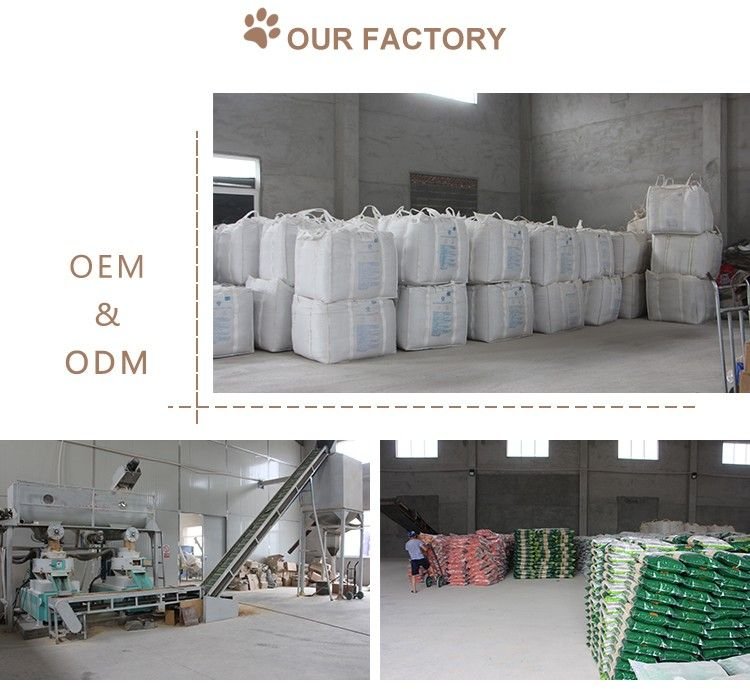
Building a cat litter production line from scratch demands raw-material sourcing networks, specialized mixing and granulation equipment, quality-control labs, packaging supply chains, and export documentation experience. For a brand entering the market, that is capital-intensive and slow.
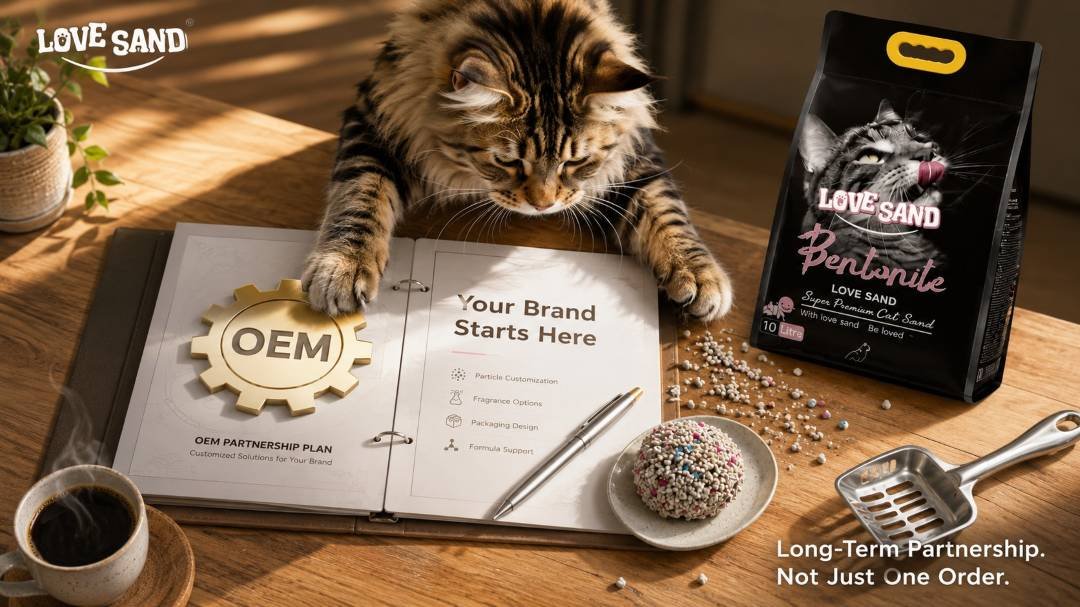
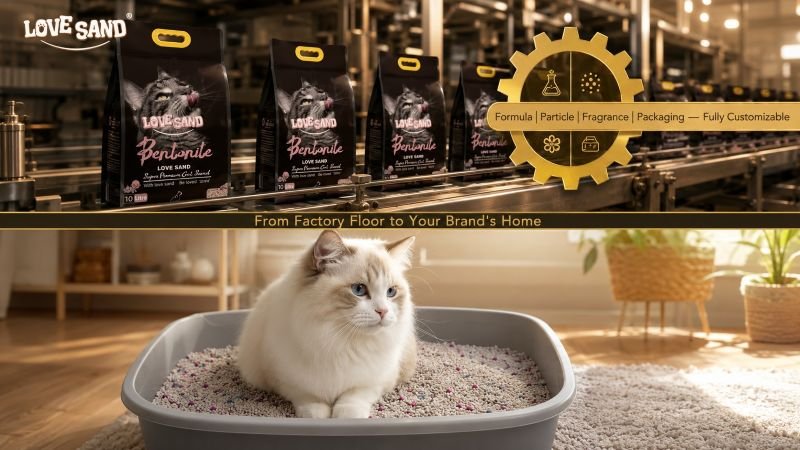
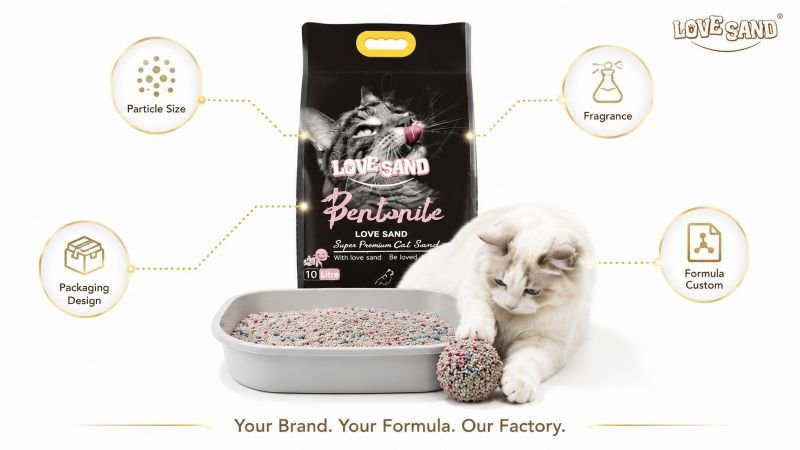
OEM cat litter manufacturing flips the model: the brand focuses on marketing, channel development, and consumer relationships, while the factory handles production, R&D support, formulation, and logistics. This is why mid-size distributors and expanding pet brands consistently choose to partner with established manufacturers rather than build in-house capacity.
Beyond cost avoidance, OEM gives brands real product ownership. A standard off-the-shelf product leaves you competing on price alone — the same bag, different label. Custom formulation, tailored packaging, and market-specific positioning create defensible differentiation that a generic supplier relationship cannot deliver.
The Five Cat Litter Types That Drive B2B Demand
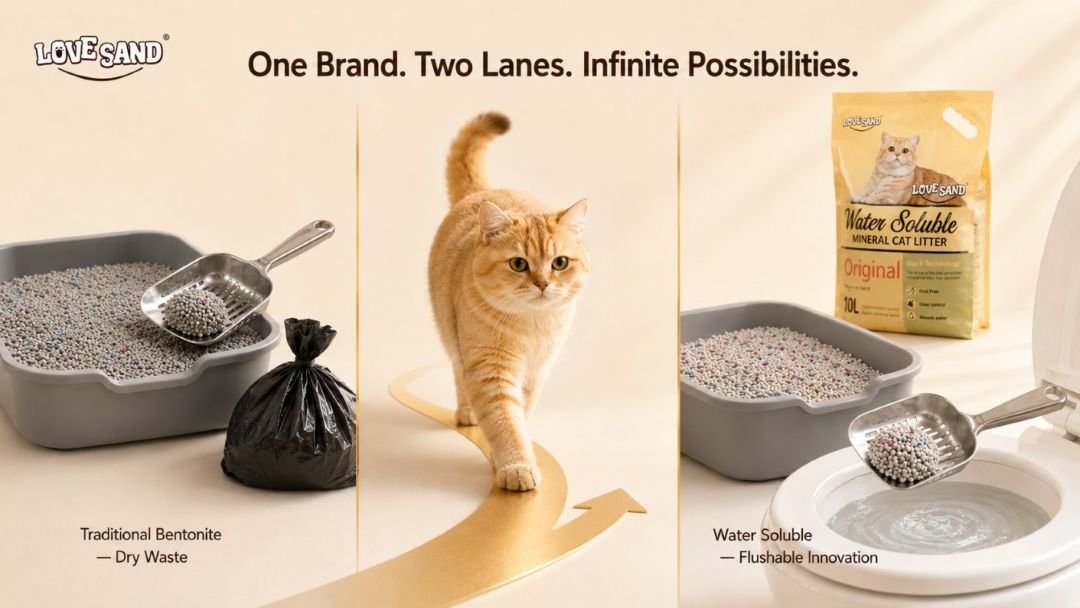
Areia de bentonita para gatos
The global volume leader. High consumer recognition, fast clumping, and strong acceptance among cats make areia de bentonita para gatos the default choice for brands entering price-sensitive or high-volume markets. For distributors, the key specification variables are clumping speed, dust level, and granule size — all adjustable in an OEM partnership.
Areia de gato de tofu
Plant-based, flushable, and near dust-free, lixo de tofu is the fastest-growing segment in eco-conscious markets — particularly Europe and parts of Asia. Brands targeting premium retail or sustainability-positioned channels should evaluate tofu as a flagship product. The B2B considerations include raw material sourcing consistency, moisture resistance in transit, and shelf-life management.
Cassava Cat Litter
A newer plant-based entrant with excellent clumping and fast water solubility. Cassava appeals to brands seeking a point of difference from the increasingly crowded tofu segment. It performs well in humid climates where traditional tofu products may struggle.
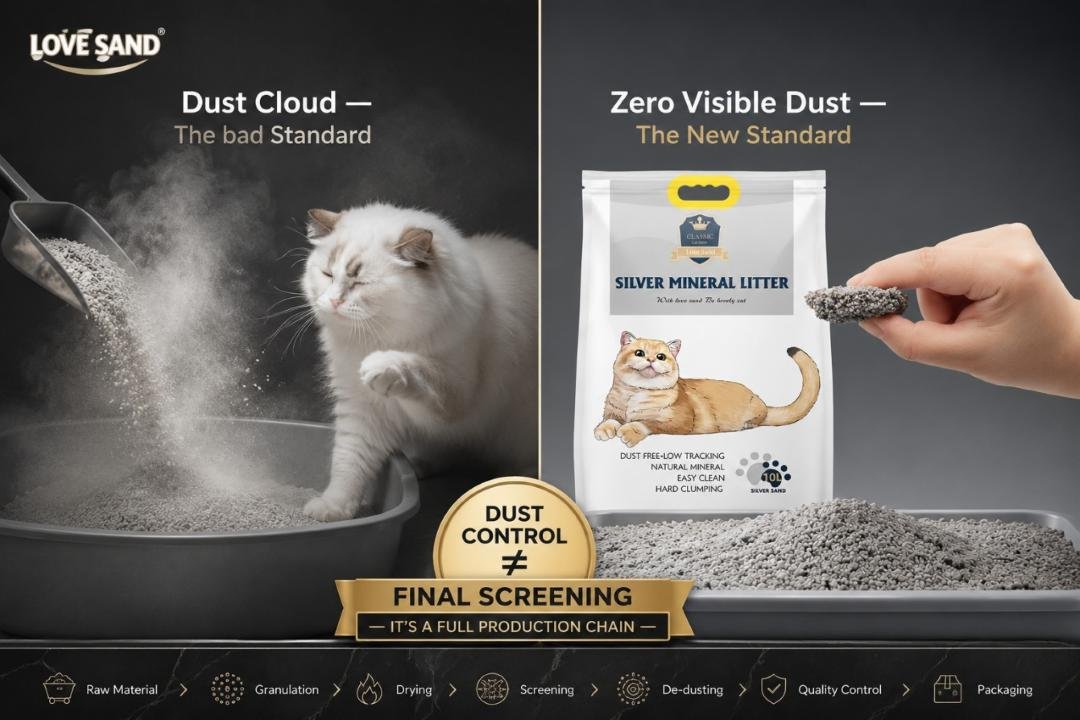
Dust-Free Mineral Sand
For brands positioning at the premium tier, low-dust mineral sand addresses the number-one consumer complaint in developed markets: airborne dust. This category is growing fastest in North America and Northern Europe, where indoor air quality is a purchase driver.
Mixed Formula Cat Litter
Blending bentonite with tofu, or cassava with tofu, creates products that capture the best of both materials — hard clumps with low dust, partial flushability with strong odor control. Mixed formulas are the safest entry point for first-time private label brands because they minimize the trade-offs consumers dislike.
How a Professional OEM Cat Litter Project Works
Most first-time buyers ask about price first. Experienced brands ask about the process. Here is the four-stage framework a reliable cat litter factory should follow.
Stage 1: Market Alignment — Start with the Consumer, Not the Product
Before discussing formulations, a competent bulk cat litter supplier will ask: Which country are you selling in? Retail, e-commerce, or wholesale? Economy, mid-tier, or premium positioning? These answers determine product type, packaging format, and even granule size. A bentonite product for a Latin American wholesale channel looks different from one targeting a European premium pet store — even if the base material is the same.
Stage 2: Product and Packaging Confirmation
With market context established, the manufacturer recommends product types and formulations. This is where multi-category production capability matters: a factory that only runs bentonite cannot help you expand into tofu when your market shifts. Packaging is decided here too — bag type (pillow, quad-seal, stand-up pouch), capacity per unit, language requirements, and whether the design suits retail shelf display or e-commerce unboxing.
Stage 3: Sample Development — Test Beyond the Lab Report
Lab specifications are a starting point, not the finish line. Real-world testing should cover: clumping integrity after simulated transit vibration, dust generation when pouring (not just at rest), odor performance under humidity, and packaging durability during handling. A manufacturer that ships samples without discussing how those samples perform in your specific market conditions is not thinking like a partner.
Stage 4: Production, QC, and Export Logistics
Consistent batch-to-batch quality is where many low-cost suppliers fail. A professional cat litter manufacturer runs inline QC checks — clumping speed, dust measurement, granule uniformity — on every production run, not just the first. Export documentation, container loading optimization, and delivery scheduling are part of the service, not afterthoughts.
According to the American Pet Products Association (APPA), pet industry expenditure in the U.S. alone exceeded $147 billion in 2024, with litter and supplies representing a stable repeat-purchase category — making supply chain reliability a non-negotiable for brands planning long-term market presence.
Three Questions to Ask Before Signing with a Cat Litter Factory
Can the Supplier Support Multi-SKU Growth?
Your first order may be one product. In two years, you will likely want three — different types, different packaging, different markets. A manufacturer with multi-category production lines keeps your supply chain consolidated and your learning curve short.
How Is Batch Consistency Controlled?
A strong sample run followed by variable production is the most common failure pattern in OEM partnerships. Ask for batch-control documentation, request to see records from previous production runs, and if possible, order a small trial run before committing to a full container.
Does the Manufacturer Understand Your Target Market?
Export experience is not just about shipping documents. It is about knowing that European buyers scrutinize eco-certifications, Middle Eastern distributors prioritize transport packaging integrity, and Southeast Asian retailers value compact bag sizes for shelf efficiency. A manufacturer that has shipped to your target region before brings that knowledge into your product development.
Buyer’s Checklist: What to Lock Down Before Production
- Product type and formulation confirmed against target market consumer profile
- Granule size, scent level, and clumping characteristics specified
- Packaging format, capacity, language version, and box quantity per master carton
- MOQ clearly stated — with flexibility for first-order trial runs
- Sample approval criteria defined and documented
- QC checkpoints and batch consistency standards agreed in writing
- Export documentation responsibilities divided clearly
- Lead time and shipping schedule confirmed
Why Unit Price Alone Is a Misleading Metric
A low quote that delivers inconsistent batches creates hidden costs: customer returns, brand reputation damage, emergency reorders, and the time cost of finding a replacement supplier. For cat litter — a product consumers buy every month — quality consistency directly impacts retention and lifetime value. The cheapest quote rarely produces the lowest total cost of ownership when measured over a 12-month relationship.
Perguntas frequentes
Q1. What is the difference between OEM and private label cat litter?
Q2. What is the typical MOQ for OEM cat litter?
Q3. How long does OEM cat litter development take?
Q4. Can one factory produce multiple cat litter types?
Q5. What packaging formats are available for OEM cat litter?
Q6. How do I verify a cat litter manufacturer's export capability?
Q7. What certifications should I look for in a cat litter manufacturer?
Reviewed by: love sand pet-litter product team (Puyuan Dalian Pet Products Co., Ltd.). Last updated: 2026-08-19. More about the manufacturer: About love sand