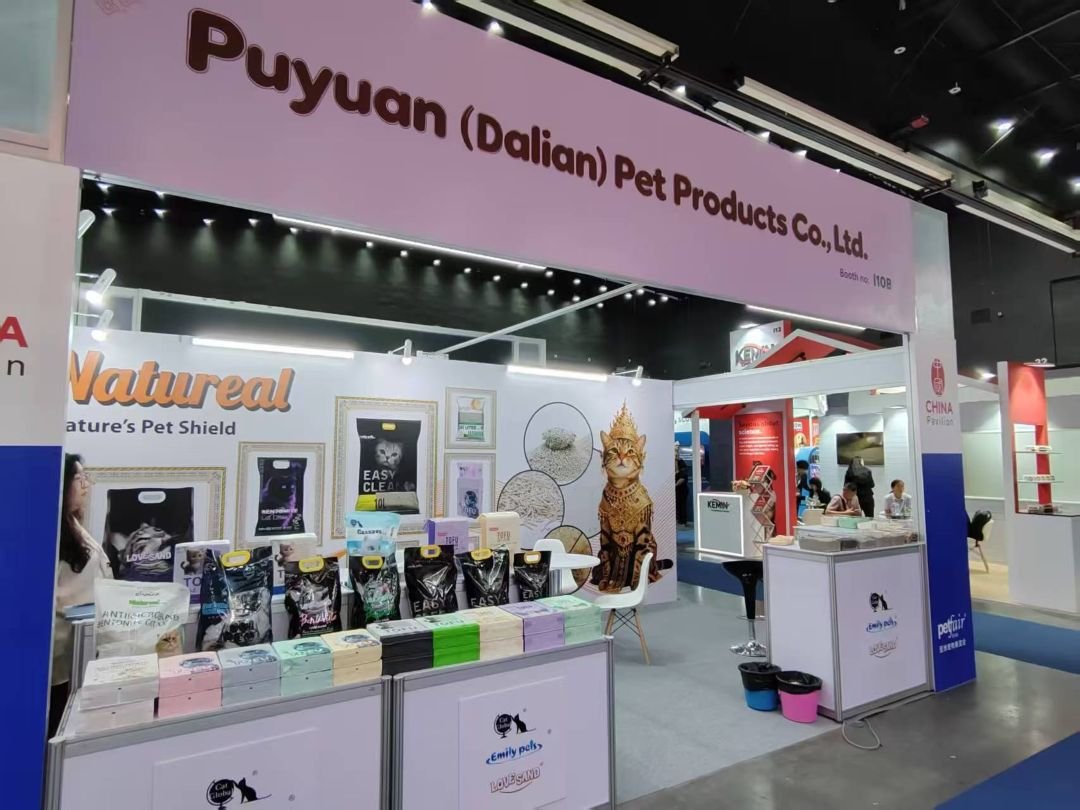
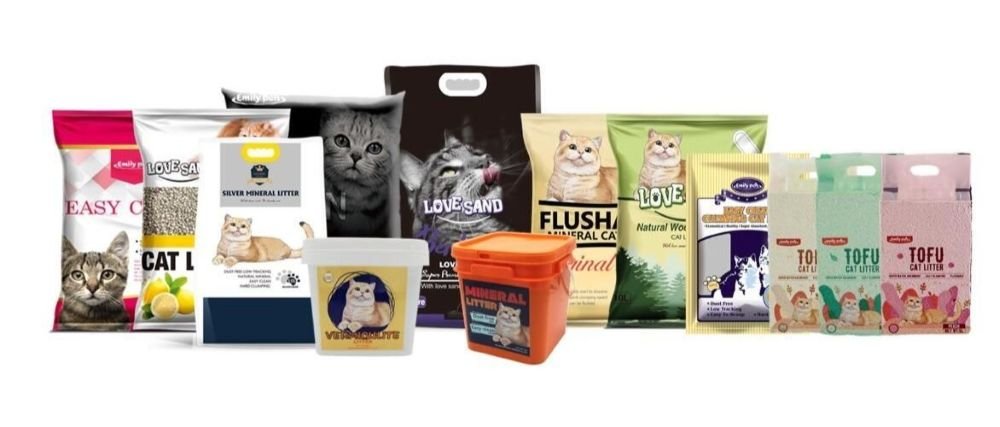
Cat litter packaging is often treated as a design decision. For an international buyer, it is closer to a product decision. The package has to protect the litter through production, container loading, port handling, warehousing and retail. At the same time, it has to communicate enough information for a customer to understand what is inside the bag and how it should be used.
A change in capacity can alter the net weight, the shipping calculation and the number of units that fit in a carton. A vacuum-packed bag can change the product’s volume and shelf appearance. A new carton size can affect pallet stacking and container loading. The artwork may look finished, but the packaging program is not finished until these practical details have been confirmed.
Start With the Market, Not the Artwork
Before asking a supplier to quote packaging, define where the product will be sold and who will handle it. A small bag for an online retail brand has a different job from a 20 kg format sold through a distributor. A premium product may benefit from vacuum presentation and a carefully finished printed film, while a bulk program may place more value on pallet efficiency and delivered cost per kilogram.
Start with five decisions:
- The cat-litter material and product formula;
- The target customer and sales channel;
- The preferred capacity and net weight;
- The storage and climate conditions in the destination market;
- The required artwork, language, labeling and shipping documents.
These decisions should be made together. Changing the bag size after artwork approval can affect the front-panel layout, carton quantity, pallet plan and container loading calculation.
Common Cat Litter Packaging Formats
There is no universal best package. Each format serves a different balance of protection, presentation, handling and cost.
Retail Bags
Retail bags are the most common format for supermarkets, pet shops, e-commerce sellers and specialty pet brands. They are usually printed with the product name, material, key benefits, directions, net weight and brand information.
For retail bags, the buyer should confirm the finished dimensions, filling tolerance, sealing method, film structure, handle design and whether the bag can stand upright on a shelf. Lightweight litter formats may also require a stronger base or more stable bag shape because the volume can be large relative to the net weight.
Vacuum-Packed Bags
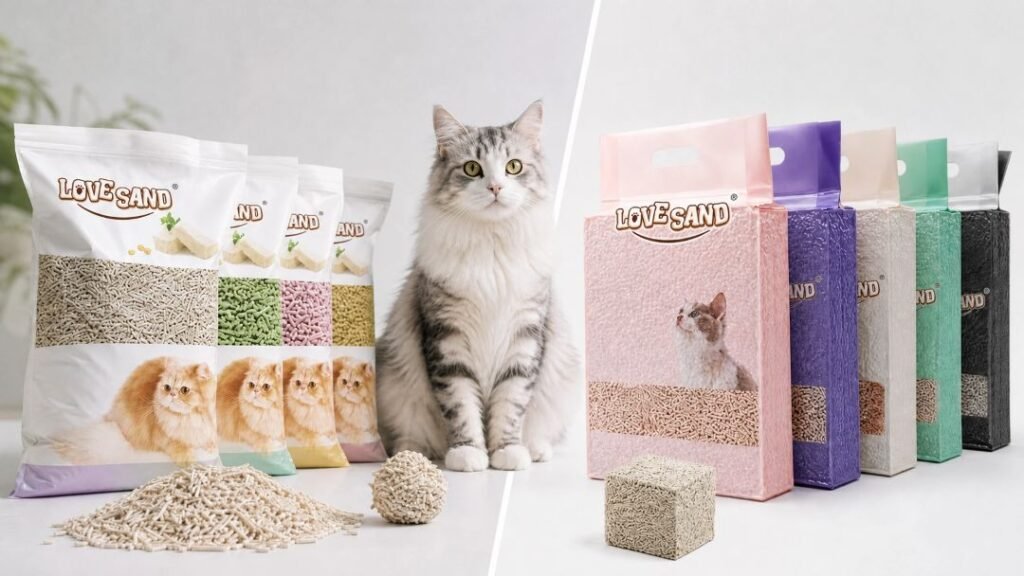
Vacuum packaging removes much of the air from the package before sealing. It can reduce the packed volume and limit exposure to external air and moisture before opening. It also creates a compact appearance that may suit premium retail and e-commerce programs.
Vacuum packaging is not a substitute for dry warehousing. Buyers should still confirm the barrier structure, seal quality, storage conditions, shelf-life statement and how the bag behaves after opening.
Love Sand tofu cat litter is available in vacuum-packed and non-vacuum formats. The current product page lists an 8L standard package and supports customized capacity for suitable programs. [View the Love Sand tofu cat litter specifications]
Non-Vacuum Bags
Non-vacuum packaging can provide a flexible and familiar retail format. It may be suitable when the product’s particle structure, package volume and shipping plan do not require compression.
The buyer should not assume that non-vacuum means lower quality. The relevant questions are whether the packaging protects the product, whether the bag remains stable during handling and whether the final packaging configuration matches the target market’s storage and shelf requirements.
Cartons and Outer Cases
Some cat litter programs place individual bags inside cardboard cartons or use an outer case to protect the retail packs during export. Cartons help with stacking, warehouse handling and retail presentation, but they also add volume and weight to the shipment.
Confirm the number of bags per carton, carton dimensions, gross and net weight, carton strength, pallet pattern and whether the outer case is suitable for the expected humidity and handling conditions.
Buckets, Bulk Bags and Industrial Formats
Plastic buckets can suit premium programs or products positioned around resealability and repeated household use. Bulk bags and ton bags are more relevant to manufacturers, repackers and buyers that plan to fill or process the material locally.
These formats require a different conversation about filling equipment, unloading, moisture protection, warehouse space, safety handling and local packaging operations. They should not be treated as a simple alternative to a retail bag.
How to Choose the Right Package Size
Package size should be selected from the consumer’s handling needs and the distributor’s economics, not from volume alone. Cat litter density varies by material and formula, so two bags with the same litre capacity may have different net weights.
| Packaging question | Why it matters |
| Litres or kilograms? | Litres describe volume; kilograms affect handling, shipping and price comparison. |
| Who carries the product? | Smaller packs may suit consumers and e-commerce; larger packs may suit multi-cat homes and wholesale channels. |
| What is the shelf position? | Package width, height and stability affect retail display and warehouse stacking. |
| What is the delivery model? | E-commerce packages may need stronger outer protection than palletized distributor shipments. |
| What is the local price point? | A pack size should support the intended retail price and repeat-purchase cycle. |
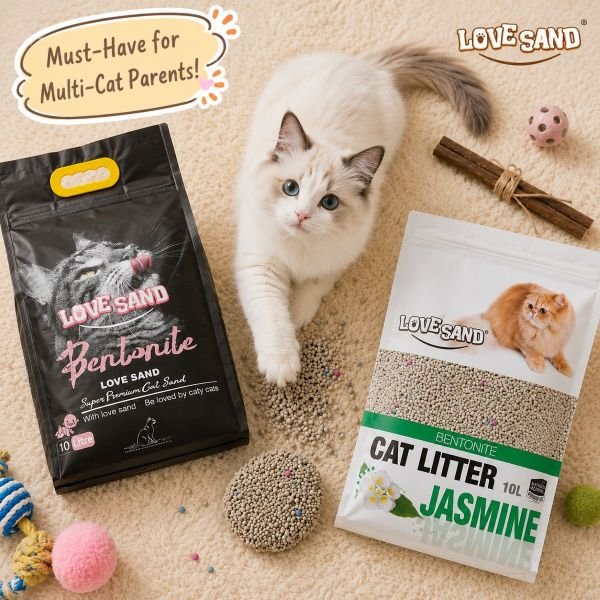
Love Sand’s bentonite category currently lists 5L / 4 kg, 10L / 8 kg, 20 kg and 25 kg formats. These are packaging choices for the same core product direction rather than automatically separate formulas. [Review the Love Sand bentonite cat litter packaging options].
Packaging Materials and Moisture Protection
Packaging performance becomes particularly important when the product will pass through a humid climate. Tofu and bentonite respond differently to moisture, but neither product can be protected by packaging alone if it is stored in a wet warehouse or left in an open container during transport.
Ask the supplier to describe the primary film or container material, the barrier properties, the sealing method and the recommended storage conditions. Confirm how the product should be handled after opening and what shelf-life statement applies under normal storage. If the destination includes a rainy season, also discuss port storage, inland transport and warehouse ventilation rather than looking only at the bag itself.
For a private-label program, the storage wording on the package should match the product specification. A claim that implies long-term moisture resistance should not be added simply because the bag is vacuum-packed.
What the Label Needs to Tell the Buyer
Label requirements vary by country, product category and the claims printed on the package. The importer of record or a local compliance adviser should confirm the final requirements. In practical terms, the label normally needs to identify the product and explain how it should be stored and used.
The final artwork may need the product name and material type, net weight or volume, directions for use, storage instructions, disposal guidance, fragrance or additive information, responsible company details and a batch or lot reference. Some markets also require a production date, best-before date, barcode, recycling marks or specific language versions.
Claims deserve particular care. “Flushable,” “biodegradable,” “low dust,” “natural,” “odor control” and “antibacterial” should all be supported by the specification and by whatever evidence the destination market accepts. A claim from a tofu product should not be copied onto a bentonite bag, and a standalone product specification should not be reused for a mixed formula without confirmation.
Private-Label Packaging Is a Product Decision
Private-label packaging works best when the product and the brand position are developed together. The buyer first defines the target country, customer profile and retail position. The supplier then matches the product format, particle structure, fragrance and capacity to that brief. Samples and the current technical specification should be reviewed before the artwork is finalized.
The artwork review should cover more than the logo. Check every translation, unit, instruction, product claim, disposal statement and required symbol. Confirm the final bag or carton template, then request a packaging proof before printing. The approved sample, technical data sheet and artwork should be kept together as the reference for bulk production.
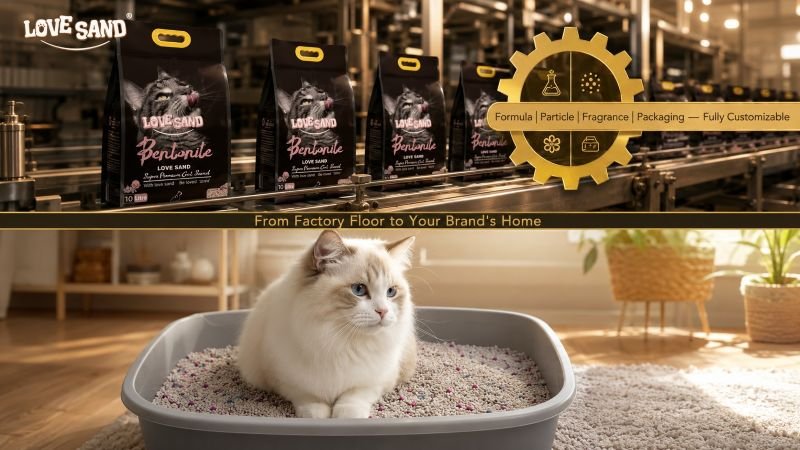
Love Sand supports selected OEM and private-label programs, including printed packaging, vacuum and non-vacuum formats, customized capacities and product selection. The available options depend on the product configuration, order volume and destination market. [Explore Love Sand OEM and private-label cat litter services].
Packaging and Container Loading
A package can be attractive and still be expensive to ship. Excess space increases the delivered cost, while over-compression can damage the bags or make pallets difficult to stack. This is why the package should be reviewed with the loading plan, not after it.
Before approval, request the finished unit dimensions, net and gross weight, units per carton, carton dimensions and pallet arrangement. Ask how many units fit in the intended container and whether different fragrances, products or package sizes can share a load. A loading photograph or simple loading diagram is often useful, especially when the order combines retail packs with bulk formats.
The final loading quantity should be calculated from the approved product and packaging configuration. A general catalogue estimate is not enough because the bag, carton, pallet and product density can all change the result.
A Sensible Pre-Order Check
Before placing the order, make sure the approved documents tell the same story.
- Confirm the exact product formula and main material.
- Confirm whether the specification is stated by litre, kilogram or both.
- Approve the primary packaging format and barrier requirements.
- Confirm vacuum or non-vacuum packaging where relevant.
- Check the net weight, fill tolerance and package dimensions.
- Approve the carton specification and units per carton.
- Confirm the label language, claims, symbols and importer information.
- Review storage, shelf-life and disposal instructions.
- Request and test a physical sample in realistic transport and storage conditions.
- Confirm MOQ, printing lead time, production lead time and container loading.
- Keep the approved artwork, sample and technical data sheet together.
- Confirm the export documents required by the destination market.
This small amount of document control prevents many avoidable problems: a bag printed with the wrong unit, a carton that cannot hold the packed weight, a claim that belongs to another formula, or a loading plan based on an old package size.
What to Include in a Packaging Inquiry
A supplier can give a more useful answer when the first inquiry includes the destination country, preferred material, package capacity, target net weight and sales channel. It also helps to mention whether you want vacuum or non-vacuum packaging, the estimated order volume, the desired fragrance or additive, the required label language and whether the artwork already exists.
If you are not sure which format suits the market, say so. A product recommendation is more useful when the supplier knows the climate, retail channel, target price range and expected launch timing. For a sample, specification sheet or private-label discussion, [contact Love Sand with your market and packaging requirements].
Final Takeaway
Good cat-litter packaging protects the product, communicates the right information and fits the economics of the market. It should be evaluated as part of the full supply system, from the material inside the bag to the carton, pallet, container and warehouse where the product will be stored.
The most reliable process is sample-led and specification-led. Decide the product and package together, test the physical sample, review the label, approve the loading plan and keep the final documents aligned with the bulk order. That approach gives global buyers a better chance of receiving a product that is not only attractive on the shelf, but also stable and practical when it arrives.