
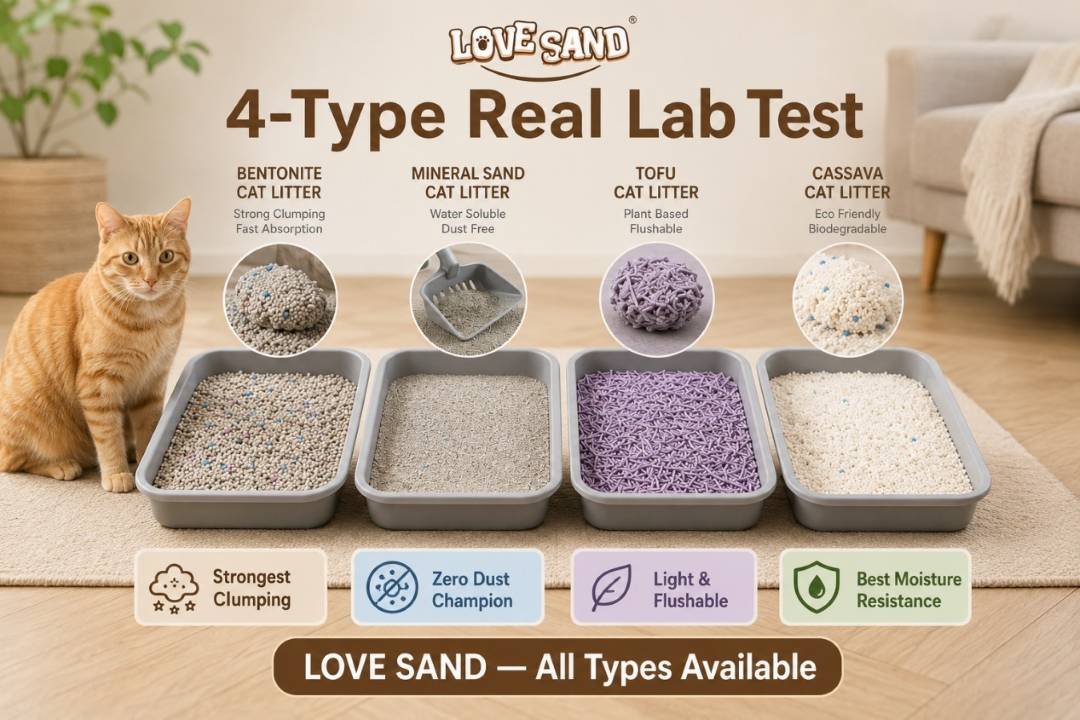
The best type of cat litter depends on more than personal preference. The number of cats, litter-box setup, local humidity, cleaning routine, dust sensitivity and disposal expectations can all affect how a product performs at home.
Bentonite, tofu, cassava and mineral cat litter each have a different material structure and use profile. A product that works well for a single-cat household may not be the best choice for a multi-cat home, a humid climate or a buyer looking for biodegradable materials.
This guide compares the main formats by clumping, dust, odor control, moisture response, daily maintenance and disposal. The goal is not to name one universal winner, but to help you identify the product format that fits your actual needs.
1. Unified test standard for this actual measurement.
In order to ensure the fairness of comparison, all the tests are unified with fixed parameters to eliminate human errors.
Fixed sand laying thickness: 6cm (general standard thickness for families)
Single simulated urine output: 25ml (normal urine output of adult cats)
Test environment: normal temperature of 25℃, conventional indoor humidity and high wet plum rainy season.
Evaluation dimensions: agglomeration speed, agglomeration compactness, slag falling and disintegration, dust raising degree, long-term loss, moisture absorption and acidity.
Detailed measured data and experience of two or four cat litter items.
2.1 Measurement of agglomeration performance: decide whether to stick to the bottom or not to agglomerate.
Agglomeration is the core ability of cat litter, and poor agglomeration will directly lead to the fragmentation of urine, the residue of pelvic floor and the breeding of odor.
Areia bentonítica comum para gatos: It has the fastest agglomeration speed and tightens instantly when it meets water. The lumps are thick and hard, and hardly disperse. The disadvantage is that the surface layer clumps quickly, and the bottom layer occasionally appears slightly sticky, so it is necessary to scrape the basin bottom lightly. The overall clustering score is extremely high, which is suitable for heavy urine and high-frequency toilet use scenes.
Dust-free mineral sand: It belongs to purified and upgraded mineral sand, and the purity of montmorillonite is higher. The agglomeration is more uniform and thinner than ordinary bentonite, and there is no local looseness. The whole piece is unbreakable and almost zero-sticky, which is the most stable category among the four types.
Areia de tofu para gatos: Tofu cat litter forms clumps through liquid absorption by its plant-fiber-based granules. The current Love Sand specification lists a clumping time of approximately 3–5 seconds, with no significant breakage after a 1.5 m free drop.
Its performance can vary with urine volume, litter depth, humidity and repeated liquid penetration. It is generally more suitable for users who remove clumps regularly rather than leaving heavily saturated litter in the box for extended periods.
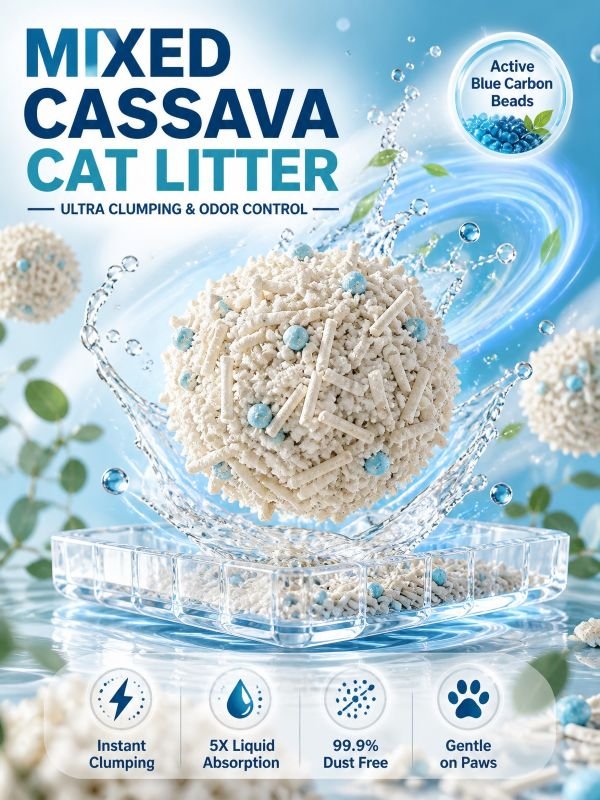
Cassava cat litter: The dough has the best toughness and is not easy to disintegrate. Compared with tofu sand, it has stronger resistance to repeated infiltration. However, in low temperature and dry environment, the agglomeration speed will be slightly slower than that of mineral sand.
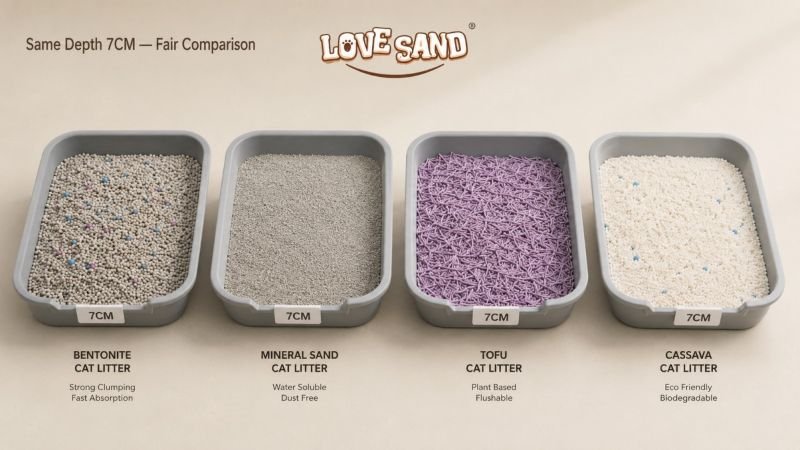
2.2 Dust measurement: It directly affects the respiratory health of people and animals.
Dust is an invisible pain point for many families to raise cats. Long-term dust will lead to sneezing of cats, itchy rhinitis and dust accumulation in furniture.
Dust-free ore: Zero floating dust and zero fine powder. After multiple dusting, washing and curing processes, the whole process of unpacking, sand pouring and cat scraping is clean, and the dust control is optimal.
Cassava cat litter: Low dust. The particle structure is compact and high in toughness, and it is not easy to be crushed. Only when it is turned violently, it will produce ultra-fine powder, and the overall experience is clean.
Areia de tofu para gatos: Tofu cat litter can offer low-dust handling when the granules are well formed and properly packaged. The current Love Sand specification lists dust content below 0.2%.
Actual dust during pouring and scooping can still be affected by granule structure, packaging, transport and storage. For this reason, buyers should compare the published dust specification and evaluate a sample before making a larger purchase.
Ordinary bentonite: The dust is the largest. Natural mineral soil comes with fine powder, which will raise dust when pouring sand, scraping sand and shoveling excrement. It is the most obvious category of dust short board among the four types.
2.3 Measurement of loss rate: Determine the cost performance of long-term cat keeping.
The higher the loss rate, the more frequent sand replenishment and the higher the cost of keeping cats for a long time. Theloss mainly comes from powder crushing, disintegration, moisture softening and frequent sand changing.
Dust-free ore: The lowest loss. The particles are hard and stable, and do not powder, rot or disintegrate. The duration of single sanding is the longest, and the frequency of sand replenishment is extremely low.
Ordinary bentonite: Low loss. The texture is thick and stable, and it is not fragile, but there are many fine powders, which will be slightly consumed after long-term accumulation.
Cassava cat litter: Medium loss. Strong toughness, not fragile, but long-term high-frequency use will slightly wear the surface.
Areia de tofu para gatos: Loss rate is affected by powdering, clump breakage, moisture exposure, tracking and the frequency of litter replacement. Plant-fiber and mineral products may show different loss patterns depending on formulation, particle structure, humidity and cleaning habits.
For tofu cat litter, storage and moisture control are particularly important. The current Love Sand product specification lists a powdering rate of no more than 1%, but actual household consumption can also depend on litter-box depth, scooping frequency and local humidity.
2.4 Moisture-proof and moisture-proof measurement:
Moisture resistance is an important consideration for plant-based cat litter, especially in humid climates.
Tofu cat litter should be stored in a cool, dry place and kept sealed after opening. Humidity can affect granule hardness, clumping behavior and product freshness. The current Love Sand specification lists a moisture content of 5–8% and a shelf life of 24 months under proper storage conditions.
Bentonite and mineral products also require dry storage, although their response to ambient humidity may differ because of their mineral structure. The actual result depends on the raw material, packaging and storage environment.
How to Read These Performance Differences
No single cat litter performs best in every category. The right choice depends on which performance factors matter most in your home or market.
– If firm clumping and resistance to repeated moisture are the priority, bentonite or mineral cat litter may be more suitable.
– If plant-fiber material, low dust and biodegradable positioning are more important, tofu cat litter may be a better fit.
– If you are looking for a plant-based format with a different balance of toughness and moisture resistance, cassava cat litter may be worth evaluating.
– If dust control is the main concern, compare the actual dust specification rather than relying only on the product category.
For buyers evaluating a plant-fiber option, Love Sand Tofu Cat Litter is made primarily from plant fiber. Its current specification lists dust content below 0.2%, water absorption of at least 200%, clumping within approximately 3–5 seconds and 100% biodegradability.
[Review Love Sand Tofu Cat Litter Specifications]
Overall Comparison by Performance Priority
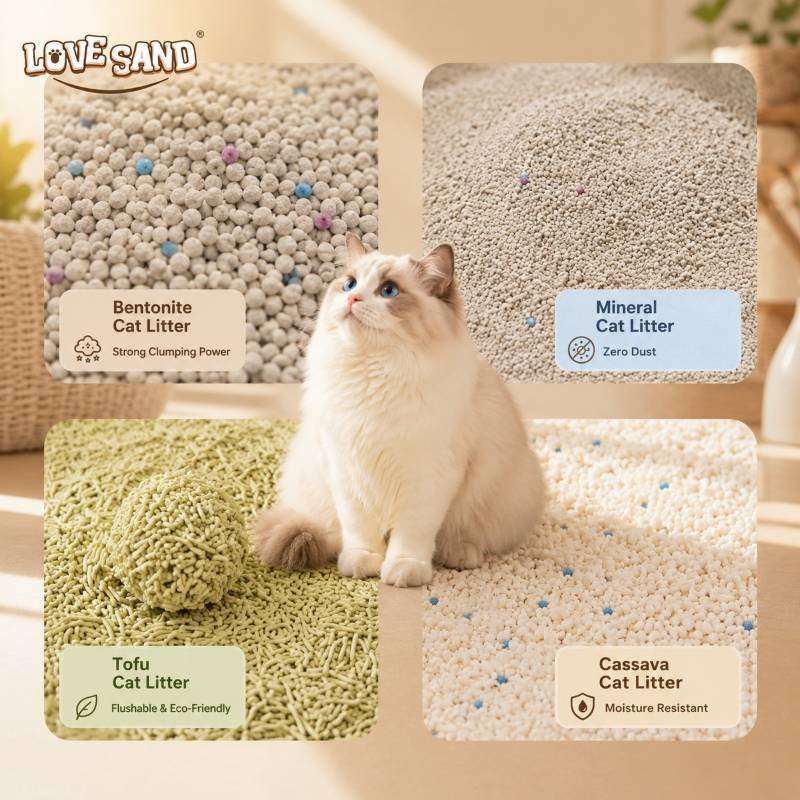
The comparison does not produce one universal winner. Each material has a different performance profile.
– For firm clumping and heavy urine volumes: bentonite and mineral cat litter are often the more practical options.
– For controlled dust and cleaner handling: compare the actual dust specification of tofu, mineral and processed bentonite products.
– For plant-fiber and biodegradable positioning: tofu cat litter is the more relevant format.
– For moisture-sensitive environments: storage conditions, packaging and replacement routines become especially important for plant-based products.
– For flexible commercial programs: buyers should evaluate samples, product specifications, packaging and market requirements together.
The best choice depends on the performance factor that matters most to the household or target market.
Need to Compare Products for Your Market?
If you are selecting cat litter for retail, distribution or private-label development, performance should be evaluated together with packaging, fragrance, particle format, storage conditions and target-market preferences.
Love Sand provides current product information and samples for selected tofu, bentonite and mineral cat litter programs. Buyers can use samples to evaluate clumping, dust, odor control, tracking and storage performance before confirming a larger order.
[Request Love Sand Product Information or Samples]

Uma resposta