Anyone doing foreign trade in pet products has felt the shift: tofu cat litter inquiries keep multiplying. European buyers ask if it can be flushed. Japanese and Korean buyers ask whether the raw materials are truly plant-based. Southeast Asian buyers ask about fruit-scented variants. Middle Eastern buyers ask whether vacuum packaging survives high-temperature ocean transit. What started as a niche category has been pulled into the mainstream by cat owners worldwide. This guide — written from a factory that runs dedicated tofu production lines — lays out what export buyers actually need to know.
Para quem é este guia?
Para você, se: you are an importer, distributor, or wholesale buyer adding lixo de tofu to your portfolio, or a pet brand planning a plant-based private label launch — and you want to evaluate formulas, quality reports, packaging, and logistics like a professional.
Não é indicado para você se: you are a retail consumer comparing brands at the pet store — this is a B2B sourcing guide.
Tofu litter’s growth is anchored in three attributes — biodegradable, flushable, and low-dust — which map precisely onto the environmental and convenience preferences of European, Japanese, and Korean households. According to American Pet Products Association (APPA) industry data, litter remains one of the pet sector’s highest-frequency repeat-purchase categories, and plant-based variants are the fastest-growing segment within it.
Principais conclusões
- Tofu cat litter is plant-fiber litter: pea or soybean fiber as the main material, starch as the structural skeleton, and a small amount of guar gum — typically 1–2% — to bind and strengthen clumps.
- The real quality differentiator is formula and process balance, not the “tofu” label itself — poorly formulated plant litter clumps loosely, sticks to the box, and turns sour over time.
- Raw material source stability is the first risk point: factories using food-waste or sawmill byproduct sources produce batches that vary in hand feel; stable plant-fiber suppliers with per-batch testing lock consistency.
- Moisture is the lifeline of tofu litter: dried below 8%, granules stay hard and shelf life reaches 18–24 months; above that, bags can mold inside a container after 40 days at sea.
- Seven indicators belong on every inspection report: water absorption (≥600%), clumping time (≤3s) and strength, moisture (<8%), dust rate (<3%), deodorization (~90%), granule spec, and shelf life (18–24 months).
- Fragrance is a regional game: fruit and floral light scents sell in Japan, Korea, and Southeast Asia; original and activated charcoal win in Europe; the Middle East demands strong odor coverage for hot climates.
- Vacuum and non-vacuum packaging are two different businesses — vacuum suits e-commerce and pet-store shelves, but burst rate under container heat is the number-one quality question to ask any factory.
Why Tofu Litter Carries an Entire Category
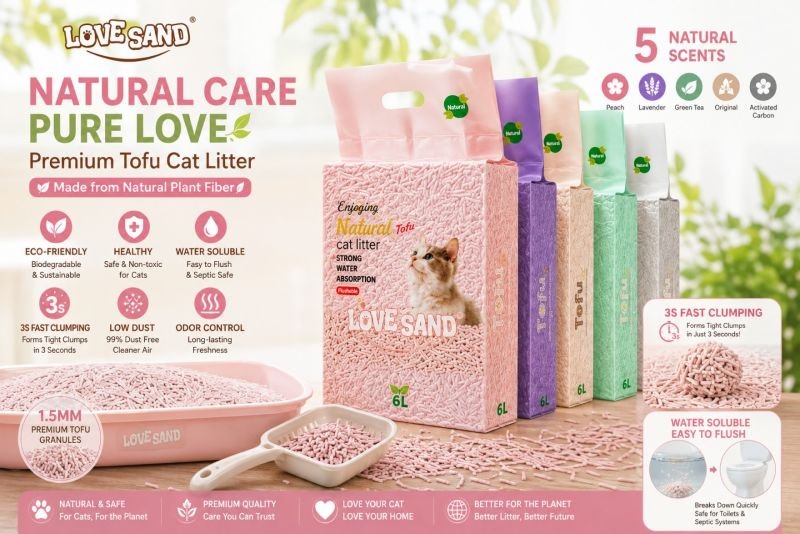
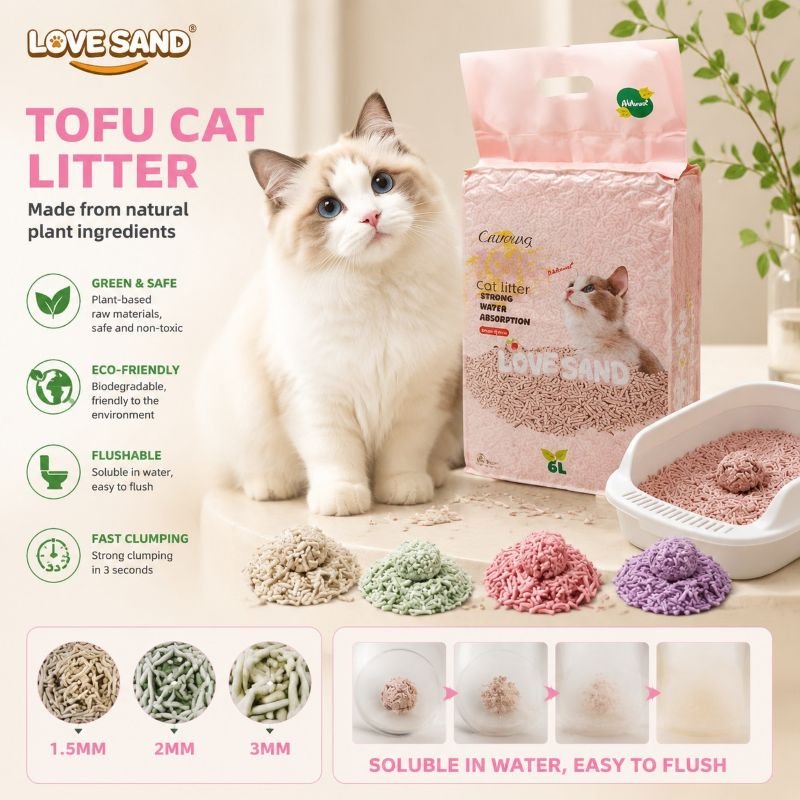
Tofu cat litter is plant-fiber litter at its core: plant materials such as bean pulp and pea fiber as the main ingredient, starch as the skeleton, and a small amount of binder. The wet mixture is extruded into strip granules and dried. Compared with mineral sand, it offers three core differences — biodegradable, flushable, and low-dust — which hit the environmental and convenience preferences of Europe, Japan, and Korea precisely. In those markets it is not a supplement product; for many households it is the primary litter.
But plant materials come with a natural weakness: if the formula and process are not right, clumps turn loose, granules stick to the box, and the product sours over time. Many tofu litters on the market sacrifice clumping performance to advertise “100% natural,” producing a poor daily experience. The real mastery in tofu litter procurement lies in formula and process balance — not in the surface question of whether it is made from tofu.
What Hides Inside the Formula
Raw Material Composition: Stability Is Everything
A typical tofu litter formula is plant fiber (pea fiber, soybean fiber, etc.) as the main material, corn or cassava starch as the forming skeleton, and a small amount of guar gum — usually kept at 1–2% — to enhance binding and clumping. Too little guar gum and clumps fall apart; too much and cost rises while granules turn sticky. Our outgoing formula — pea fiber plus starch with guar gum in that range — was fixed after repeated destructive testing.
The trap to watch in sourcing is raw material origin. Some factories use food-factory waste bean pulp or sawmill offcuts as feedstock: cheap, but waste quality fluctuates wildly — one batch high in protein, the next high in crude fiber, producing litter with unpredictable hand feel. We source from stable plant-fiber suppliers and test every incoming batch for moisture and fiber content before it goes into production, locking batch consistency at the source. When evaluating a supplier, ask: whose raw materials are they using, and is there per-batch testing? A supplier who cannot answer is gambling with your bulk quality.
Drying Process: Moisture Is the Life-and-Death Line
Tofu granules are wet-extruded and carry high moisture, so they must be dried below 8% to guarantee strength and shelf life. If moisture is not controlled, granules soften, crumble, and mold — and 40 days sealed inside a shipping container can turn an entire container into a moldy loss. Our drying line uses segmented temperature control; outgoing moisture is held under 8%, and shelf life reaches 18–24 months. When inspecting, squeeze a handful of granules hard — if they crush, moisture is likely out of spec.
Seven Indicators Every Export Buyer Must Check
Ask for the factory’s tofu litter test report and verify these seven items — each one maps to end-consumer experience:
Water absorption
The industry bar for good products is 600% or higher. Our outgoing standard is ≥600% — one kilogram of litter absorbs more than six kilograms of liquid. Absorption drives durability, directly affecting the consumer’s monthly cost and your repurchase rate.
Clumping time and strength
Require clumping within ≤3 seconds, with clumps that are hard, non-sticking, and unbreakable when scooped. Do not trust verbal claims — test the sample yourself.
Moisture
Below 8%. This is the hard indicator governing ocean-transit safety and shelf life.
Dust rate
Tofu is naturally low-dust, but poorly processed product still sheds. Our outgoing standard is under 3%.
Deodorization rate
Good products reach about 90%. Tofu litter deodorizes through plant-fiber absorption and natural-ingredient neutralization; fragrance is only an aid. Do not confuse “strong scent” with “good odor control.”
Granule specification
Standard strips are 1–3 cm long with a diameter of about 1.5 mm. Too fine and granules track out of the box; too coarse and clumping slows. Choose according to your target market’s habits.
Shelf life
18–24 months is a reasonable range; be cautious with anything below 12 months.
Fragrance and Odor-Control Formulas by Market
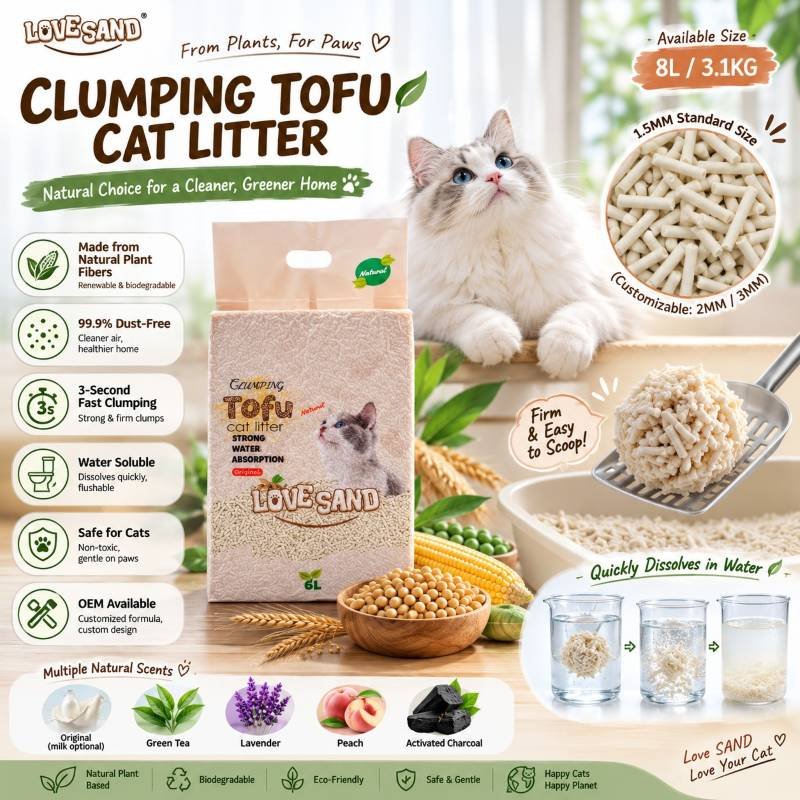
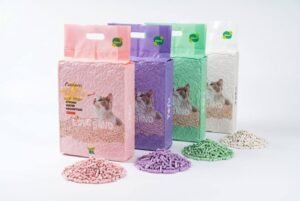
Fragrance is a strongly regional selling point for tofu litter. We run six standard variants: original, peach, green tea, lavender, activated charcoal, and corn. Experience says: Japan, Korea, and Southeast Asia prefer light fruit and floral scents; European markets trust original and activated-charcoal “no-added” profiles; Middle Eastern markets, because of hot climates, demand stronger odor coverage and masking power. Fragrance concentration must be controlled — overscenting makes cats refuse the box, and the return rate will teach you that lesson quickly. All of these are customizable — OEM clients adjust based on their own channel feedback.
Packaging and Logistics: Vacuum and Non-Vacuum Are Two Businesses
Tofu litter packaging splits into vacuum and non-vacuum categories, and buyers should decide based on what their channel actually sells.
Vacuum packaging (compressed bags) is the mainstream choice for e-commerce and pet stores: smaller volume, lower transport and warehousing cost per unit, more bags per carton, and better shelf presence. Our vacuum line runs standard 8L bags, six per carton, carton size 435×310×210 mm, with roughly 18–19 tons per 20-foot container.
Non-vacuum packaging costs a bit less and suits wholesale volume and commercial bulk formats.
Ocean transit is the special examination: vacuum bags expand slightly inside a hot container, and factories with weak packaging processes produce burst bags and lost vacuum — arriving with ruined presentation. We have years of export experience behind our vacuum sealing parameters and loading methods, with palletization and moisture-barrier film as standard practice. When sourcing, ask the factory directly: what is your vacuum bag burst rate on ocean shipments? A factory willing to answer with data is likely telling the truth.
Container Strategy: Get the Freight Math Right
Tofu litter is lighter than mineral sand — a 20-foot container carries roughly 18–19 tons versus about 20 tons for bentonite — so freight economics favor planning around volume, not just weight. Two practical points for buyers:
Mixed loading is your friend
- Different granule sizes, scents, and bag formats can share one container, and tofu can be combined with bentonite or other pet products in the same shipment. For a starting brand, one mixed container tests multiple SKUs with a single MOQ commitment.
Seasonal timing
- Overseas pet product demand concentrates between September and February. Reserve production early and fix delivery dates in the contract — capacity tightens every year in that window.
Perguntas frequentes
Q1. What exactly is tofu cat litter made of?
Q2. What are the most important quality indicators for tofu cat litter?
Q3. Can tofu cat litter really be flushed?
Q4. What is the difference between vacuum and non-vacuum tofu litter packaging?
Q5. Why does moisture matter so much in tofu cat litter?
Q6. Which fragrance profiles sell best in different markets?
Q7. What is the typical MOQ for tofu cat litter export orders?
Reviewed by: love sand pet-litter product team (Puyuan Dalian Pet Products Co., Ltd.). Last updated: 2026-08-06.More about the manufacturer: About love sand