With the continuous growth of the global pet industry, the cat litter market is also expanding rapidly. More and more importers, brands, e-commerce sellers and pet products distributors have begun to enter the field of cat litter, hoping to build their own product lines.
When purchasing, many customers will encounter two high-frequency words:
- OEM Cat Litter
- Private Label Cat Litter
Many people will think that the two are the same concept, but in fact, they are obviously different in product development, brand control, production mode and long-term business strategy.
For buyers who have just entered the cat litter industry, if the difference between OEM and Private Label cat litter is not clear, it is easy to encounter problems such as unclear product positioning, cost exceeding budget, unreasonable order quantity and even unstable supply chain in the follow-up cooperation.
So, what’s the difference between OEM and Private Label cat litter? Which model is more suitable for your market and brand?
This paper will comprehensively analyze the differences, advantages and disadvantages of the two models and the suitable people from the perspective of actual production and overseas market operation.
What is OEM Cat Litter?
The full name of OEM is: Original Equipment Manufacturer
In the cat litter industry, the core logic of OEM is:
The customer puts forward the demand, and the factory makes customized production according to the customer’s requirements.
In this mode, customers can not only print their own brands on the packaging, but also participate in the development process of the products themselves.
For example:
- Raw material ratio of cat litter
- grain size
- Flavor type
- Water absorption rate
- Agglomeration strength
- Dust control
- Packing structure
- Outer bag material
- Color design
- Function upgrade (such as activated carbon, deodorization factor, etc.)
Can be adjusted according to customer requirements.
Which customers are OEM cat litter usually suitable for?
1. Brands with mature sales channels
For example:
- Chain pet store
- Supermarket channel
- E-commerce platform brand
- Regional agent
These customers usually have a stable market and hope to build brand competitiveness through differentiated products.
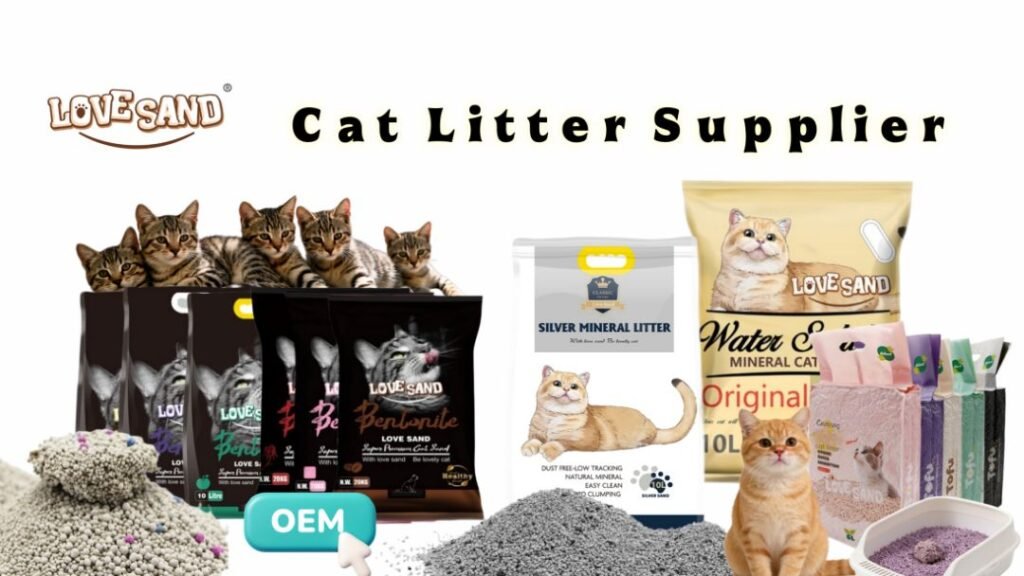
2. Importers who want to build independent brands.
Many overseas customers are not satisfied with simply selling goods, but hope:
- Establish long-term brand equity
- Control product positioning
- Improve profit margin
- Reduce homogenization competition
At this time, OEM is very suitable.
3. Customers with clear requirements on product performance
For example:
- Desiring low dust
- I hope the reunion will be faster.
- Want to add activated carbon
- I hope it is suitable for multi-cat families.
- Hope to develop environmentally friendly formula
OEM can help customers upgrade their products in a real sense.
Advantages of OEM cat litter
Stronger brand differentiation
Today’s cat litter market is very competitive.
If you only sell “ordinary bentonite cat litter”, it is easy to fall into a price war.
The biggest advantage of OEM is:
Can create unique products.
For example:
- Activated carbon deodorizer
- Low dust upgrade version
- Color particle model
- Baby powder Xiang xing
- Cassava mixed cat litter
- High-end environmental protection series
These can be differentiated.
Higher profit margin
Many mature brands will eventually find:
What really makes money is not selling “currency products”, but selling brands.
OEM can help customers:
- Increase product premium
- Increase repurchase rate
- Building consumer awareness
Long-term profit is usually higher than that of ordinary distribution products.
Higher product control rights
Customers can participate in:
- Formulation development
- Packaging design
- Product positioning
- Quality standard
This means: Customers really have their own product system.
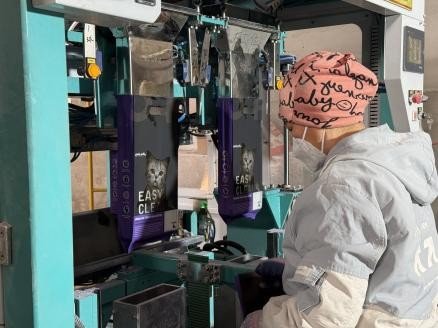
What cat litter OEM services does Love Sand provide? >>>
The challenge of OEM cat litter
MOQ is usually higher.
Because it involves:
- Custom packaging
- Independent production
- Machine debugging
- Raw material procurement
Factories usually require:
A cabinet
Or a high MOQ.
For small customers who have just entered the market, the pressure is great.
The development cycle is longer
OEM is not a spot model.
Usually need:
- Proofing
- test
- Packaging confirmation
- Formula adjustment
Therefore, the overall cycle will be longer.
Higher requirements for suppliers.
OEM cooperation is most afraid of:
- Unstable quality
- Formula fluctuation
- Packing damage
- The factory lacks R&D capability.
Because OEM is essentially a long-term cooperation.
If the supply chain is unstable, the brand will be directly affected.
What is Private Label Cat Litter?
The core logic of Private Label is:
The factory has mature products, and customers directly post their own brands for sale.
Simple understanding:
“Ready-made products+customer brands”
Customers don’t need to redevelop products, but choose the maturecat litter scheme that the factory has.
For example:
- Ordinary bentonite cat litter
- Tofu cat litter
- Activated carbon bentonite cat litter
- Scented cat litter
The factory has stable production, and customers only need to:
- Change packaging
- Printed LOGO
- Adjust brand information
You can quickly enter the market.
Which customers is Private Label more suitable for?
1. New customers who just entered the cat litter industry.
Many importers make cat litter for the first time:
- Don’t understand products
- Don’t know the formula
- I don’t know the market preference
At this time, Private Label is the lowest risk option.
2. E-commerce sellers
For example:
- Amazon
- Mercado Libre
- Shopee
- TikTok Shop
These sellers are usually more concerned about:
- New product launch speed
- Packaging design
- Profit space
Rath than complicated research and development.
3. Small and medium-sized distributors
Many customers want:
Test the market first
Then decide whether to expand investment.
Private Label is more flexible.
Advantages of Private Label
Fast listing
Because the product is mature:
- No need to re-develop
- No need for repeated testing
- No complicated debugging is needed.
Customers can start selling quickly.
The cost is lower.
Due to the use of mature production lines:
Low development cost
Low risk
MOQ is usually more friendly.
It is very suitable for testing market.
Less risk.
Mature products mean:
- stable property
- Market verified
- User acceptance is higher.
Suitable for start-up brands.
Limitations of H2: Private Label
Product homogeneity is serious.
Because many customers may use the same formula.
There will be:
Different packaging
The products are almost the same
It is easy to fall into price competition in the end.
Low brand barriers
It may be difficult for consumers to remember brands.
In the long run:
Lack of real core competitiveness.
Limited product adjustment space
Customers can usually only: adjust the packaging, fragrance and specifications.
But it can’t deeply change the product structure.
| Item | OEM | Private Label |
| Product development | Deep customization | Use ready-made products |
| Formula control | High | Low |
| MOQ | Relatively high | Relatively low |
| Development Cycle | Longer | Faster |
| Brand Differentiation | Strong | Average |
| Suitable Clients | Mature brands | New market entrants |
| Product Risk | Relatively high | Relatively low |
| Long-term profit | Higher | Moderate |
Which one is more suitable for the current market?
In fact, many successful brands will experience:
Step 1: Private Label
Test the market first.
Confirm:
The demand of users
Price acceptance
Marketing channel
Step 2: OEM upgrade
When the sales volume is stable:
- Start upgrading the formula
- Start developing differentiation
- Start building brand barriers
This is a very common development path of the pet industry at present.
Why are more and more brands choosing OEM?
In recent years, the global cat litter market has changed.
Consumers are increasingly concerned about:
- Deodorization ability
- Dust control
- environmental protection
- Packaging experience
- Component safety
The traditional “ordinary bentonite cat litter” has been difficult to meet the high-end market.
So more and more brands began to:
- Developing activated carbon series
- Develop low dust series
- Developing plant mixed cat litter
- Developing environmental protection packaging
These all need OEM support.
What should a reliable cat litter OEM factory have?
This is the most concerned issue for many overseas customers.
A truly professional OEM factory usually needs to have:
Stabilize the supply of raw materials
The cat litter industry relies heavily on:
Bentonite ore source
Tofu cat litter raw materials
Activated carbon quality
Stabilizing raw materials determines the final quality.
Complete quality inspection system
Including:
- Dust detection
- Water absorption test
- Cluster test
- Packaging drop test
Especially for the export market, stability is very important.
Packaging development capability
Many customers pay more and more attention to:
- Packaging strength
- Visual design
- Anti-package breaking ability
Packaging is more than just “loading products”.
Long-term supply stability
Many brands fear most:
The quality was good at first.
The back is getting worse.
Therefore, long-term stable supply capacity is more important than low price.
FAQ
Q1: Which cost is lower, OEM or Private Label?
A: Generally speaking, the cost of Private Label is lower, because off-the-shelf products and mature production lines are used, and additional research and development and debugging are not needed. Although the initial investment of OEM is higher, the long-term brand value and profit space are usually greater.
Q2: Are small customers suitable for OEM?
A: If you just enter the market, it is recommended to start with Private Label. When the market is stable, it will be safer to upgrade to OEM gradually.
Q3: OEM OEM cat litter need a large order?
A: Not necessarily. Now many factories will accept more flexible MOQ in order to support growing customers. But usually it will still be higher than ordinary spot products.
Q4: Can the formula of Private Label products be modified?
A: Generally, only minor adjustments can be made, such as: fragrance, package, specifications. Depth adjustment usually enters OEM mode.
Q5: Why do more and more brands choose activated carbon cat litter?
A: Because consumers are paying more and more attention to deodorizing effect. Activated carbon is becoming more and more popular in Europe, America and Latin America because it can help absorb ammonia smell and improve the overall use experience.