Most distributors start with one litter and one supplier. Then a customer asks for something low-dust. Another wants plant-based. A retailer wants a lighter bag. An e-commerce brand wants a point of difference. At that moment the question stops being “which litter is best” and becomes “how should my product line fit together?”
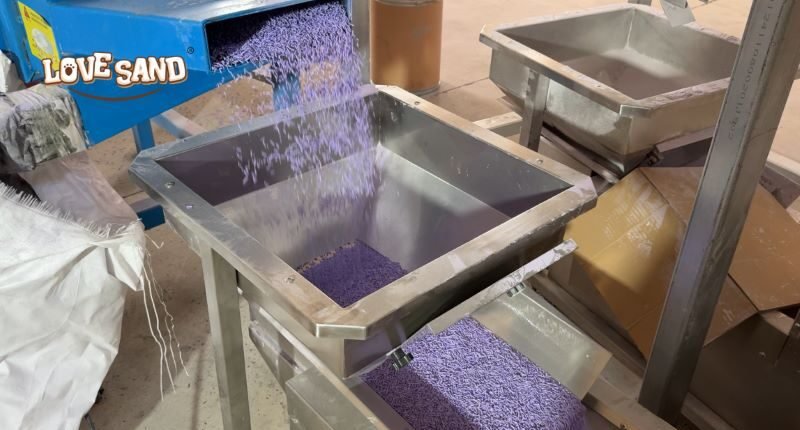
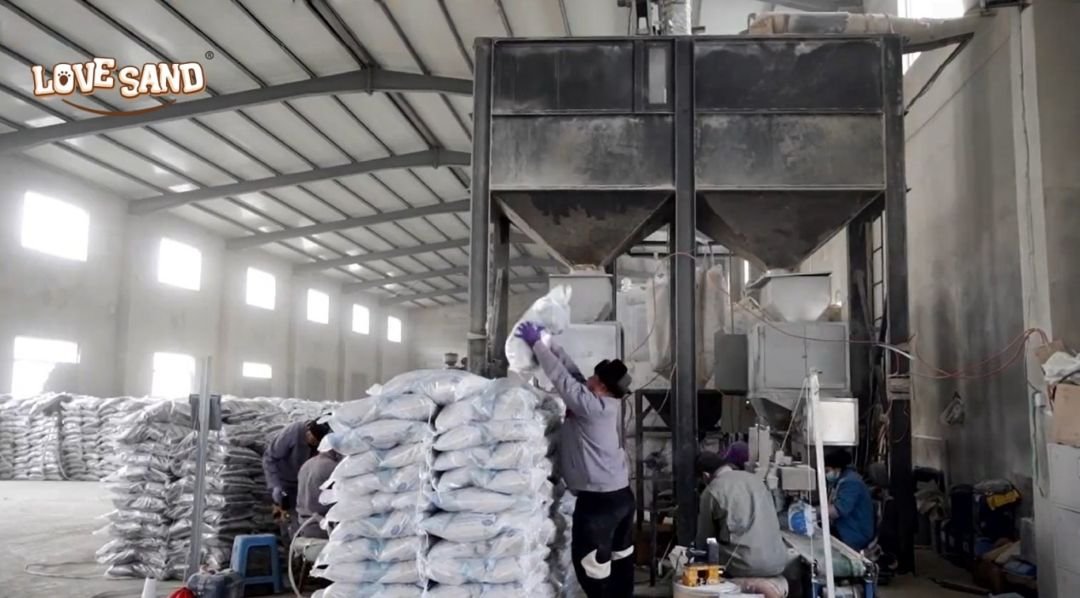
The answer rarely starts with a bigger catalog. It starts with a supplier that can build several product directions from one manufacturing system — and that understands where each product sits in a line. That is the model love sand has been building: one factory, multiple cat litter solutions.
Who This Cat Litter Range Guide Is For
For you if: you are an importer, wholesaler or private-label brand that wants to build a multi-SKU cat litter line step by step, and you want to see how different materials fit together instead of being sourced in isolation. Not for you if: you only need one single product for a spot order — the product overview still helps, but the portfolio sections are aimed at line building.
Key Takeaways
- A product line is a business decision, not a catalog: every SKU should have a clear reason to exist.
- Bentonite remains the volume base for mass-market channels — and can be differentiated, not just cheap.
- Tofu is the plant-based entry that broadens your consumer conversations without replacing clay.
- Dust-free mineral sand is a different product from regular bentonite — separate positioning keeps the line honest.
- Water-soluble litter is a differentiation SKU for crowded markets, not necessarily a volume driver.
- Mixed formulas (cassava + tofu, tofu + bentonite) create new positions without inventing new categories.
- Buying multiple products from one manufacturing system cuts coordination cost and keeps the line extendable over time.
LOVE SAND Cat Litter Product Range at a Glance 2026
| 제품 | Raw Material Direction | Role in a Line | Best For |
| 벤토나이트 고양이 쓰레기 | Natural sodium bentonite | Volume base for the mass market | Pet stores, supermarkets, wholesale |
| 두부 고양이 쓰레기 | Plant fiber (pea / soy) | Plant-based entry, premium tier | E-commerce, eco-driven markets |
| Dust-free mineral litter | Natural mineral sand | Upgrade tier: fine granules, low dust | Sensitive owners, higher-end channels |
| Water-soluble litter | Natural mineral | Differentiation SKU | Crowded, convenience-first markets |
| Mixed formula | Cassava + tofu / tofu + bentonite | Flexible development space | Brands seeking a new position |
From Selling One Litter to Managing a Portfolio
Most cat litter brands follow a similar path. They start with one main product — a 10L bentonite or a standard tofu bag — use it to enter the market, test consumer feedback and build channels. Then sales grow and new demands appear: some consumers find clay heavy and want a lighter plant-based option; some are dust-sensitive; some want new scents; some retailers want different price points. A single SKU cannot cover all of them.
But launching a dozen products at once is not the answer either — too many SKUs mean more inventory, more packaging, more complex purchasing plans and higher market-testing cost. The more workable approach is a product hierarchy: one mass-market bentonite as the core, a plant-based tofu as the second line, then dust-free mineral sand or mixed formulas as the market asks. Each product gets a clear function and price position. Consumers get more choice, distributors get different products for different channels, and the factory gets a clearer development direction. love sand’s product system is laid out around exactly this logic.
Bentonite Cat Litter — The Core Foundation of a Line
In any complete cat litter product range, bentonite still holds a central position — because of market maturity. Millions of consumers already use it, so little education is needed, and it opens pet stores, supermarkets and traditional wholesale channels easily. That makes it the natural base SKU of a portfolio.
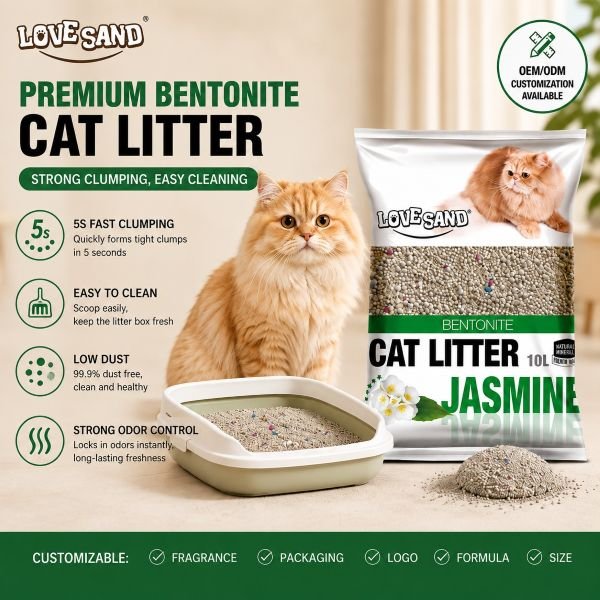
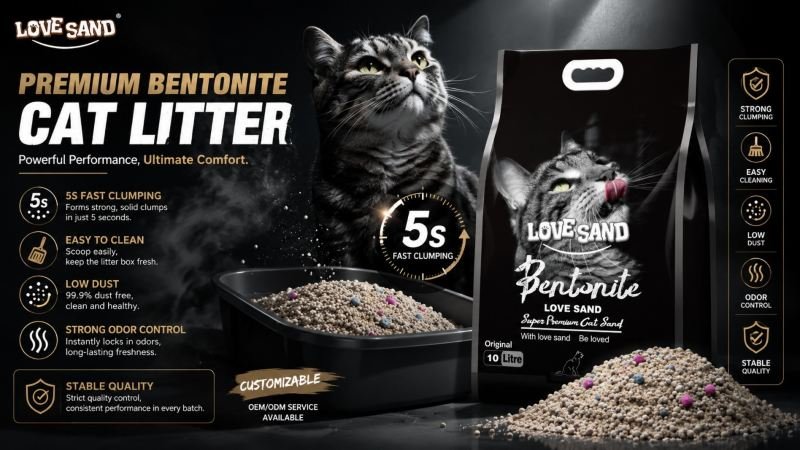
Bentonite does not have to be a “cheap product.” love sand’s bentonite range is built on Natural Sodium Bentonite, with different granule specs, scents and packaging directions: current directions include 5L, 10L, 20KG and 25KG, plus Original, Apple, Lemon, Lavender, Coffee, Rose and Baby Powder scents. A basic product can serve price-sensitive markets; a low-dust version can serve households that care about indoor experience; adding odor-control materials or special granules can build a higher-end direction. For many overseas distributors, bentonite can carry the “base SKU” role of the whole system — high acceptance, with room to expand through different specifications. Our 벤토나이트 고양이 쓰레기 line shows how one material can be positioned in several ways.
Tofu Cat Litter — The Entry Point to Plant-Based
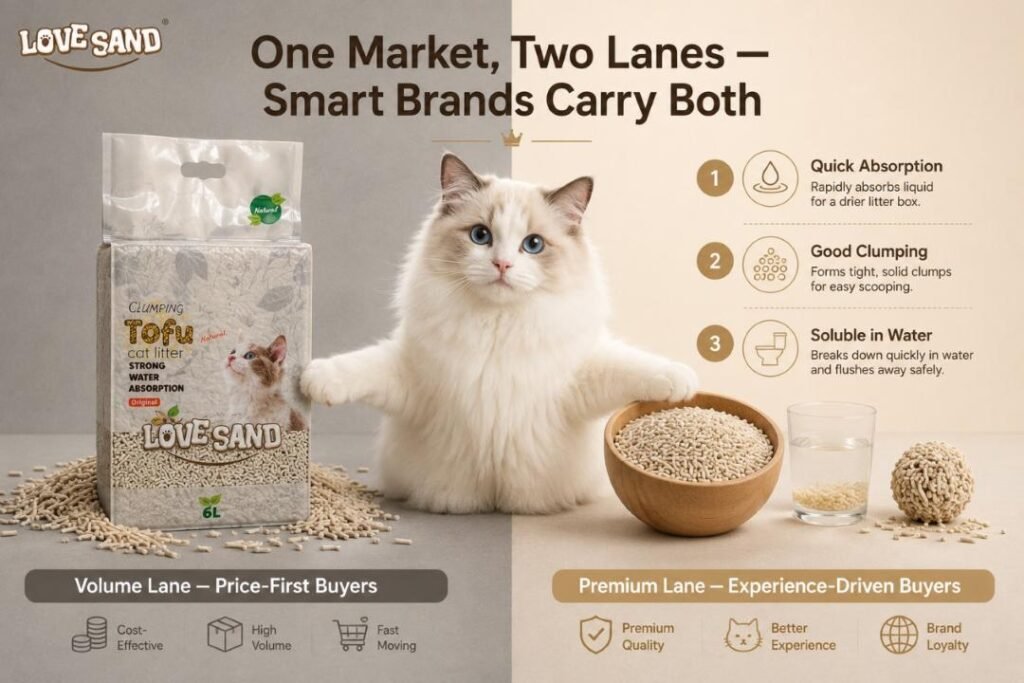
If bentonite represents the mature mass market, tofu represents the fast-growing plant-based direction. It does not replace clay — for most distributors the two coexist, serving different consumer needs. love sand’s tofu litter uses a plant-fiber direction with strip-shaped granules, a standard presentation of 1.5mm diameter and 1–3cm length, and published parameters of ≥600% absorption, ≤3s clumping, <8% moisture and <3% dust.
Tofu’s biggest commercial value is helping a brand build a new product tier. A brand that only sold bentonite can add one plant-based product and enter different consumer conversations: some will choose it for low dust, some for plant-based material, some for the strip granule experience. love sand also offers scent directions from Original, Peach, Green Tea, Lavender, Activated Charcoal and Corn, with both vacuum and non-vacuum packaging. For a distributor, tofu is more than one extra product — it is the first step from a traditional clay range toward a broader one. Our tofu cat litter product page details the base program.
Dust-Free Mineral Cat Litter — Not a Repeat of Bentonite
One of the biggest mistakes in line building is adding products that look different but have no real difference. Dust-free mineral litter exists precisely to offer a direction distinct from regular bentonite. love sand’s dust-free mineral litter sits in the mineral system but emphasizes fine granules, low dust, fast clumping and strong odor control, achieved through mineral-material combination and granule processing, with different specs and packaging options.
For a distributor, this product belongs in a different tier from ordinary bentonite. If the traditional bentonite product is positioned on maturity, economy and strong clumping, the dust-free mineral line can lead with low dust, fine granules and use experience. That makes the difference between the two products easy for consumers to understand — which is what a good product structure requires. A portfolio should not differ only in package color; every product needs a clear reason to buy. If you already carry bentonite, ask whether dust-free mineral sand reaches a consumer
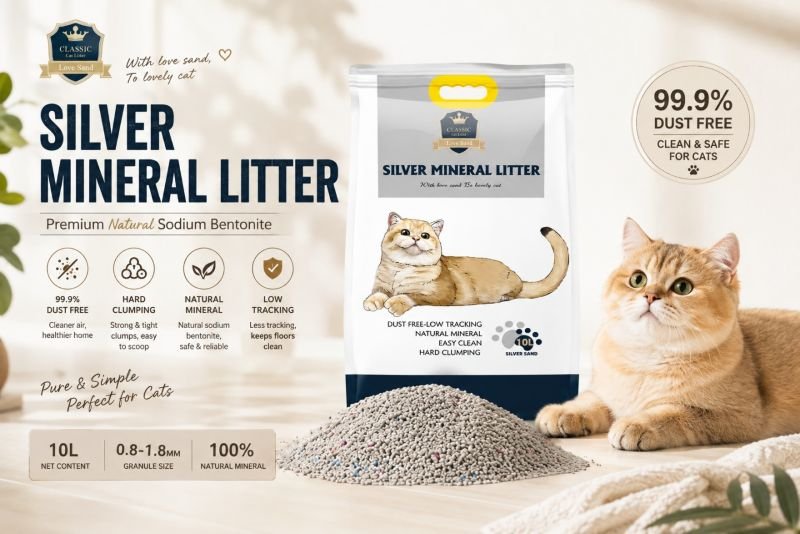
Water-Soluble Cat Litter — A Differentiation SKU for Crowded Markets
Water-soluble litter is another direction in the love sand system. For consumers already familiar with both clay and plant-based litter, a water-soluble product gives brands a new talking point. love sand’s water-soluble litter uses a natural mineral direction and emphasizes that it gradually disperses and dissolves when exposed to enough water, with low dust, fast clumping and odor control listed as main features.
A note of caution: water-soluble does not mean consumers can dispose of unlimited product in any pipe condition. B2B brands must explain correct use clearly. But from a portfolio view, this product helps distributors build a different selling point from traditional mineral litter — especially in markets where consumers already have many choices, a new product feature creates new communication space. Water-soluble litter does not need to be the biggest SKU; it can be the differentiating one.
Mixed Formula Cat Litter — Extending Without Adding New Categories
There is another way to extend a line: instead of adding more single-material products, combine materials into new formulas. love sand’s developing mixed directions include Cassava + Tofu and Tofu + Bentonite. Plant-based material brings lightness and a natural story; mineral material brings its own clumping and use characteristics. Combined, the product position can be tuned toward a target market.
Mixed formulas suit brands that want to avoid an overly traditional line. The market already has plenty of plain bentonite and tofu — a brand selling an identical product competes on price, while a mixed formula becomes a differentiation route. But blending is not just putting two products together: the material ratio changes final performance. Development should start from a clear target — stronger clumping? lighter weight? less dust? a new price band? Different goals point to different directions. As our overview of manufacturers and hybrid formulas notes, hybrid products are where a growing part of the market is moving.
Why “One Factory, Many Products” Matters in Practice
Sourcing different products from different suppliers is possible: bentonite from factory A, tofu from factory B, mineral sand from factory C. But every supplier brings different communication styles, spec formats, packaging requirements, order cycles and quality-confirmation processes. Managing that multiplies coordination cost. When multiple products come from one manufacturing system, purchasing becomes easier to align.
love sand currently offers multiple cat litter directions, so clients can combine products around their market needs. A new client can start with two products — one mass-market bentonite and one plant-based tofu — then add dust-free mineral sand or mixed formulas once the market stabilizes. The line grows step by step, which is easier to manage than buying many types at once. And when several SKUs come from the same manufacturing system, packaging development, order communication and later adjustments form a continuous process. This does not mean every product must be bought at once — the real value is having a product base that can keep expanding.
Different Markets Need Different Combinations
There is no fixed product structure that fits every country. Price levels, consumer habits and sales channels all differ. A complete line does not mean “more products is better” — it means choosing the right combination for the market. In a market dominated by pet stores and wholesale, bentonite may stay the most important core product. In markets with high e-commerce share, where consumers care about low dust and plant-based material, tofu may have more room. In highly competitive markets, distributors may need dust-free mineral sand or mixed formulas to create new selling points.
That is why product development at love sand starts from the client’s actual needs: where is your target market? What are your main channels? Do consumers care more about price or experience? Which competing products already exist? What does your brand need to add? Once these are answered, the right combination becomes much clearer.
Build the Line in Three Stages
A client entering cat litter for the first time does not need to buy five products. Too many SKUs usually increase inventory risk. A staged approach is more practical:
Stage 1 — Establish a Core Product
Choose the product your market accepts most easily. For many markets that is bentonite cat litter. Confirm granule, packaging, scent and price position, then build stable sales first.
Stage 2 — Add a Different Product Attribute
Once the base product is stable, add tofu cat litter. The brand now covers both mineral and plant-based directions.
Stage 3 — Build Differentiation SKUs
Based on market feedback, add dust-free mineral sand, water-soluble litter or mixed formulas. The line moves from one SKU to several clearly positioned products. The advantage of this approach: every product addition has a purpose — not “more products,” but new market needs being met.
Buyer Tips|Three Questions Before Building Your Line
1. What is your current line missing?
If you already sell bentonite, the next product probably should not be another similar bentonite. Consider plant-based litter or low-dust mineral sand so the difference is real.
2. Does every product have its own position?
Consumers should be able to understand why this product and how it differs from another. If all products share the same selling points and only the packaging differs, the added SKU carries little commercial value.
3. Are you building inventory you cannot manage yet?
Start with two or three core products and expand with sales data. That lowers inventory pressure and shows you what the market actually wants.
How LOVE SAND Helps Distributors Build a More Complete Range
One of love sand’s advantages is that the product line is not limited to a single material. Current directions cover multiple cat litter types: bentonite cat litter as the base for traditional markets; tofu cat litter for plant-based and low-dust directions; dust-free mineral litter for fine-granule, low-dust experiences; water-soluble litter for a new selling point; and mixed formula for flexible product development.
For a distributor, this means products can be added according to market conditions without starting from scratch. Within the existing product system, granule, scent, packaging and brand needs can all be discussed. love sand also supports OEM and private-label services, so clients can combine existing product directions with their own brand packaging and positioning. From product development to packaging confirmation to final order production, multiple products can form a continuous cooperation model — and for distributors planning to stay in the cat litter business long-term, that continuity matters.
FAQ|Building a Complete Cat Litter Line with LOVE SAND
Q1. What main cat litter types does love sand currently offer?
Q2. If we only sell bentonite now, what should our next product be?
Q3. Can we buy several different cat litter types from love sand in one program?
Q4. What mixed cat litter directions does love sand currently have?
Q5. If we start with one SKU, can we expand the line later?
Q6. Can different cat litter types share one brand packaging system?
Conclusion|A Complete Product System Beats a Single Product in the Long Run
For a cat litter distributor, building a product line does not mean adding SKUs endlessly. An effective system gives every product a role: bentonite provides base volume in mature markets; tofu opens the plant-based direction; dust-free mineral sand leads with a different granule and low-dust experience; water-soluble products create a new selling point; mixed formulas leave room for further development. These products do not replace each other — together they form a more complete cat litter product range.
love sand currently provides multiple cat litter choices for overseas importers, distributors and private-label clients through different raw materials and product directions. Clients can start from one core SKU and add products step by step according to market sales. That reduces early inventory pressure and keeps every expansion aligned with real demand. For a B2B client planning to stay in this business long-term, the important thing is not finding a factory with the most products — it is finding a manufacturing partner that keeps offering new options as your market grows, and that helps you build a complete line from one SKU upward. From one litter to a full range: that is how love sand supports distributors in building a product system that belongs to their own brand and channels.
Reviewed by: love sand pet-litter product team (Puyuan Dalian Pet Products Co., Ltd.). Last updated: 2026-09-28.
More about the manufacturer: About love sand