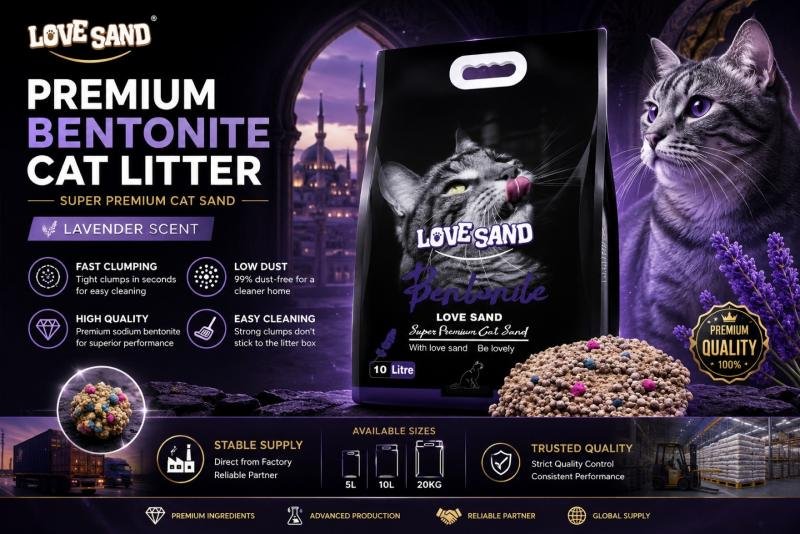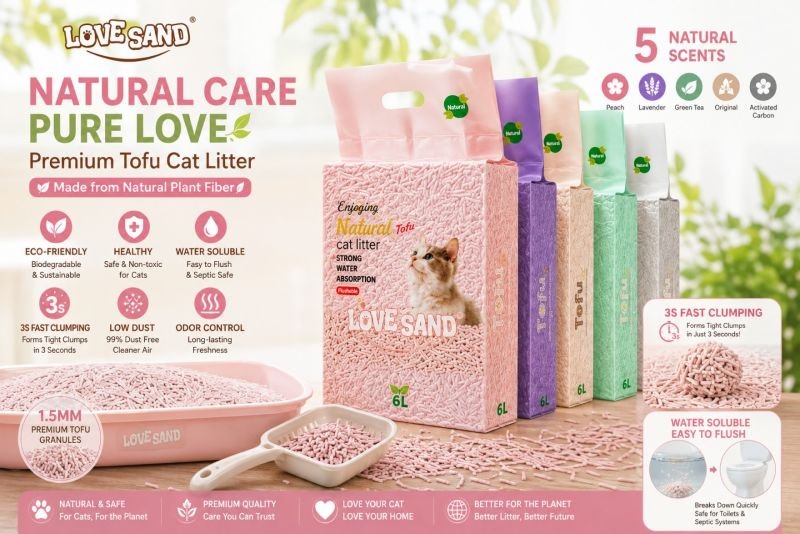
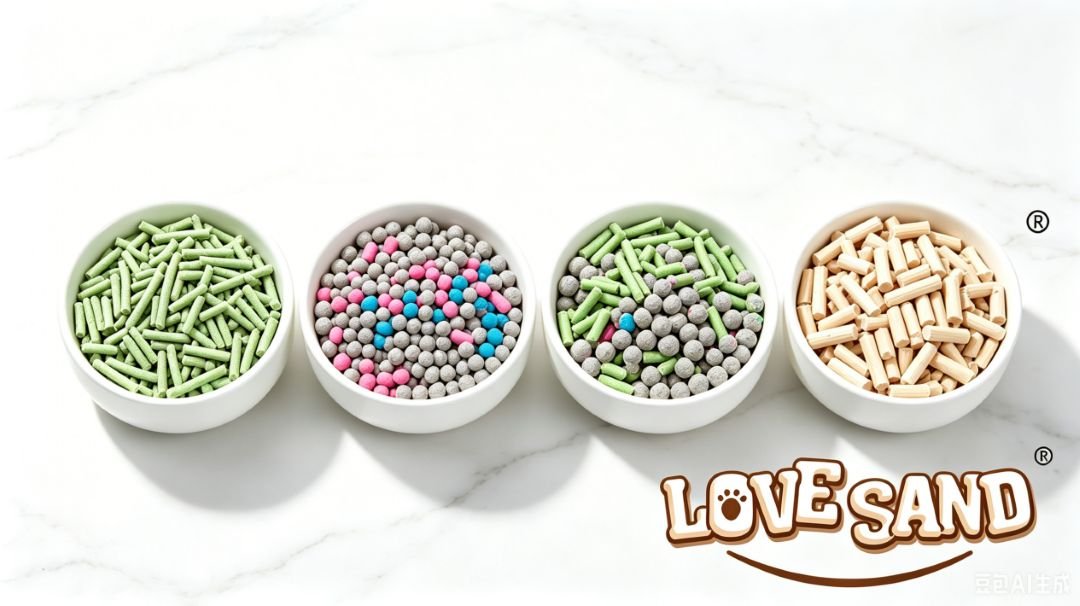
In the pet consumables market, the iteration speed of cat litter category is extremely fast. Tofu cat litter, bentonite cat litter, mixed cat litter and pine cat litter account for more than 90% of the global market share. Ordinary consumers can only judge whether it is good or bad from the experience of use, but for foreign trade distributors, buyers and brands, the core that really determines product stability, repurchase rate, price range and export adaptability is the difference of cat litter production technology and raw material attributes.
The fundamental reason why the cat litter with the same price and face value has the gap of agglomeration, dust, loss and fragrance retention comes from the difference of material formula, processing technology, equipment standard and quality control system at the factory end. In this paper, from the perspective of the source factory, the four mainstream cat litter production differences are deeply dismantled to help buyers select products accurately, avoid the risk of batch instability and lock in the cost-effective supply chain.
1. Tofu cat litter: plant regeneration material with the highest technological threshold.
1) Core raw materials and production logic
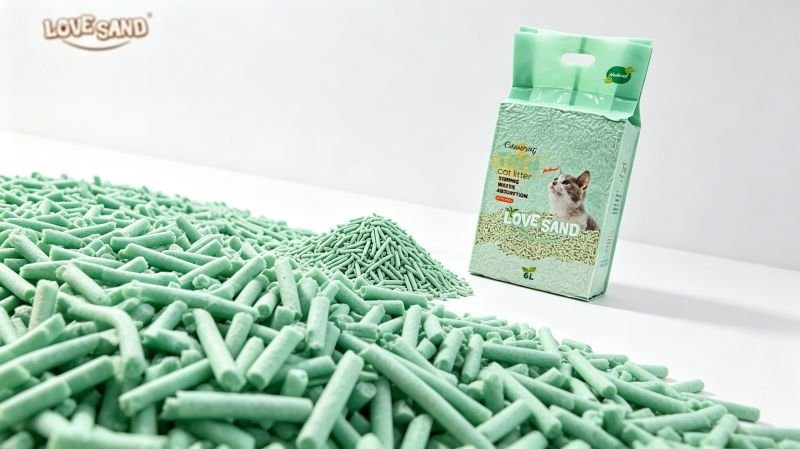
豆腐の猫砂 is mainly made of starch and plant fiber, which is a degradable and environmentally friendly material. The core logic of its production is: fine grinding of plant powder+high temperature and high pressure puffing granulation+dehydration and solidification.
Because the raw materials belong to plant organic matter, tofu cat litter is the category that requires the highest precision of the production line among the four major materials. The moisture content of raw materials, powder mesh, extrusion temperature and cooling time will directly affect the hardness, dust, agglomeration speed and bottom sticking probability of finished products.
2) Process characteristics, advantages and disadvantages
Tofu cat litter produced by regular factories will undergo three times of fine screening, two times of high-temperature drying and low-temperature curing, and the finished product has uniform particles, high toughness and is not fragile. In order to reduce the Cost, small factories will reduce the screening process and the drying temperature, resulting in large dust, fragmentation and looseness in water.
利点がある: flushing toilet, low dust, environmental protection and good fragrance retention;
Disadvantages: high raw material cost, limited production capacity, humidity sensitivity, and easy moisture absorption and softening in wet areas.
2. Bentonite cat litter: mineral material, depending on mineral source and purification process.
1) Production core principle
ベントナイト猫砂 is a natural mineral material with montmorillonite as its core component. Its production does not depend on complex puffing equipment, but on the quality of ore source, purification and screening, ball rolling and granulation, drying and dust removal.
The core difference of high-end bentonite cat litter is not the equipment, but the purification process. After multi-stage impurity removal, desliming and purification, the content of montmorillonite is higher, and the agglomeration speed, water locking ability and deodorization ability are greatly improved.
2) Process characteristics, advantages and disadvantages
The bentonite cat litter production threshold is low, but the quality control threshold is extremely high. The low-end factory directly grinds and granulates the original stone, which has many impurities, high risk of heavy metal residue and huge dust; Export-grade factories will carry out four-stage washing purification, negative pressure dust removal and aseptic drying.
利点がある: fast grouping, strong wrapping, high cost performance, suitable for all cats;
Disadvantages: non-degradable, serious dust when the process is insufficient.
3. Mixed cat litter: composite material and formula compounding are the core technical barriers.
1) Production logic
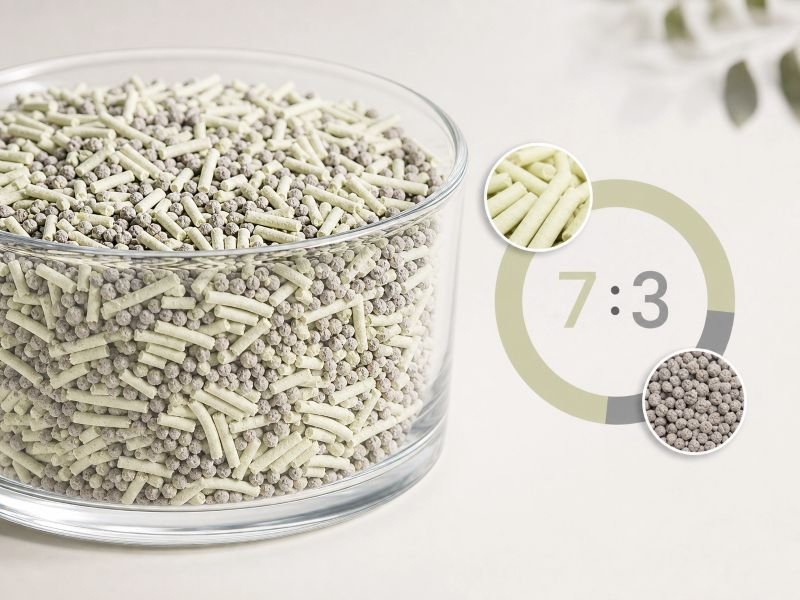
The mixed cat litter is generally made of tofu and bentonite, and the mainstream ratio is 7:3, 6:4 and 5:5. Many buyers mistakenly think that “mixing is just simple stirring”, but it is not. High-end mixed cat litter needs powder premixing technology, synchronous granulation technology and density ratio calibration.
If it is only physical mixing, there will be problems such as stratification of the two materials, uneven agglomeration, and a big gap in the experience of a bag of sand. The formal factory adopts a granulation process, which makes the two materials deeply integrated, taking into account the advantages of agglomeration and low dust.
Why choose mixed cat litter? >>
2) Process characteristics, advantages and disadvantages
Mixed cat litter is the highest export category in the world, and it is also the product with the best technical balance. It solves the double pain points of weak caking of tofu sand and large bentonite dust. However, the requirements for factory formula debugging ability and raw material proportioning accuracy are extremely high, and small factories are prone to batch instability.
4. Pine cat litter: wood fiber pressing material, depending on carbonization and process.
1) Production logic
Pine cat litter is made from pine sawdust and plant wood fiber through high temperature carbonization, high pressure pressing and dealdehyde treatment. The core of production lies in carbonization temperature control and aldehyde removal process, which directly determines whether it is pungent or not and whether it is safe.
2) Process characteristics, advantages and disadvantages
Pine cat litter has strong water absorption, good bacteriostasis and almost no dust, but the products with poor technology will have residual wood sour taste, excessive formaldehyde and loose slag when it meets water pine. High-end factories will increase the processes of secondary aldehyde removal and vacuum flavor dispersion to adapt to the high-end markets in Europe and America.
Summary of cat litter production differences between the five and four major material factories
Precision of bean curd cat litter mixing equipment, purification of bentonite cat litter mixing source, mixing cat litter mixing formula technology, pine cat litter mixing carbonization technology. For distributors, understanding the differences in material production can explain the product premium, accurately match the market demand, and stabilize the quality of supply.