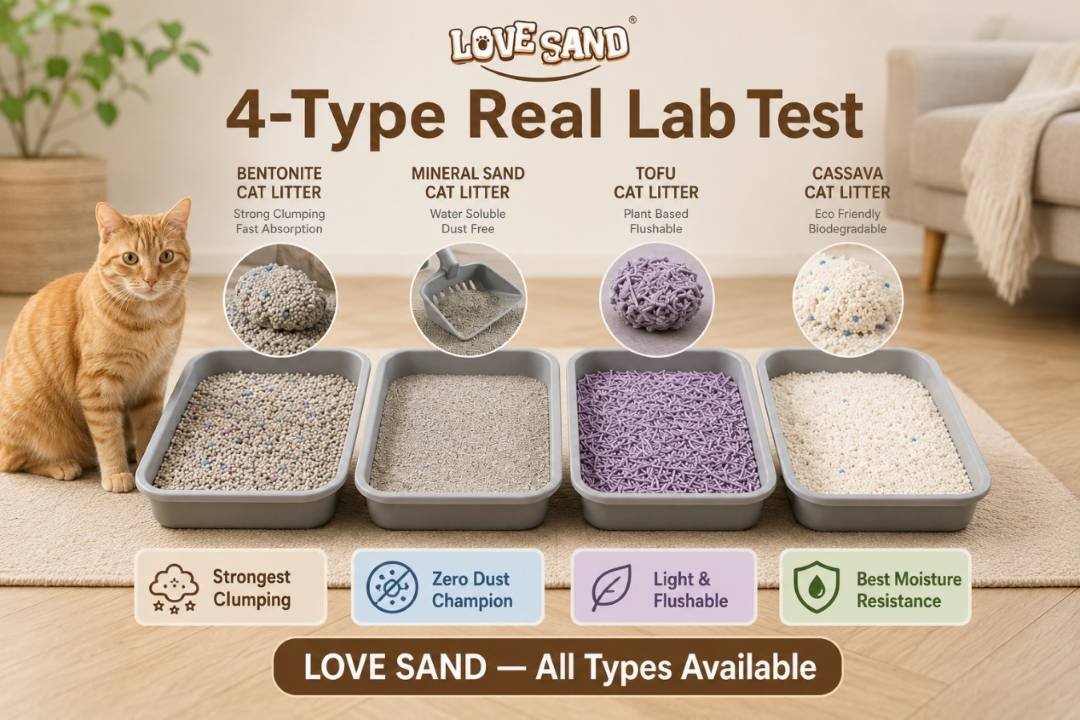
At present, the mainstream household cat litter on the market is basically divided into four categories: tofu cat litter, cassava cat litter, ordinary bentonite cat litter and dust-free mineral sand.
Many shovelers choose cat litter, and they are used to watching online celebrity’s recommendation, store sales and feedback from others. However, the environment, the number of cats, the amount of urination, and the dry and wet climate in different families are completely different. Cat litter used by others is easy to roll over in their own homes.
If you really want to choose the best type of cat litter that suits you, the core only depends on four hard indicators: agglomeration stability, dust size, daily loss rate and moisture-proof and moisture-resistant ability. These four data directly determine the cleanliness, worry-free degree, cost performance and odor control ability of cat litter.
In this paper, the unified standard of simulating cat urination in the same environment, the same sand thickness and the same amount of water is used to make a complete measurement and comparison of the four cat litter.
1. Unified test standard for this actual measurement.
In order to ensure the fairness of comparison, all the tests are unified with fixed parameters to eliminate human errors.
Fixed sand laying thickness: 6cm (general standard thickness for families)
Single simulated urine output: 25ml (normal urine output of adult cats)
Test environment: normal temperature of 25℃, conventional indoor humidity and high wet plum rainy season.
Evaluation dimensions: agglomeration speed, agglomeration compactness, slag falling and disintegration, dust raising degree, long-term loss, moisture absorption and acidity.
Detailed measured data and experience of two or four cat litter items.
2.1 Measurement of agglomeration performance: decide whether to stick to the bottom or not to agglomerate.
Agglomeration is the core ability of cat litter, and poor agglomeration will directly lead to the fragmentation of urine, the residue of pelvic floor and the breeding of odor.
Ordinary bentonite cat litter: it has the fastest agglomeration speed and tightens instantly when it meets water. The lumps are thick and hard, and hardly disperse. The disadvantage is that the surface layer clumps quickly, and the bottom layer occasionally appears slightly sticky, so it is necessary to scrape the basin bottom lightly. The overall clustering score is extremely high, which is suitable for heavy urine and high-frequency toilet use scenes.
Dust-free mineral sand: it belongs to purified and upgraded mineral sand, and the purity of montmorillonite is higher. The agglomeration is more uniform and thinner than ordinary bentonite, and there is no local looseness. The whole piece is unbreakable and almost zero-sticky, which is the most stable category among the four types.
豆腐の猫砂: the agglomeration speed is moderate, and the water absorption and penetration are uniform. Normal urine volume is complete, but it is easy to be stratified and broken when encountering a lot of concentrated urine and repeated infiltration. In the environment with high humidity, the compactness of agglomeration will decrease obviously.
Cassava cat litter: the dough has the best toughness and is not easy to disintegrate. Compared with tofu sand, it has stronger resistance to repeated infiltration. However, in low temperature and dry environment, the agglomeration speed will be slightly slower than that of mineral sand.
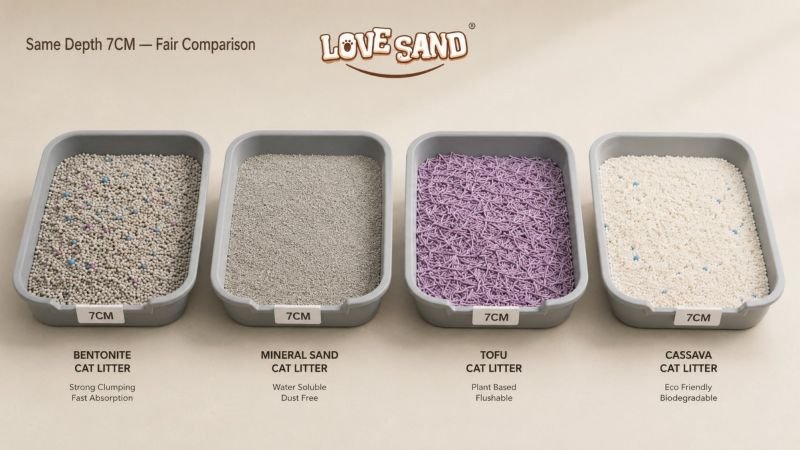
2.2 Dust measurement: It directly affects the respiratory health of people and animals.
Dust is an invisible pain point for many families to raise cats. Long-term dust will lead to sneezing of cats, itchy rhinitis and dust accumulation in furniture.
Dust-free ore: zero floating dust and zero fine powder. After multiple dusting, washing and curing processes, the whole process of unpacking, sand pouring and cat scraping is clean, and the dust control is optimal.
Cassava cat litter: low dust. The particle structure is compact and high in toughness, and it is not easy to be crushed. Only when it is turned violently, it will produce ultra-fine powder, and the overall experience is clean.
Tofu cat litter: slight dust. Ordinary cheap tofu sand is easy to get foggy powder when it is unpacked, and the dust of high-end craft will be greatly improved, but it is still not as clean as ore sand and cassava sand.
Ordinary bentonite: the dust is the largest. Natural mineral soil comes with fine powder, which will raise dust when pouring sand, scraping sand and shoveling excrement. It is the most obvious category of dust short board among the four types.
2.3 Measurement of loss rate: Determine the cost performance of long-term cat keeping.
The higher the loss rate, the more frequent sand replenishment and the higher the cost of keeping cats for a long time. Theloss mainly comes from powder crushing, disintegration, moisture softening and frequent sand changing.
Dust-free ore: the lowest loss. The particles are hard and stable, and do not powder, rot or disintegrate. The duration of single sanding is the longest, and the frequency of sand replenishment is extremely low.
Ordinary bentonite: low loss. The texture is thick and stable, and it is not fragile, but there are many fine powders, which will be slightly consumed after long-term accumulation.
Cassava cat litter: medium loss. Strong toughness, not fragile, but long-term high-frequency use will slightly wear the surface.
Tofu cat litter: the highest loss. It is easy to collapse, powder and break into lumps when it meets the tide. It needs frequent sand replenishment and slag cleaning, and the speed of consumables is the fastest.
2.4 Moisture-proof and moisture-proof measurement:
In humid environment, cat litter is most afraid of moisture absorption, sourness, mildew and loss of water absorption ability.
Dust-free mineral sand and bentonite: no moisture absorption at all. The mineral material has a stable structure, does not absorb air vapor, does not become soft, sour and moldy in the rainy season, and has almost no attenuation in wet environment.
Cassava cat litter: excellent moisture resistance. Plant fiber is dense and stable, and its moisture resistance is far better than that of tofu sand, so it can basically be used stably in southern China.
Tofu cat litter: the worst moistureproof. High humidity environment is easy to absorb moisture, soften, sour and breed bacteria. If it is not changed for a long time, there will be obvious stuffy smell.
Comprehensive scores of the third and fourth cat litter and summary of the applicable population.
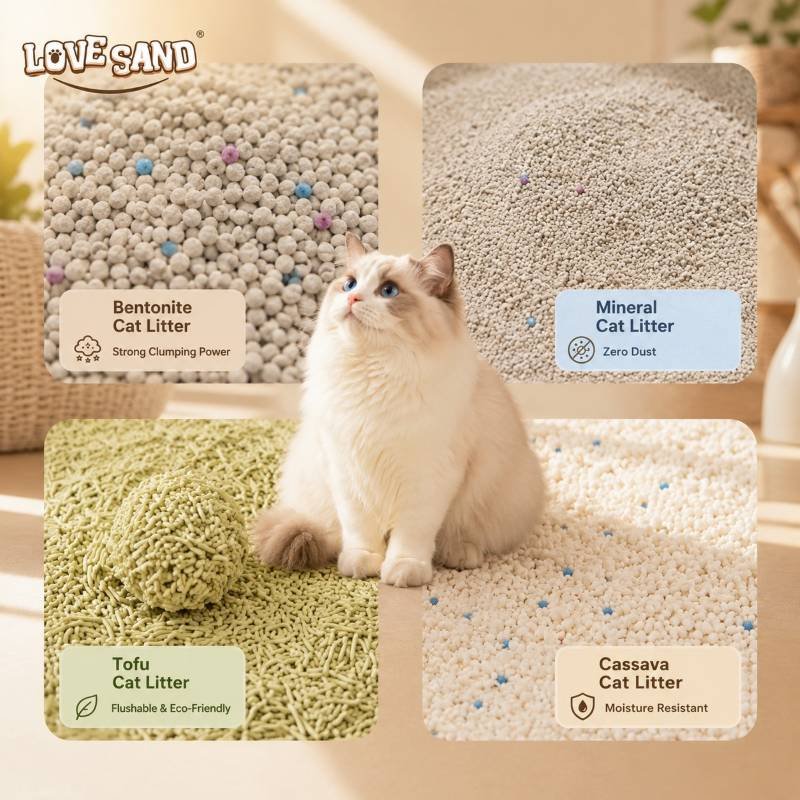
Dust-free ore: comprehensive full score. Stable agglomeration, zero dust, low loss and no fear of moisture. Suitable for exquisite families, rhinitis people, multi-cat families, wet areas and high-end cat users.
Ordinary bentonite: high cost performance and strong agglomeration. The only shortcoming is that the dust is too large, which is suitable for families who don’t care about slight dust and pursue cost-effective locking.
Cassava cat litter: low sensitivity, cleanness and moisture resistance. Suitable for young cats, sensitive cats, cats with weak stomachs, and users who pursue safety without adding.
Tofu cat litter: limited adaptation scenarios and high loss. Suitable for users in dry areas, single cat families, who need to observe urine balls and occasionally flush toilets.