
Strip pellets and crushed granules can come from the same arena de tofu para gatos formula and the same production line. The difference is what happens after extrusion: strip litter keeps the original pellet, while crushed litter sends it through a crusher to break it into smaller, irregular pieces.
The crushed version usually begins clumping a little sooner. That is the part buyers notice first. The trade-off appears later, when the clump is lifted, when loose fines settle around the box and when the bag is used over several weeks.
For an importer or private-label brand, the useful comparison is not simply “which shape clumps faster?” It is whether the product stays consistent through transport, daily scooping and the full life of the bag.
The Two Shapes in Practical Terms
| What is being compared | Strip pellet | Crushed granule |
| Initial clumping speed | Bien | Usually faster |
| Clump strength | Usually stronger | More likely to break at the edges |
| Dust and fines | Lower when screening is controlled | More fines can be created by crushing and transport |
| Transport stability | Keeps its original structure better | More vulnerable to abrasion and breakage |
| Overnight stability | More likely to remain intact | More likely to leave loose pieces |
| Usable product from the bag | Generally higher | Some material becomes fines or is discarded with broken clumps |
These are practical tendencies rather than a substitute for sample testing. A well-made crushed product can perform better than a poorly made strip product, but the extra crushing step creates a different set of risks that should be checked before ordering.
How the Two Shapes Are Made
A tofu cat litter formula generally combines plant fiber with starch and a small amount of binder. The plant fiber gives the granule its structure and absorption, starch helps the mix hold together during forming, and guar gum can improve toughness and clumping. The reference LOVE SAND formula uses guar gum in the range of about 1–2%.
Strip Pellets
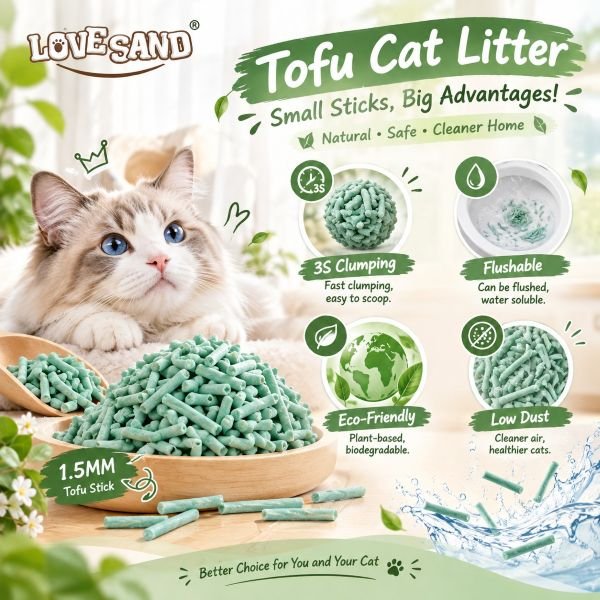
After mixing, the material passes through an extruder and leaves the die as a continuous strand. The strand is cut into pellets, commonly around 1.5 mm in diameter and 1–3 cm long. Drying, screening and fines removal follow.
The die gives the pellet a regular cross-section, while extrusion pressure determines how dense the inside becomes. When the process is stable, the pellets in a batch stay within a relatively narrow size range and have a continuous outer surface.
Crushed Granules
Crushed litter starts with the same strip pellet. A crusher then breaks the cylinders into pieces of different sizes. That changes the shape, widens the size distribution and opens the interior of the pellet at new fracture surfaces.
Those exposed surfaces allow liquid to move into the material quickly, which helps explain the faster start to clumping. They also give the formed clump more points at which it can split. The two effects come from the same mechanical change.

Clumping: Speed Is Only One Part of the Result
Crushed tofu cat litter often begins to clump sooner because the pieces are finer and have more exposed surface. This can suit customers who prefer a fine texture under the paw or who want the clump to start forming quickly.
Daily use involves more than the first few seconds. The clump also needs to remain together while it is lifted, survive the trip to the waste bag and stay stable if it sits in the box overnight. A denser strip pellet generally gives the clump more internal support. A crushed pellet has more fracture faces, so the edge may open during scooping.
The right comparison is therefore a sequence: how quickly the clump starts, how long the user waits before scooping, how cleanly it lifts and how much material remains behind. A faster beginning does not automatically mean a better result.
How Strip Clumping Is Controlled
Strip litter starts slightly more slowly than a fine crushed product because the pellet is denser and the liquid needs a little longer to move into it. That is a consequence of shape, not necessarily a quality problem.
The formula, extrusion pressure and drying moisture all affect the balance. LOVE SAND uses absorption of at least 600% as a reference release standard and checks clumping against its internal batch requirements. The aim is to produce a pellet that absorbs quickly enough for normal use while keeping the clump intact during scooping.
A second pass through a crusher is not the only way to improve the first few seconds of clumping. The same result can be adjusted through the formula and forming process, without giving up the original pellet structure.
What One Bag Looks Like in Use
The difference is easier to understand by following a bag from opening to empty rather than looking at one laboratory number.
When the Bag Is Opened
A well-screened strip bag should contain mostly regular pellets, with relatively little loose powder around the opening. Crushed litter naturally contains a wider range of sizes. Fine material may collect near the mouth or at the bottom of the bag, and more powder can become airborne while it is poured.
The first impression matters in retail. A product sold as low-dust cat litter should not leave a visible layer of powder around the package or the litter box. If dust is the main selling point, compare the product with a dedicated dust-free mineral range as well as with another tofu formula.
During Scooping
A strong strip clump is more likely to lift as one piece. In a crushed formula, the edges may break more easily because the clump forms around irregular pieces and exposed fracture surfaces. The main clump may still lift, but small pieces can remain in the clean litter and require a second pass.
Those pieces are not only a cleaning issue. They continue absorbing liquid in the box and can contribute to stronger odor or earlier tray replacement. The effect may be small on one day, but it becomes more noticeable over repeated use.
When the Bag Is Nearly Empty
A bag may lose usable material before it reaches the end of its advertised volume. Some fines are created during crushing and filling, and transport vibration can create more. Broken clumps add another type of loss because usable litter leaves the box with the waste instead of remaining in the tray.
This is why two bags with the same nominal size may last different numbers of days. A more useful commercial comparison is the cost per usable day, not only the price printed on the bag.
Where Strip Consistency Comes From
A consistent strip pellet is the result of several controls working together. No single setting explains the final performance.
Raw-Material Ratio
Plant fiber provides structure and absorption. Starch helps bind the mix, while guar gum can improve toughness and the way a clump holds together. The ratio needs to remain stable from batch to batch. A change in fiber condition or binder level can affect both the pellet and the finished clump.
Extrusion
Extrusion determines how dense the pellet becomes. If it is too loose, the interior can contain weak areas that fall apart after absorbing liquid. If it is too dense, the liquid takes longer to penetrate. Holding pressure within a workable range is what allows the product to balance speed and strength.
Drying and Moisture
Moisture affects both clumping and storage. A pellet that leaves the line too wet can soften during transport, pick up humidity more easily and lose shelf stability. The reference LOVE SAND moisture target is below 8%, with batch testing before shipment.
Screening and Fines Removal
Screening removes oversize pieces, short pieces and loose fines. A narrower size range helps the pellets absorb more evenly, so clumps are less likely to be thick in one area and weak in another.
Batch Checks
Absorption and clumping should be checked for every production batch. A problem found at the factory is manageable; the same problem found after a customer has received a container is much more expensive to correct.
What Buyers Should Test
A buyer does not need a complex laboratory to see the main difference between strip and crushed tofu cat litter. The comparison should be made with the same water volume, waiting time, litter depth and scoop.
Compare Days per Bag
Ask how many usable days the supplier expects from each bag size, then check the answer with a sample. A lower unit price is not a better value if a large portion of the bag becomes powder or if broken clumps have to be discarded.
Run the Same Ten-Minute Check
- Spread a handful on white paper and look for visible fines.
- Fill two boxes to the same depth and add the same amount of liquid.
- Wait for the same period, then scoop each clump several times.
- Leave one clump overnight and check whether it remains intact the next morning.
Request Consecutive Batch Records
One good test result does not establish consistency. Ask for absorption and clumping records from at least three consecutive batches and compare the range. A narrow spread suggests that the formula and process are being controlled more reliably than a single attractive result.
Strip or Crushed: Which One Makes Sense for a Market?
Crushed tofu litter may make sense where a fine texture and faster initial clumping are the main selling points. The buyer should be comfortable with the possibility of more fines, more variation in particle size and weaker clumps at the edges.
Strip pellets are usually the safer starting point where low dust, transport stability, clean scooping and longer use per bag matter more. They also give a private-label brand a more consistent product format across repeated orders.
This is separate from the choice betweentofu against bentonite. Material choice answers one set of market questions; pellet shape answers another. The two decisions should not be treated as substitutes.
Preguntas frecuentes
Is crushed tofu cat litter made from different raw materials?
Does strip litter clump more slowly because it is lower quality?
Why can crushed tofu cat litter produce more dust?
Where does product loss occur with crushed litter?
How can I check strip-litter consistency?
Why does LOVE SAND focus on strip pellets?
Conclusión
Crushed tofu cat litter is not a separate material. It is the same type of pellet after one additional mechanical step. That step can make the first clump form sooner, but it can also create more fines, more irregular pieces and weaker edges during scooping.
For procurement, compare both shapes in the same test rather than relying on the bag price or the first few seconds of clumping. Look at dust, transport damage, clump strength, overnight stability and the number of usable days from the bag.
Importers, brands and e-commerce sellers can request strip tofu cat litter samples and batch records from LOVE SAND.
Reviewed by: Love Sand Pet Litter Product Team (Puyuan Dalian Pet Products Co., Ltd.)
Last updated: November 2, 2026
Más información sobre el fabricante: https://love-sand.com/about/