Introduction: Many buyers’ first action after coming to the factory is not inquiry.
People who come to the fábrica de arena para gatos for the first time usually ask, “How much can you produce a year?” “How many containers can be loaded every day?”
People who have really made a brand of cat litter are rarely in a hurry to talk about the price.
They prefer to put on a pair of safety shoes and walk into the production workshop.
Because they know that the value of a bag of cat litter is not worth selling for a long time, many times it is not determined by the quotation, but the answer given by the production site.
In LOVE SAND, we have received customers from different countries in Europe, South America, the Middle East and Asia. The product positioning that everyone pays attention to is different, but one detail is surprisingly consistent.
They will go to the production line, grab a handful of freshly produced ore and put it in the palm of their hand and rub it gently.
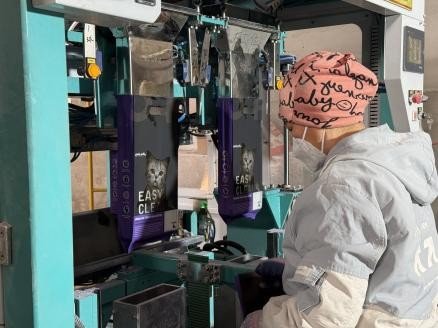
Some people observe whether the particles are uniform, some people will look down to see if there is obvious powder in their palms, and some people will put some cat litter back next to the machine and compare it with the previous batch of products.
This action seems simple, but it can quickly judge whether a factory really values quality.
Because the truly excellent ore is not only a few data in the laboratory test report, but also should remain stable in daily production and every batch of products.
Many suppliers like to emphasize their products “low dust” and “quick agglomeration”.
There is nothing wrong with these selling points.
But if the time is extended to three months, a year, or even longer, the problems that buyers really care about will change.
They began to pay attention to:
“Can the next batch of goods keep the same quality?”
“After 40 days by sea, will consumers find more dust when they open the package?”
“After the brand is made, can the factory continue to be consistent?”
These problems are the key to long-term cooperation.
Today, we are not going to introduce from the catalogue, but follow a bag of ore to see what links it went through before leaving the LOVE SAND factory.
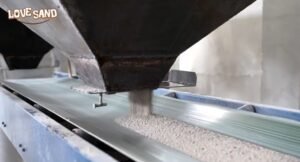
First stop: raw materials arrive at the factory-stabilize the quality, starting with the first turning of sodium bentonite.
Every morning, the first batch of vehicles entering the factory are not necessarily packaging bags, but vehicles carrying raw materials.
For ordinary consumers, these gray-white ores don’t look much different.
But for the quality team, each batch of raw materials means a new beginning.
Ore is a mature product, but maturity does not mean simplicity.
Especially for the export market, a bag of cat litter may need to be shipped by sea for more than a month before entering warehouses and retail channels in different countries. If the raw material itself fluctuates, even the advanced equipment can hardly make up for it completely.
Therefore, before the real start of production, the stability of raw materials will always rank first.
LOVE SAND ore products use **100% sodium bentonite * * as the main raw material.
Many buyers have known that sodium-based bentonite has good water absorption and swelling properties, but it is not just “whether it is sodium-based” that really affects the product performance.
The particle structure, water content and subsequent processing performance of different batches of sodium bentonite will affect the final agglomeration effect.
It is precisely because of this that Love sand established its own factory, strictly controlled the processing procedures, controlled the quality, and ensured the “continuous and stable” supply, instead of a particularly excellent test result.
This is especially important for OEM brands.
Consumers will not form loyalty just because a bag of products performs well. They will truly trust a brand because they have bought it for months and years and always get the same experience.
So, when many customers ask us, “What is your greatest advantage?”
Our answer is usually not “equipment” or “capacity”.
But:
Stable.
Stable raw materials.
Stable production.
Stable quality.
These four words seem simple, but they are the most difficult thing for an export-oriented factory to adhere to.
BuyerInsight | What buyers should really see is not just the name of raw materials.
Many importers will confirm one question when purchasing ore for the first time:
“Is it 100% sodium bentonite?”
This question is of course important.
But if we just stay here, it’s not enough.
What is more worth continuing to understand is:
How does this factory ensure the consistency of different batches of raw materials?
If you continue to purchase for one year in the future, can the products still maintain the same performance?
Do samples, bulk goods and next orders adopt the same production standards?
These problems often better reflect the real strength of a factory than the phrase “100% sodium bentonite”.
For brands, what is really expensive is not the purchase cost, but the return, complaints and loss of consumer trust caused by quality fluctuation.
Therefore, a mature OEM factory provides not only raw materials, but also a set of quality system that can run stably for a long time.
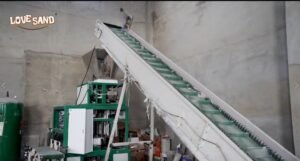
Third stop: real low dust, not in the last process.
There is a process on the production line, which often attracts the attention of customers who visit the factory for the first time.
The equipment keeps running, fine particles keep passing through the screen, and particles with different specifications are separated and recycled before entering the next process.
Many people will ask when they see this:
“Is the more careful the screening, the lower the dust?”
This is a very common misunderstanding.
Screening is of course important, but it is more like the last inspection than the starting point to determine the quality of products.
If the low dust is completely pinned on the last screening, it is like hoping to make up for all the problems in the previous links through the last process. Such products, although the samples may look good, are difficult to maintain the same state after long-distance transportation.
The real low dust is determined from the moment the particles are formed.
A particle with stable structure is not easy to break due to collision during transportation; A particle with insufficient strength, even if there is almost no fine powder when it leaves the factory, may continue to rub during the sea voyage and eventually produce new powder.
This is especially important for export-oriented products.
After a bag of cat litter leaves the factory, it may take more than a month to go by sea, then pass through ports, warehouses and logistics centers, and finally be put on the shelves. What consumers see when they open the package is not the state on the day of production, but the state after going through the complete supply chain.
So, the real concern is not:
“Is there any dust when leaving the factory?”
But:
“Can it maintain the same performance after 40 days of transportation?”
This is why, to evaluate a Dust-Free Mineral Sand, we should not only look at a test data, but also combine its stability in the real logistics environment.
Quality should stand transportation, not just display.
Many brands spend a lot of time comparing samples when developing ore products for the first time.
This is necessary.
But if the sample is just for “showing”, it doesn’t mean much.
A truly mature OEM project pays more attention to whether the samples are consistent with the bulk goods and whether the bulk goods are consistent with the next batch of orders.
For consumers, they won’t know what equipment the factory uses.
They will only remember one thing:
Is the product you bought this time as good as last time?
The reputation of the brand is built up bit by bit.
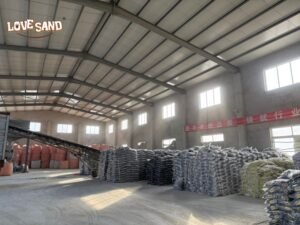
At LOVE SAND, we prefer to understand quality as a kind of “repeatability”.
Products produced today will still maintain the same standard three months later; In the first cabinet and the tenth cabinet, the experience that consumers get is as consistent as possible.
For B-end customers, this is more valuable than any slogan.
Buyer Insight | When you evaluate “low dust”, you might as well ask the supplier one more question.
Many buyers will ask suppliers for dust test results, which is a good start.
However, if we are going to cooperate for a long time, there is still one problem worth continuing to understand:
“How do you ensure that the products remain low in dust after long transportation?”
There is no standard answer to this question.
But a factory with real export experience usually doesn’t just answer a number.
They will talk about raw materials, particle structure, production control, packaging methods and quality management in the whole supply chain.
Because of low dust, it has never been completed by a certain link, but the result of a set of systems.
The fourth stop: a packaging bag protects not only the product.
At the end of the production line, the sound of machine running began to slow down.
Bags of filled cat litter slowly advance along the conveyor belt, after sealing, weighing, code spraying, and then neatly stacked on the tray.
If the previous process determines what a bag of cat litter is, then starting from here, we will pay attention to another thing-what state it will reach customers.
Many people will understand packaging as a part of brand display.
Whether the design is beautiful, whether the color is eye-catching and whether the Logo is prominent enough is of course very important.
But for export products, packaging has a more realistic task: protecting products.
After a bag of cat litter leaves the factory, it usually doesn’t reach the consumers immediately.
It may enter the container first and sail at sea for several weeks; Then it goes through port loading and unloading, warehouse stacking and truck transportation, and finally enters the supermarket shelves or e-commerce warehouses.
In this process, packaging is always the first barrier between the product and the external environment.
If the packaging structure is unreasonable, even if the quality of the product itself is stable, it may affect the first impression of consumers when they receive the product because of moisture, extrusion or transportation wear.
For brands, this influence is often more profound than a product complaint.
Because the moment consumers see the packaging, they have already begun to judge whether the brand is professional or not.
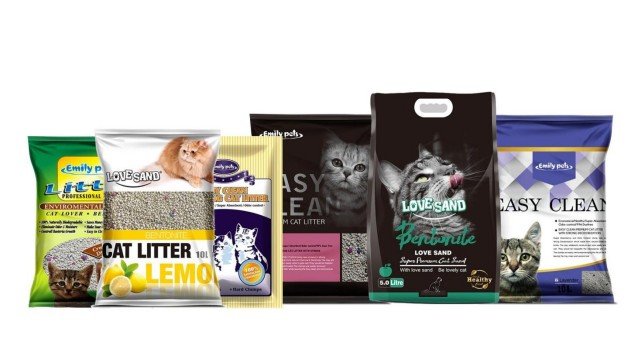
OEM packaging, not just printing a Logo.
At the beginning of many procurement projects, packaging design is the most discussed.
Some people have prepared a complete brand vision system, some people already have a mature packaging scheme, and some people just want to bring existing products to market quickly.
These demands are normal.
However, with the deepening of cooperation, we increasingly find that a mature OEM project really discusses more than just the design draft.
For example, do different packaging capacities meet the buying habits of the target market?
Can the packaging materials adapt to long-distance sea transportation?
Can the printing method ensure the consistency of colors in different batches?
These problems will not appear in consumer comments, but will directly affect brand operation.
At LOVE SAND, we prefer to regard packaging as a part of product development rather than the last step after production.
Because an excellent product should not start thinking about transportation after the packaging is completed, but should take the whole supply chain into account at the product design stage.
Real Buyer Scenario | When the brand starts to grow, the packaging needs to grow together.
An overseas customer chose the most basic packaging scheme at the initial stage of brand creation.
There is no problem in doing so.
For new brands that have just entered the market, controlling costs is always an important step.
As sales increased, they began to receive new feedback from dealers.
Some customers want packaging to be easier to display, some channels want to increase different capacity specifications, and some markets are beginning to pay attention to the consistency of brand vision.
At this time, they realized that packaging is not just a “bag for products”.
It began to undertake more tasks-helping consumers identify brands, improving shelf performance, and protecting the stability of products during the whole transportation process.
So, instead of changing products, they gradually optimized the packaging scheme.
The product is still the same product, but consumers’ perception of the brand has changed.
This is also the development path of many mature brands.
Truly sustainable brands rarely complete all designs at once, but constantly improve products and packaging in market feedback.
For OEM cooperation, this ability of continuous optimization is more valuable than one-off design.
Fifth stop: After leaving the factory, the quality management has not ended.
In the afternoon, the last batch of products were palletized.
The forklift slowly drove to the container loading area, and the staff reconfirmed the tray fixation, packaging status and container loading sequence.
For the production workshop, the day’s work is coming to an end.
But for a bag of cat litter ready for export, its real journey has just begun.
Many people think that after the product leaves the factory, it belongs to the logistics company.
In fact, for an OEM factory that has served overseas customers for a long time, quality management will not stop at the moment of cabinet loading.
Because what really faces consumers is not the product that has just been produced, but the bag of cat litter that finally appears on the retail shelves after several weeks of transportation.
If the packaging is damaged during transportation, the product gets wet, or there are obvious differences between different batches, consumers will not distinguish which link the problem occurs.
They only remember the brand.
For brands, this means that every link in the supply chain will affect the final evaluation of consumers.
This is why, when more and more mature buyers inspect suppliers, they no longer only pay attention to whether the factory has production capacity, but begin to understand whether the whole export process is mature.
They want to cooperate with a factory that can continuously deliver stable products, not a factory that can only complete production tasks.
Stable delivery is more important than one success.
For import and export projects, the successful completion of an order does not mean much.
It is the second cabinet, the fifth cabinet, the twentieth cabinet that really establishes the cooperative relationship, and even the continuous cooperation after several years.
Many international brands will put “Consistency” in a very important position when choosing suppliers.
There is a simple reason.
What brands fear most is not competition, but uncertainty.
If today’s products perform well and the quality changes next month, the brand needs to spend more time explaining, compensating and even winning back the trust of consumers.
In contrast, a factory that can continuously maintain product consistency is more likely to become a long-term development partner of the brand.
At LOVE SAND, we prefer to understand ourselves as a part of the supply chain, not just a production factory.
When products leave the factory, it is only a node of cooperation, not the end.
Brand development needs stable product support, and stability often comes from adhering to the same standards every time.
Editor’s Note | Why do we want to write this article?
Many articles about cat litter will introduce the agglomeration speed, dust rate or deodorization ability.
These contents are of course important.
But if we only stay in the product parameters, it is difficult to really understand why a product is recognized by the market.
For B-end buyers, choosing a cat litter is actually choosing a supply system.
From raw materials, production, quality control, to packaging, transportation and subsequent OEM support, every link will affect the final market performance.
We hope this article can answer a more important question than “which product is better”:
How is a bag of cat litter worth selling for a long time made?
At LOVE SAND, we believe that an excellent factory can not only produce products, but also help partners build long-term and stable brand competitiveness.
Conclusiones clave
If you only remember a few key points after reading this article, we hope they are the following:
The quality of a bag of real Dust-Free Mineral Sand is not determined by the last process, but runs through the whole production process.
100% Na-bentonite is only the foundation, and particle consistency, production control and transportation stability also affect the consumer experience.
Packaging not only undertakes the function of brand display, but also is an important part of protecting product quality.
For OEM brands, long-term and stable supply capacity has more commercial value than a low-cost purchase.
When choosing suppliers, we should pay more attention to how the factory manages the whole export process, not just the quotation.