
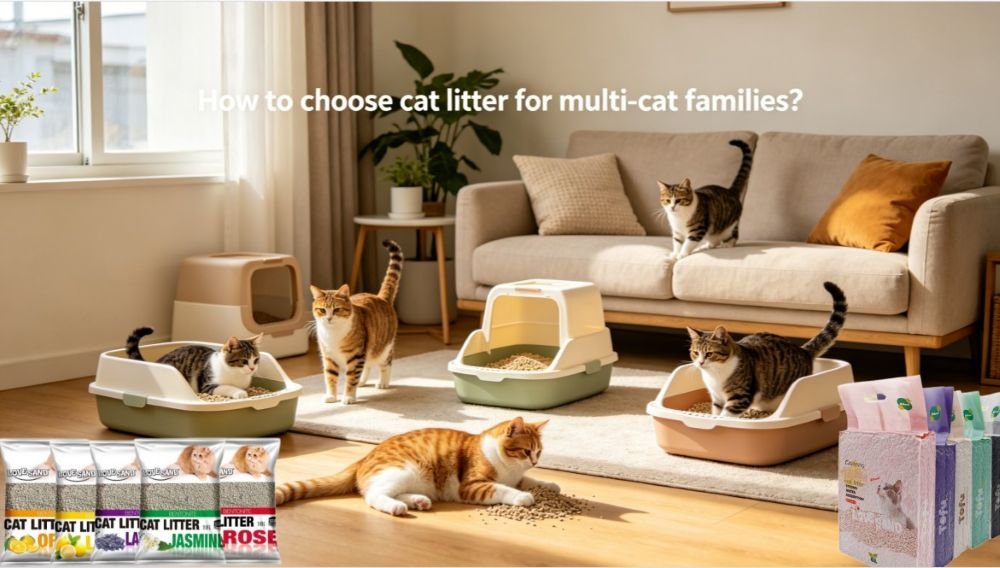
Choosing cat litter for a single cat is relatively simple and straightforward.
However, when multiple cats are kept in the same family, the requirements for cat litter will change significantly.
Odor accumulates faster, cat litter consumption doubles, and cleaning work becomes more frequent.
A product that performs well in a single cat environment may soon become inadequate in a multi-cat environment.
For this reason, choosing the right cat litter is very important to ensure family hygiene and achieve long-term cost-effectiveness.
Why do multi-cat families demand more cat litter?
Families with many cats will continue to put pressure on the performance of cat litter.
Every time a cat is added, the amount of urine, solid waste and the intensity of odor will increase. This cumulative effect will quickly weaken the efficacy of cat litter with poor performance.
What seems to be acceptable in a single cat environment is often stretched in the actual multi-cat use scene.
Increased odor load
Odor is the most significant challenge in a multi-cat environment.
The more cats there are, the more ammonia gas will be produced, and the faster the ammonia gas will accumulate in a closed space.
If cat litter can’t quickly neutralize or lock the odor generated by excrement, the odor will spread throughout the home.
This problem is particularly prominent in apartments or small living spaces.
The saturation speed of cat litter is accelerated.
The absorption capacity of cat litter to water is limited.
In a multi-cat family, the cat litter will reach saturation much faster.
Once it reaches saturation, its performance will drop sharply.
This will lead to problems such as wet bottom of the litter box, caking of the litter box, and leakage of peculiar smell that cannot be locked.
Put forward higher requirements for cleaning frequency.
Families with many cats need to clean the litter box more frequently.
If the caking performance of cat litter is poor, the cleaning work will become inefficient and laborious. This not only increases the workload of daily maintenance, but also reduces the satisfaction of users.
A well-designed cat litter should be able to minimize this burden.
Core performance requirements of cat litter for multiple cats.
Strong and fast clustering ability.
The ability to agglomerate is the basis of various properties of cat litter for multiple cats.
Rapid agglomeration can prevent urine from spreading and infiltrating into the whole cat litter box.
The compacted cat litter is not easy to break when cleaning and shoveling. This will help reduce the waste of cat litter and keep the remaining cat litter available for a longer period of time.
In this respect, high-quality sodium bentonite or mineral-based cat litter usually performs best.
High efficiency absorption
The absorption capacity determines the speed at which cat litter can treat liquid excrement.
In a multi-cat family, slow absorption will cause cat litter to stick to the bottom. This will not only cause health problems, but also produce unpleasant smells.
Efficient absorption capacity can reduce the difficulty of cleaning and improve the comfort of use.
Lasting deodorization
Deodorization effect must be sustained and effective, not a flash in the pan.
Activated carbon, zeolite and plant enzymes are commonly used deodorizing components. These materials can effectively adsorb or neutralize ammonia molecules.
Excellent deodorizing effect can reduce the need for frequent replacement of cat litter.
Low dust formula to improve indoor air quality.
With the increasing frequency of use, the problem of cat litter dust will become more and more obvious.
Cats shave sand many times a day, which will scatter fine particles into the air.
The low dust formula can improve the breathing comfort of pets and owners. This is especially important in indoor environment.
Anti-take-out performance
The more cats there are, the higher the frequency of going in and out of the litter box.
This will lead to a significant increase in the situation that cat litter is taken out.
Particle size, weight and surface texture will all affect the situation of cat litter.
Cat litter with heavy particles and regular shape can effectively reduce the chance of being taken out of the cat litter basin.
Comparison of common cat litter types
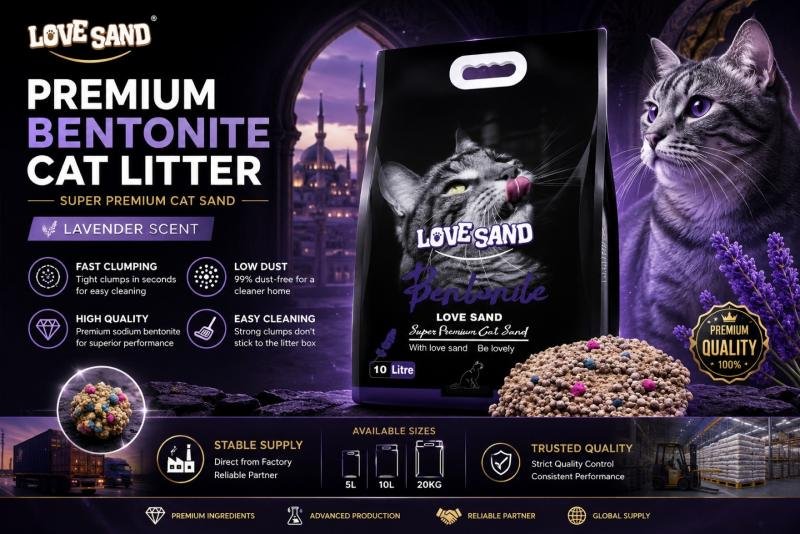
Bentonite cat litter
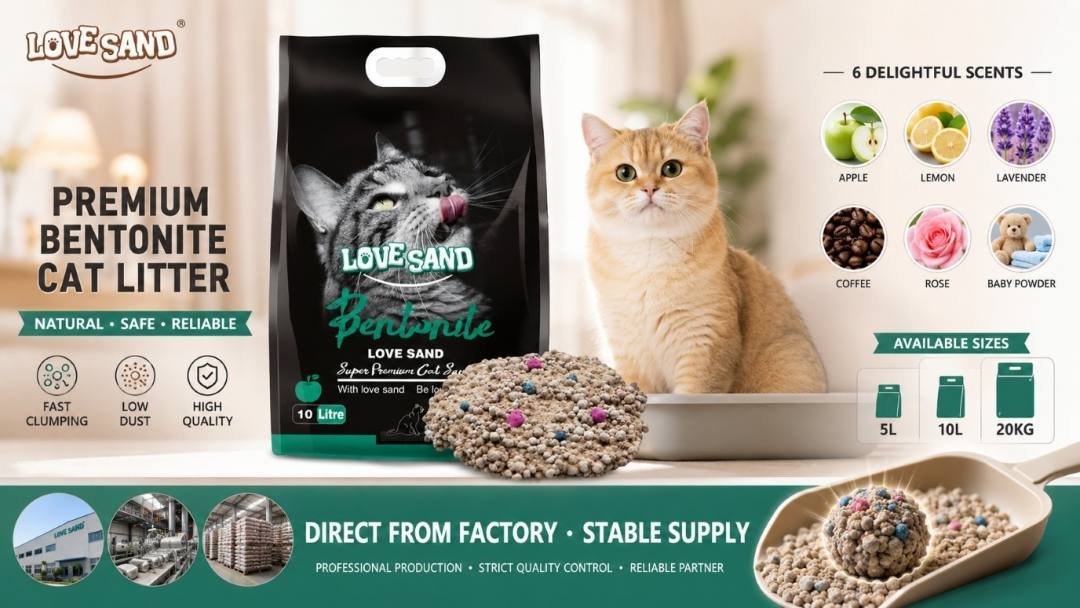
Bentonite is still one of the most popular cat litter types. It has strong agglomeration ability and reliable deodorization effect. In multi-cat families, high-quality sodium bentonite performs particularly well.
However, the degree of dust emission depends largely on the quality of processing technology.
Inferior bentonite may bring many troubles to daily maintenance.
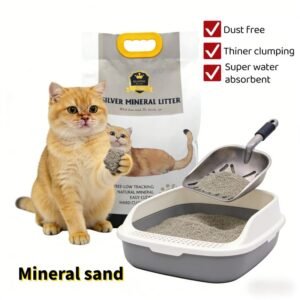
Mineral sand (100% sodium bentonite)
Mineral sand is an upgraded refined version of bentonite cat sand. It can quickly form a compact and moderately thick lump. This can not only reduce the waste of cat litter, but also improve the efficiency of shoveling excrement.
Its high density helps to reduce the cat litter and keep the environment clean and tidy.
In the high-end multi-cat family-specific product series, mineral sand is often the first choice.
The most important thing is that due to the outstanding caking performance, the caking is not fragile and does not pollute the cat litter basin, and the cat litter can be added directly afterwards.
Tofu cat litter
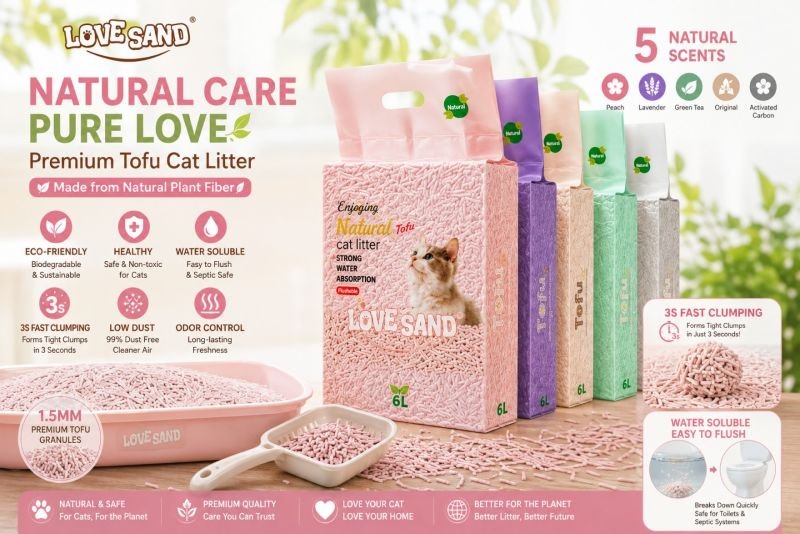
Tofu cat litter is a plant-based material with good environmental protection characteristics.
It has extremely low dust and is very safe for cats that are sensitive to physical fitness.
However, in a multi-cat family, tofu cat litter may need to be replaced more frequently.
If it is mixed with other materials, its comprehensive performance can be further improved.
It is more suitable for the environment with moderate intensity.
Silica gel cat litter
For multi-cat families, silica gel cat litter is usually not recommended.
Although it can absorb water, it can’t agglomerate.
In the case of frequent use, its water absorption capacity will quickly reach saturation.
Once it reaches the saturation limit, its deodorizing effect will be weakened.
It will perform better in families with only one cat or less frequent use.
Pine cat litter
This cat litter is very suitable for cat houses because of the high water absorption of 100% natural pine.
After absorbing urine, it can be quickly converted into powder, which is an economical choice for multi-cat families, especially cat houses.
But there are two problems that pine cat litter should pay attention to:
- Need to use a double-layer cat litter box.
- The excrement is poorly wrapped, which mainly depends on the natural properties of pine to achieve the deodorizing effect.
Practical Layout Strategy for Multi-cat Families
Choosing the right cat litter is only part of the solution.
Reasonable layout settings can significantly improve the overall use effect.
A general principle is: each cat is equipped with a litter box and an extra spare box is added.
Doing so will help ease the competition among cats and … make the amount of cat litter evenly distributed.
The thickness of cat litter is very important.
Insufficient thickness of cat litter will reduce the absorption efficiency. Laying a thicker layer of cat litter is helpful to improve the agglomeration effect and deodorization ability.
It can also prevent excrement from directly contacting the bottom tray.
Cleaning frequency
In a multi-cat family, cat litter must be cleaned frequently. Even high-quality cat litter, if it lacks daily maintenance, its performance will be greatly reduced.
Insist on daily cleaning, which can ensure that the cat litter basin always maintains a good sanitary condition and effectively controls the odor.
Ventilation and placement position
Good air circulation helps to reduce the accumulation of odor. The litter box should not be placed in a completely enclosed space.
Good ventilation environment can comprehensively improve the use effect of cat litter.
Cost-effectiveness of multi-cat family use
Many users often only pay attention to the unit price of cat litter.
But in a multi-cat family, the consumption efficiency (utilization rate) of cat litter is more critical.
Inferior cat litter usually needs to be replaced more frequently, and the replacement cycle of the whole cat litter basin is shorter.
Although its purchase unit price is low, frequent replacement will lead to an increase in the total monthly expenses.
In the long run, high-performance cat litter is more cost-effective.
The importer’s market perspective
Multi-cat families represent a high-value consumer group.
Such users tend to pay more attention to product performance rather than being too sensitive to price.
They are more inclined to continue to buy back products with stable and excellent quality.
Therefore, this group is very suitable as the target audience of high-end brand positioning strategy.
Providing different grades of product lines will help to gain a wider market share.
Final conclusion
Multi-cat families have higher and more advanced requirements for the performance of cat litter.
Agglomeration strength, deodorization ability and absorption efficiency are the most critical factors.
Choosing the right cat litter can significantly improve the daily cleaning and maintenance experience.
A well-designed cat litter product can not only reduce the cleaning burden of the owner, but also improve the overall satisfaction.
A deep understanding of these key factors will help both users and businesses make more informed decisions.
Frequently Asked Questions (FAQ)
Q1: What kind of cat litter is the best for a multi-cat family?
A1: Generally speaking, high-quality bentonite cat litter or mineral cat litter is the safest and most reliable choice.
Q2: Why is the litter box in a multi-cat family more likely to produce odor?
A2: Because the total amount of excrement is large, it will lead to the acceleration of ammonia generation, thus making the cat litter basin reach the odor saturation state faster.
Q3: Is Tofu Cat litter suitable for multi-cat families?
A3: You can use it, but you need to pay attention to the caking ability of tofu cat litter, or mix it with other types of cat litter.
Q4: How many litter boxes are needed for a multi-cat home?
A4: The industry standard is the ‘n+1 rule.’ You should provide one litter box for each cat, plus one additional box, to prevent territorial issues and hygiene breakdown.
Q5: How to reduce the odor in a multi-cat family?
A5: Use agglomerated cat litter, clean cat litter every day, and ensure good indoor ventilation.
One Response