The same bag of cat litter can be a bestseller in one country and a slow mover in another. The product did not change — the market did. In mature clay markets, buyers compare clumping and price per kilo. In eco-driven markets, they ask what it is made of and whether it can be flushed. In convenience-first markets, they ask how easy it is to live with.
Which is why cat litter raw materials selection was never about finding “the best cat litter.” It is about matching the right material to the right consumer — and for brands, importers and wholesalers, the material choice quietly decides which customer you serve, which price range you sit in, and which image your brand carries.
Who This Cat Litter Formula Guide Is For
For you if: you are a cat litter brand, importer or wholesaler choosing which raw material to develop for a specific market, and you want to compare materials by market fit rather than by reputation. Not for you if: you are an end consumer buying litter for one cat — for that household-level comparison, see our consumer guide to bentonite vs tofu sourcing.
Key Takeaways
- No formula is universally “best” — the right material is the one your market’s buyers will pay for repeatedly.
- Bentonite is the mass-market foundation: familiar, proven, low education cost — and the most crowded price battlefield.
- Tofu is the plant-based entry point: flushable, low-dust, premium-feeling — at a higher price point.
- Cassava gives plant-based brands a second story when the market is saturated with tofu.
- Dust-free mineral and water-soluble mineral innovate within clay — health and convenience as product upgrades.
- Mixed formulas blend materials to balance performance and cost, letting you test a new position without betting everything on one material.
- A multi-product manufacturer lets you start with one SKU and expand without rebuilding the supply chain.
Cat Litter Material Comparison 2026
| Material | Consumer Profile | Positioning | Role in a Brand Line |
| Bentonite (clay) | Price- and performance-focused mass market | Familiar value; low education cost | First SKU, volume base |
| Tofu (plant fiber) | Eco-conscious, convenience-seeking owners | Plant-based, flushable, low dust | Premium second line |
| Cassava (plant-based) | Plant-based buyers wanting something new | Differentiation within plant-based | Niche / differentiation SKU |
| Dust-free mineral sand | Mid-to-high-end clay users | Health and comfort upgrade | Upgrade SKU |
| Water-soluble mineral | Convenience-first households | Disposal innovation | Innovation SKU |
| Mixed formula | First-time and all-round owners | Balanced performance and cost | Flexible all-round option |
Bentonite Cat Litter — The Mass-Market Foundation
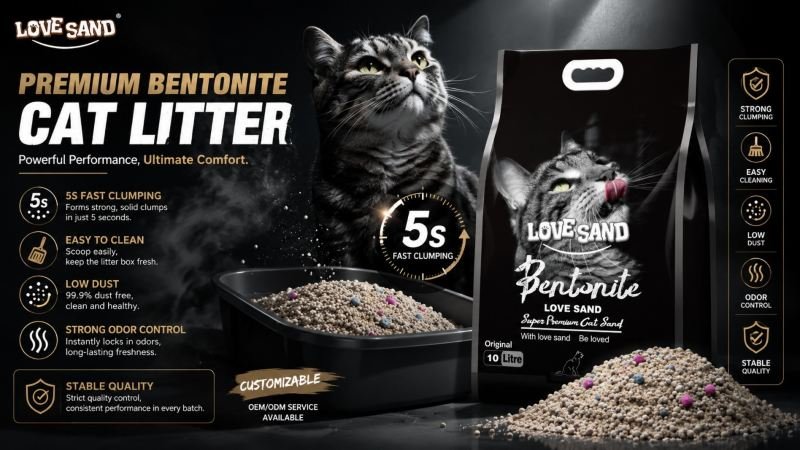
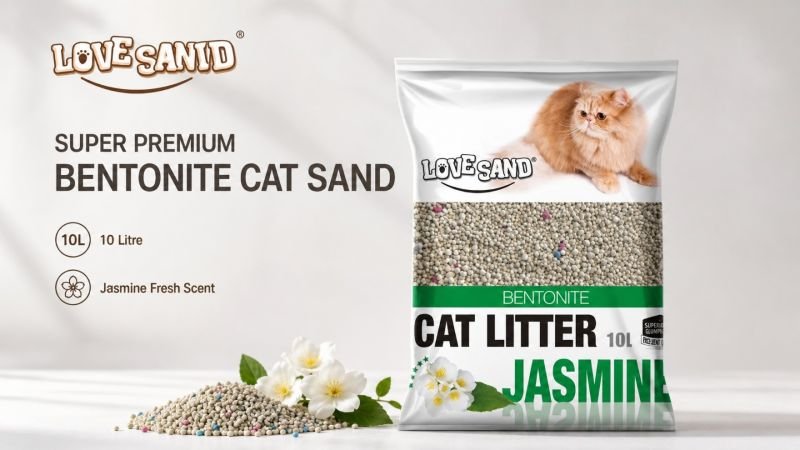
Even as plant-based and innovative litters keep arriving, bentonite cat litter holds a very stable consumer base. The reason is familiarity: bentonite generally clumps well, and consumers already know how to use it. For large retail channels, pet stores and wholesale markets, that maturity means low product-education cost. For a brand entering the market, bentonite is also the easiest product to understand — positioning can be built around clumping performance, low dust, odor control and granule size.
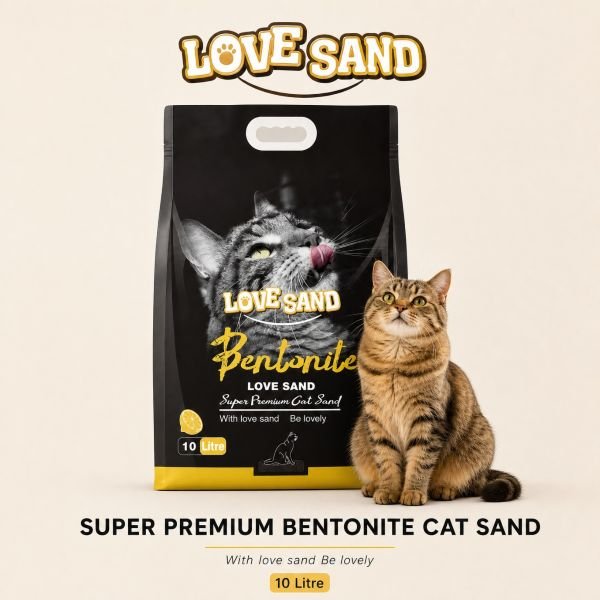
That said, bentonite competition is fierce. A brand cannot just take an ordinary product and sell it cheaper. The smarter path is differentiation through granule spec, dust performance, scent, packaging and overall positioning. In love sand’s product system, bentonite remains an important direction — and when we talk with overseas brands, the question we discuss most is whether they need a basic bentonite or a clearly positioned product within a mature category.
Tofu Cat Litter — The Plant-Based Entry Point
Tofu litter’s biggest market feature is its obvious plant-based identity. For a growing group of consumers, litter is no longer just a clumping consumable — they pay attention to what it is made of and how it feels to use. Tofu cat litter is built on plant fibers, clumps well, and is light and low-dust, which makes it the natural first choice for brands building a plant-based line.
For a brand, tofu’s value is not only the product itself but the positioning it enables — a different story from traditional clay. It suits brands that emphasize plant-based values, modern pet care or a premium image, and it works well as a second line beside bentonite: a brand that starts with bentonite and builds a customer base can later add tofu to give consumers a different option. At love sand, tofu is a long-term part of our system, offered in different specifications, granule shapes and directions per client need.
Cassava Cat Litter — Differentiation Within Plant-Based
Cassava litter sits in the same plant-based family as tofu but is not the same product — and for brands, that difference matters. If the market is already crowded with tofu, cassava becomes an alternative way to differentiate. Brands can build product stories on different plant raw materials instead of converging on one mature category. Our four-type comparison test shows how cassava actually behaves against bentonite, tofu and mineral sand.
Whether cassava works as a main product or a differentiating SKU depends on the target market. In markets with an established plant-based consumer base, it can be a main product; for brands just testing plant-based, it works as a niche SKU to learn consumer feedback through small-scale market tests. This is an important principle in B2B product development: a new product does not have to become the brand’s biggest product on day one. Sometimes a single SKU’s job is to test a new consumer group.
Dust-Free Mineral Sand — Upgrading the Clay Story
Many buyers treat mineral sand as a fully mature category. Mature, yes — but not without innovation space. Consumer expectations keep rising, and dust is one of the key factors. Dust-free mineral cat litter lets traditional clay litter enter a more segmented product market: for brands, it works as an upgrade product beyond basic mineral sand, especially for mid-to-high-end lines that emphasize a better use experience.
One common mistake: brands see “dust free” on many packages and put the same words on their own. But a real product position is not a single claim. Buyers also need to consider granule quality, absorption, use experience, packaging positioning, price range and sales channel. If these do not form one coherent position, a single feature will not build a brand difference. That is why product development should start from the whole formula and market position, not from a few keywords on the packaging.
Water-Soluble Mineral Cat Litter — Convenience as Innovation
Modern pet owners care more and more about daily convenience, and litter — a high-frequency consumable — is directly affected. Some brands now focus on products with different disposal methods, such as water-soluble mineral litter. For B2B clients, the value is escaping the traditional way of competing: instead of only comparing who clumps better, who is cheaper or who is dustier, brands can compare who is more convenient and who fits the consumer’s lifestyle better.
A note of caution: different countries have different requirements for litter disposal and related regulations. Brands developing this product must judge based on their target market’s reality rather than copying a product concept across all countries.
Mixed Formula Cat Litter — Blending for Balance
One of the most interesting trends in the industry: brands no longer have to choose between two materials. Different raw materials can be combined into a new product position. A tofu-bentonite blend, for example, combines plant-based identity with the clumping strength of clay; cassava-tofu combinations can become a differentiating direction inside a plant-based line. If you want an all-round option that hedges between materials, a mixed formula is the fastest route to test it.
For a brand, mixed formula means more development space: it helps find a performance-and-cost balance for a specific market, and it creates SKUs that are distinct from single-material products.
How to Choose Your First Formula by Market
Price-Sensitive, High-Volume Markets
Start with bentonite. Education cost is low, performance expectations are well understood, and the supply chain is mature. Differentiate with granule spec, dust control, packaging and positioning rather than price alone.
Eco-Conscious and Premium Markets
Consider tofu as the entry product, and cassava if tofu is already saturated. Plant-based consumers will pay more for flushability, low dust and a natural story — but they also judge whether the product lives up to that story.
Mid-to-High-End Clay Markets
Dust-free mineral sand upgrades the familiar clay experience. It suits channels where consumers already buy premium mineral litter and are sensitive to indoor air quality and tracking.
Convenience-Driven Markets
Water-soluble mineral litter targets households where disposal is the pain point. Verify local disposal regulations and consumer habits first — the concept cannot be copied blindly across markets.
Uncertain or New Markets
Use a mixed formula or start with a small test SKU. Let real sales data, rather than assumptions, tell you which material fits before you scale.
Three Questions to Answer Before Your First Product
New clients ask us the same thing: what should our first product be? The honest answer is that it depends on three market questions — not on what a supplier happens to have.
1. Who is your consumer?
If your consumers are highly price-sensitive, a basic bentonite builds volume fastest. If they care about plant-based products, consider tofu or cassava. If the brand position is premium, look at dust-free mineral sand or other functional products.
2. Which channel will you sell through?
Pet stores, supermarkets, e-commerce and specialty pet channels have different consumer demands. E-commerce emphasizes packaging and visual expression; specialty pet channels care more about performance and repeat purchase. Product positioning must be combined with the channel.
3. What product structure do you want the brand to have?
The most overlooked question. Do not only ask “what should we sell now?” — ask “what could we sell next?” If the goal is a complete cat litter brand, a manufacturer that can supply multiple materials gives you far more room than a supplier with one product.
Why a Multi-Product Manufacturer Expands Your Options
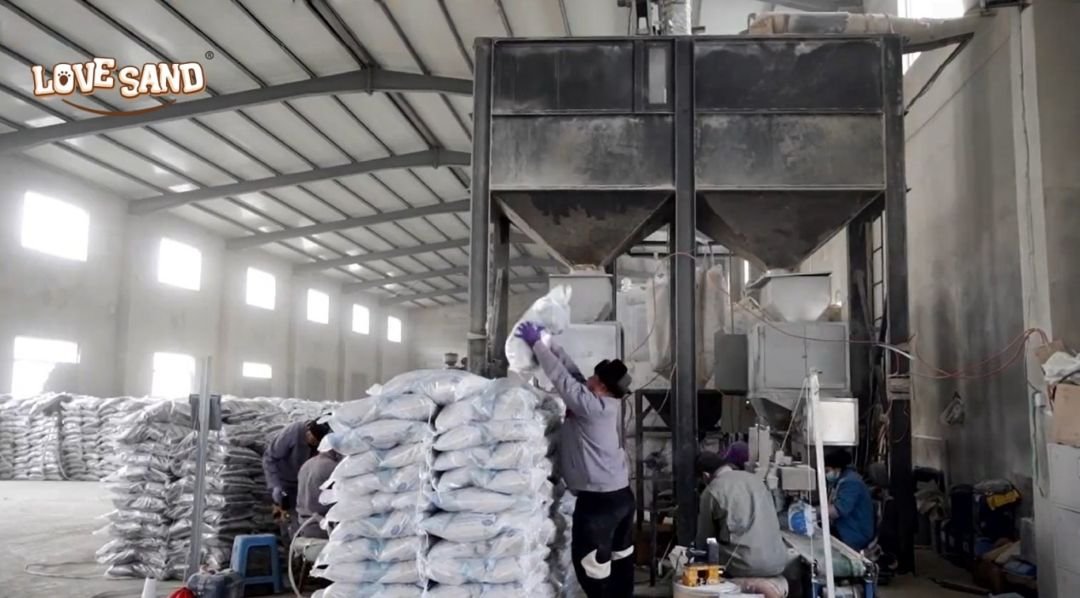
love sand does not produce around a single category. Our product system covers bentonite cat litter, tofu cat litter, cassava cat litter, mineral sand and mixed formula cat litter. The value for B2B clients is not “many products” in itself — it is that a brand can develop step by step: start with bentonite to build market foundation, add tofu later, then develop cassava or mixed formulas according to the target consumers. Clients with mature channels can enrich the matrix with dust-free mineral sand or other functional products. The payoff: you do not need to rebuild the supply chain every time the product line upgrades.
Buyer Tips|Formula Selection Checklist
Before locking in a formula, do not only ask the supplier for a price. Work through at least these five points:
- Target market — does the market value price, performance, plant-based identity or convenience?
- Sales channel — will the product go into pet stores, supermarkets, e-commerce or specialty channels?
- Product positioning — mass market, mid-range, or a higher-end segment?
- Product portfolio — is this the brand’s only SKU, or part of a future matrix?
- Supply capability — can the current supplier support different litter types and future development?
A mature product plan considers market, product and supply chain together — not just unit price.
FAQ|Formula Selection Questions from B2B Clients
Q1. Is bentonite cat litter still worth developing for a new brand?
Q2. Can tofu and cassava cat litter coexist in one brand line?
Q3. Why should a brand consider mixed formula cat litter?
Q4. Can love sand help a brand develop different types of cat litter?
Q5. Which formula should a first-time brand choose?
Q6. How do disposal regulations affect formula choice?
Conclusion|The Right Formula Is Part of Your Brand Position
For a B2B buyer, choosing cat litter raw materials is not simple product purchasing — it is part of brand positioning. Bentonite helps a brand enter the mature mass market; tofu and cassava provide plant-based directions; dust-free mineral sand opens a more segmented clay market; water-soluble products innovate around convenience; and mixed formula gives room to keep developing.
No cat litter can be defined as “the best product” in isolation. What matters is whether it fits your consumers, your channel and your brand position. This is one reason love sand built a multi-category product system: we want to give brands in different markets more choices, not require every client to sell the same litter. For importers, wholesalers and private-label brands developing new products, a manufacturer with multiple cat litter capabilities makes product development more flexible — start from the first SKU, then build a complete line step by step. That usually serves long-term brand development better than chasing a wide range at once.
Reviewed by: love sand pet-litter product team (Puyuan Dalian Pet Products Co., Ltd.). Last updated: 2026-09-07.
More about the manufacturer: About love sand