Two things decide whether a cat litter SKU makes money. One is what the container weighs when it leaves the port. The other is what the shelf will pay for the bag. Single-material litter usually wins on one and loses on the other.
Pure bentonite is cheap per tonne and heavy per litre, so a 40-foot box runs out of payload before it runs out of space. Pure tofu sits light and sells on the plant story, but the raw material has climbed year after year, and buyers keep sending back the same complaint: after a long soak, the bottom of the tray turns to paste.
Mixing two materials is how most factories got out of that corner.
Adding a second material can improve the balance, but the result depends on the ratio and on how the materials are handled during production and shipping. Two ingredients that look well mixed in a sample bag can separate during a month at sea if the granule sizes and packing method are not suitable.
This guide compares two common routes: tofu with cassava and tofu with bentonite. It explains what the main ratios are intended to do, how to check the blend, how to choose a container and which details should be agreed before the first order.
The Main Blend Options
| Blend | Ratio | What it solves | Where it sells |
| Tofu + cassava | 70% tofu / 30% cassava | Clumps releasing from the tray floor | Premium plant-based ranges in the EU, Japan, Korea |
| Tofu + cassava | 50% tofu / 50% cassava | Clump hardness for rotating screens | Self-cleaning litter box channels |
| Bentonite + tofu | 70% bentonite / 30% tofu | Cost per tonne and a shelf upgrade for mineral brands | Mass retail, discount chains, price-led markets |
| Tofu + bentonite | 70% tofu / 30% bentonite | A cheaper tofu alternative with faster clumping | E-commerce listings competing on price |
Why Single-Material Litter Stopped Working
The two complaints that push buyers toward a blend are not really about performance in the abstract. They are about money and reviews.
Tofu: the raw material price and the mush at the bottom
فضلات التوفو is built from plant fiber, starch and a small amount of guar gum, usually between one and two percent, which is what gives the granule its toughness. The fiber is hygroscopic. When a cat urinates in the same corner every day, or the urine reaches the plastic at the base of the tray, soaked granules turn into a gel and bond to the wall.
Scooping that is a chore. Push too hard and the clump breaks apart, which soils the rest of the tray. Wash the box and you are scraping with a brush. A handful of photo reviews on that theme will pull down conversion on a listing faster than any price move.
Bentonite: the container hits its weight limit first
البنتونيت is rock. A 40-foot high cube fills easily with light consumer goods, but load pure bentonite and the box is often half full by volume when the payload reaches the 21 to 24 tonne ceiling that road limits and shipping lines impose. The buyer pays a full container of freight for half a container of product, and every bag carries that overhead.
There is a shelf problem too. In plenty of mid and upper-tier stores, plain mineral litter is filed under the old low-cost category, and the retail margin stays thin no matter how good the clumping is.
Route One: Tofu with Cassava, the Experience Play
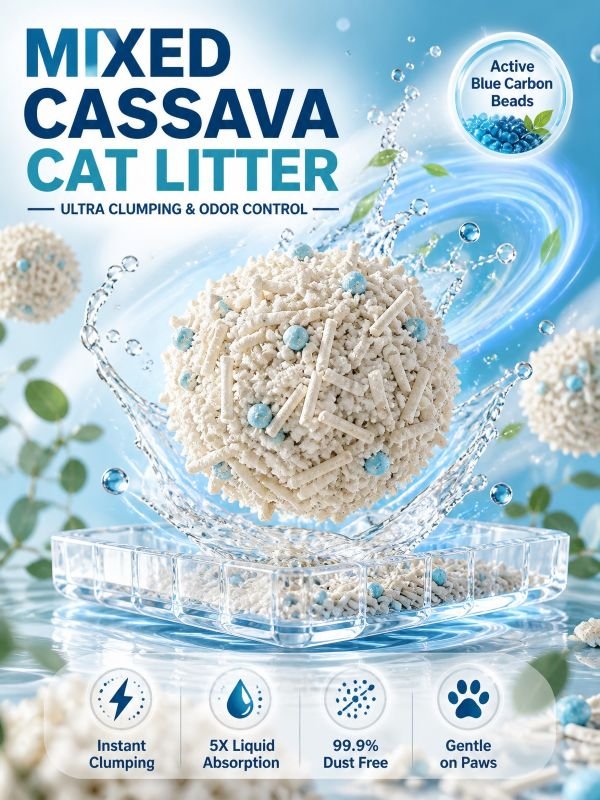
This is the route for markets where the customer reads the back of the pack and cares what is in it. Both materials are plant-based, so the formula carries no mineral content at all.
Why cassava stops the clump from welding to the tray
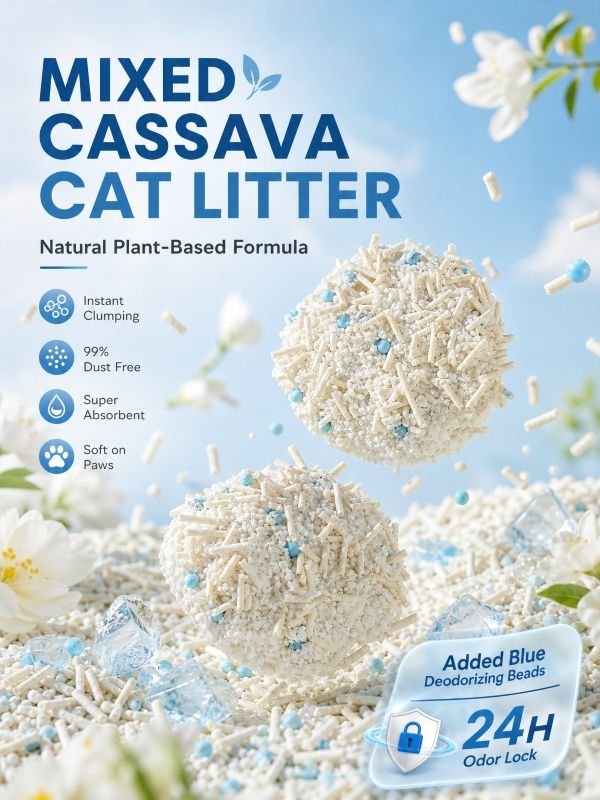
Cassava starch is high in amylopectin, and that changes how it behaves on contact with liquid. Instead of breaking down into loose mud the way pea fiber does, it gelatinises quickly into a firm gel block. The block has low adhesion to a smooth plastic surface, so when the urine reaches the tray floor, the underside of the clump comes away flat and clean. Slide a scoop under the edge and the whole piece lifts.
On the line we treat that as the single measurable reason to pay for cassava. In our trials, close to 80% of the sticking complaints that come with a straight tofu SKU disappear once cassava is 30% of the fill.
What the tofu strip contributes
Load a bag with nothing but fine cassava granules and the litter tracks everywhere. The particles are small, they work into a cat’s paw pads, and long-haired cats carry them across the floor. The tofu side of the blend fixes that.
Our tofu granules are cylindrical, 1.5 mm in diameter with a 3 to 10 mm length, which is the shape that lets them stack into a loose lattice rather than settling into a solid mass. That lattice does two jobs. It pulls liquid down into the top layer instead of letting it run straight to the bottom, and it traps the smaller cassava particles in the gaps so they stop travelling.
70% tofu with 30% cassava, the standard seller
This is the ratio most of our plant-blend volume ships at. Open the bag and it still reads as tofu litter, strips in the majority with cassava scattered evenly through. Absorption and flushability behave the way a tofu customer expects, because the tofu is still the bulk of the fill.
It suits a brand that already sells tofu and wants to upgrade the formula without alarming the existing customer. The product looks familiar, the price moves modestly, and the complaints about the tray floor drop.
50% tofu with 50% cassava, the automatic-box formula
Push cassava to half the fill and the clump gets hard fast, inside about three seconds, firm enough that squeezing it between thumb and finger does not crumble it. That is what a rotating self-cleaning box needs. The screen lifts a soft clump and it smears across the mesh; lift a hard one and it drops cleanly into the waste drawer.
This ratio costs more per tonne, so it belongs in a channel where the customer has already spent several hundred dollars on the box. Selling it as a value line is the wrong move.
Who buys the plant route
Two types show up. Premium specialist retail in Europe, Japan, Korea and the big Southeast Asian cities, where a fully plant-based, biodegradable formula is a purchasing condition rather than a nice-to-have, and the pack can carry a plant-based claim without a mineral caveat. The other is the urban household that has already decided the daily scraping is worth two or three dollars a bag to avoid.
Both groups read labels. Before a plant claim goes on a pack, confirm what the destination market allows, because the wording rules differ more than most buyers expect.
Route Two: Tofu with Bentonite, the Volume Play
This route exists for a different shelf. Mass grocery, discount chains, and price-sensitive markets in Latin America, the Middle East and parts of Southeast Asia. Here the buyer is not paying for a story. They are paying for a bag that clumps and does not cost much.
Where the saving comes from
Sodium bentonite at the specification we run, montmorillonite at 80% or above, is a fraction of the cost of plant fiber per tonne. Blending the two is the most direct lever a buyer has on landed cost, short of changing the packaging.
Our own costing puts the difference at 25% to 35% off the ex-works tonne price once bentonite is 30% to 50% of the fill, holding absorption and clumping roughly where they were. That spread is what funds a retailer’s promotional calendar, and it is usually the difference between winning a listing and losing it to the brand next door.
70% bentonite with 30% tofu, the mineral upgrade
Aimed at a brand already selling straight bentonite that wants a mid-tier step without rebuilding its supply chain. Thirty percent tofu strips, plain or scented, scattered through the mineral base changes how the bag looks on shelf. Grey becomes something more colourful, and a clear window turns that into a selling point.
There is a functional gain as well. The porous structure of the plant fiber catches some of the ammonia that mineral alone leaves behind, and the dust profile improves because the strips displace fine clay at the top of the bag.

70% tofu with 30% bentonite, the e-commerce fighter
The mirror image, for listings where the customer wants tofu but balks at the price. Most of the bag is tofu strip, so it reads as tofu on arrival, while the bentonite underneath acts as a fast-absorbing base. Clumping is quicker than straight tofu, and the retail price can be set lower than the category leader.
One thing to settle before this goes to print. Because the bentonite does not dissolve, this blend cannot carry a flushable claim, even at 30%. The pack needs to say dispose with household waste. Buyers who have been burned by a compliance complaint in Europe or Australia tend to raise this before we do.
Keeping the Blend From Separating in Transit
A ratio that looks right in a sample bag can arrive as two layers after a month at sea. This is the failure buyers actually remember, and it comes from geometry more than from mixing time.
Break the mineral down to 1 to 2 mm so it wedges between the strips
Round bentonite spheres in a bed of long strips will roll downward under vibration. The gaps between strips are wider than the spheres, so nothing stops them. Break the clay into irregular 1 to 2 mm fragments and the sharp edges catch in the lattice instead. The two materials lock against each other, and neither can migrate far.
Mix slowly and cushion the drop
Tofu strips are brittle. A standard high-speed vertical mixer will pulverise them before the batch is even uniform. We run horizontal twin-ribbon mixers at low speed, where the material is folded rather than thrown, and every discharge pipe carries silicone baffles to take the impact out of the fall.
The target we hold is a top-to-bottom ratio deviation within plus or minus 2% in every finished bag. That is checked by sampling, not assumed from the setpoint.
Export Practicalities: Moisture, Dust, Packaging and Container Math
A good formula still fails if the container arrives with mould or a bag of powder. Four items carry most of that risk.
Moisture held at 5% to 8%, and cooled before bagging
A steel box crossing the equator swings from over 50 degrees in the afternoon to much colder at night, and condensation follows. Plant material that goes in warm will sweat inside the bag. We hold finished moisture between 5% and 8%, measured online through the run, and every batch passes a cooling tower before it reaches the packing head. Get that right, with a sealed liner, and an 18 to 24 month ambient shelf life is realistic.
Dust below 0.5% on mixed formulas
Two materials rubbing together in a mixer generate dust that neither would produce alone. Negative-pressure pulse-jet bag filters sit at the mixer inlet and outlet, the vibrating screen and the packing hopper, and finished mixed litter is held below 0.5% dust. That number matters more than it sounds. It is the claim a customer can test in three seconds by opening the bag.
Vacuum brick packs for anything containing plant fiber
For a 6 litre pack, roughly 2.4 to 2.5 kg, we recommend a rectangular vacuum brick. Once the air is out, the bag behaves like a solid block, the granules have no room to move against each other, and breakage over a month of vibration drops to almost nothing. Flat-sided bricks also stack tightly on a pallet, which raises container utilisation compared with rounded bags.
If the buyer wants a softer gusseted bag instead, the line runs a double vibrating air-sift after mixing, and the cartons go to five-layer corrugated so the bottom layer is not crushed by the weight above.
Container choice follows density, not habit
The plant blend is light for its volume, so it cubes out. Load it into a 40-foot high cube and 19 to 21 tonnes is typical, which works out at roughly 8,000 to 9,000 vacuum packs. Freight per bag is at its lowest there.
Once bentonite passes 50% of the fill, the blend turns into heavy cargo. The box reaches its payload ceiling with space still visible, so a 20-foot general purpose container at 18 to 20 tonnes is the better arithmetic. Filling a small box to its weight limit is how the per-bag freight number stays sane.
Order terms, sampling and lead time
Standard scents and ratios are held as samples and dispatch within 3 to 5 days by courier. A custom ratio, say 60/40 or a specific deodorising granule, goes to the lab and usually comes back within a week.
The entry point is one 20-foot container. To help a new brand test without committing a full container to a single SKU, we allow two or three scents or pack formats to share the load, subject to print space on the bag.
On timing, a first order with new packaging needs film blowing, bag making and gravure printing, which runs 12 to 15 days. Scheduling, mixing, packing, vacuuming and palletising add 7 to 10 days, so a first container is normally 25 to 30 days from artwork approval to the port. A repeat order on existing bags usually lands inside 15 to 20 days. More on scheduling sits under sourcing and delivery time.
Adding Fragrance and Functional Granules
Scent carries further in a blend than in a single material, because the plant fraction holds it and releases it slowly. Available profiles include apple, lemon, lavender, rose, coffee, green tea, orange, strawberry, peach, jasmine, baby powder and soybean original, with an exclusive profile possible for one brand.
On the functional side, activated carbon, baking soda and silver ions can go in at 2% to 5%. Coloured deodorising granules are another option. The cost is modest, tens of yuan per tonne up to around a hundred depending on the additive, and it gives a listing a second claim beyond clumping.
الأسئلة الشائعة
Can a tofu and cassava blend be flushed?
Can a blend containing bentonite carry a flushable or fully eco claim?
What is the minimum order, and can one container hold two formulas?
Will the blend separate during a month at sea?
Which ratio should a first-time buyer start with?
How does a mixed formula compare with straight bentonite on cost?
Do you develop custom ratios?
The Factory Behind These Lines
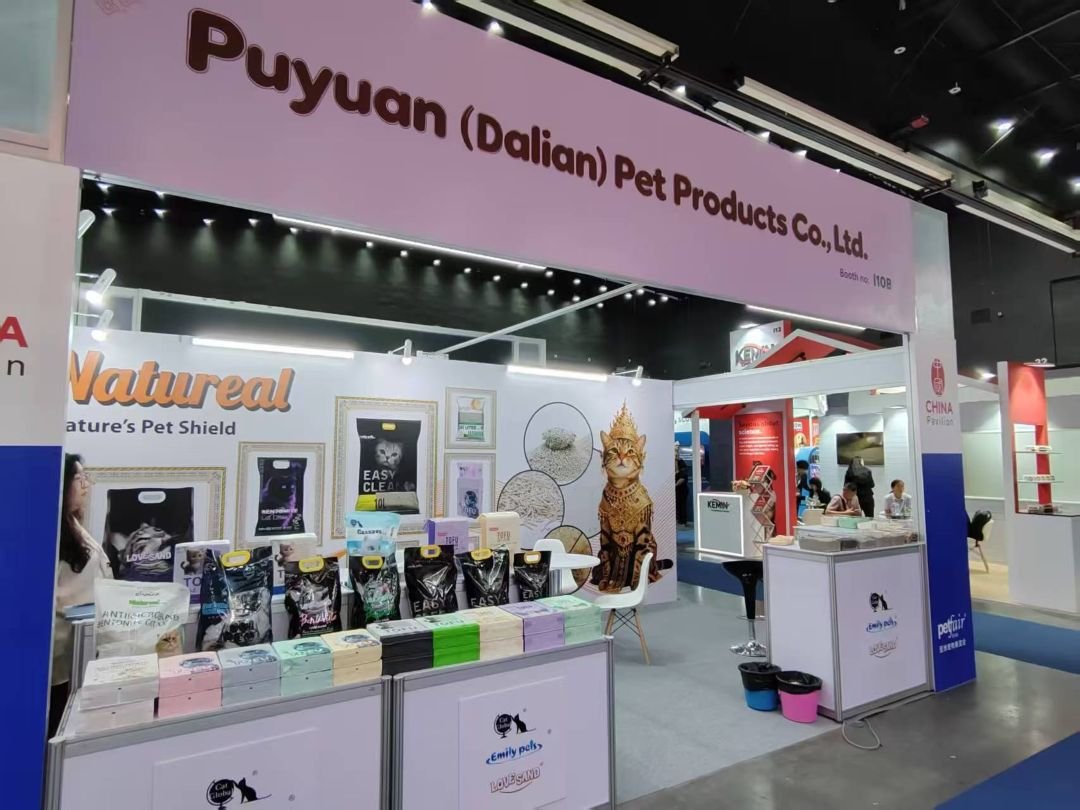
LOVE SAND is the export brand of Puyuan (Dalian) Pet Products Co., Ltd., a manufacturer established in 2000 and working in the pet industry for more than 25 years. The site covers 60,000 m², with 20,000 m² under roof, and runs 13 production lines: six for bentonite, two for tofu and one for cassava, alongside the wood-based lines. Annual capacity stands at 300,000 tonnes, exports reach more than 86 countries, and the plant holds SGS, BSCI, ISO, CE, EPA and REACH certification. Containers load at Dayao Bay in Dalian.
That matters less as a credential list and more as a scheduling fact. A blended order needs both raw materials in stock at the same time, and a plant running its own lines can hold that allocation rather than buying one component in from a third party when a container is due.
الخاتمة
Between the two routes, the decision is not which formula is better. It is which shelf you are selling into. Plant-led blends buy you a premium position and a story the customer will pay for. Mineral-led blends buy you a cost base that survives a discount war.
Bring us the target market, the retail price band and the rough volume, and we will propose the ratio against those three rather than against a catalogue. Write to chloe@love-sand.com or send a WhatsApp to +86 13052774957, or send the requirement through the contact form. Samples are free, freight is on the buyer’s account, and they usually land within 7 to 10 days.
Reviewed by: love sand pet-litter product team (Puyuan Dalian Pet Products Co., Ltd.). Last updated: 2026-10-20.
المزيد عن الشركة المصنعة: About love sand