One of the biggest headaches in raising cats is to find that the cat litter is firmly stuck to the bottom of the basin when shoveling excrement. Scraping with a shovel can’t be cleaned; Knock hard, and the litter box will bang; Soaking in water is both time-consuming and water-consuming.
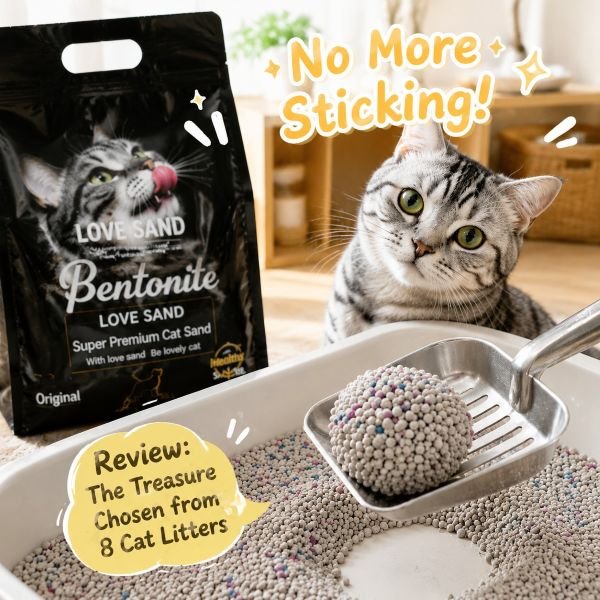
In order to find a cat litter that really doesn’t stick to the bottom, we decided to do an actual non sticky cat litter review, measurement-open 8 pots of cat litter at the same time, simulate the real use scene, and record their sticky bottom, caking quality and use experience. It turned out that there were some unexpected findings.
Why does cat litter stick to the bottom?
Before entering the actual measurement, let’s briefly talk about the causes of sticking to the bottom.
Cat litter sticking to the bottom is mainly related to three factors:
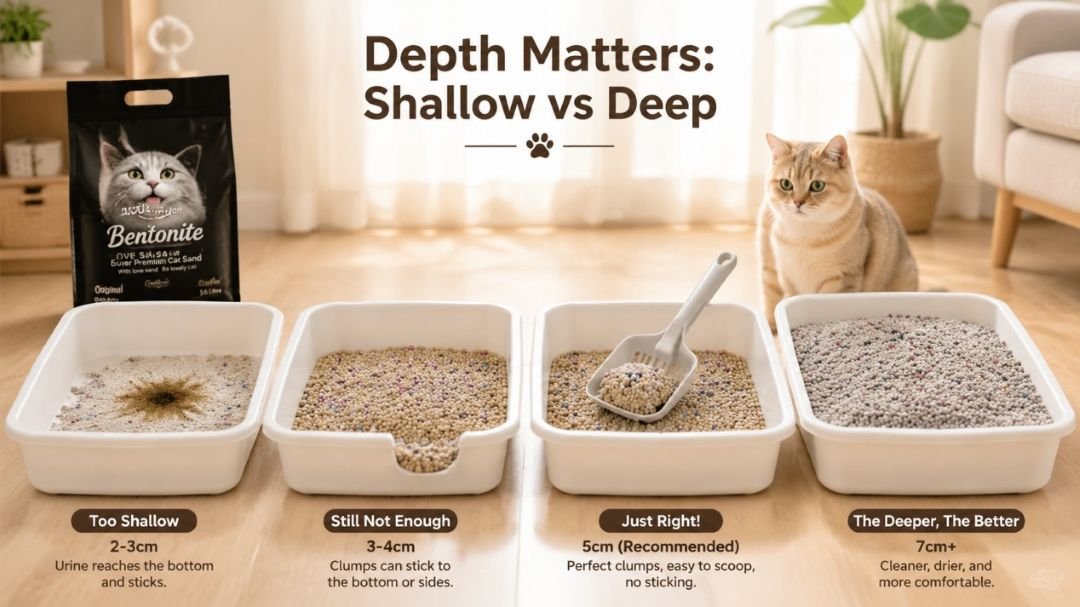
The cat litter is too thin. The cat litter is not deep enough, so the urine directly penetrates to the bottom and naturally sticks to the bottom of the basin. It is generally recommended to lay 3 to 5 cm thick.
Cat litter doesn’t agglomerate fast enough. If the cat litter absorbs water and clumps slowly, the urine will “seep down” first and then clump, which is equal to the knot on the bottom of the basin.
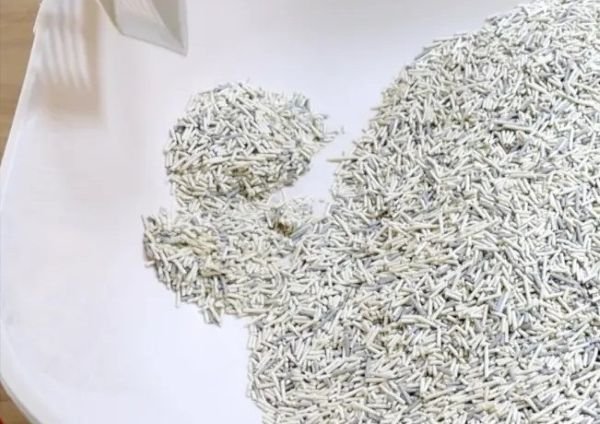
Cat litter particles are too fine or the powder content is too high. Powder turns into mud when it meets water and sticks firmly to the bottom of the basin.
Therefore, if you want to find cat litter that doesn’t stick to the bottom, you should start from two directions: “laying cat litter thick enough+grouping quickly”.
Actually measured setting
Test method: Open 8 cat litter pots at the same time, and pour the cat litter into each pot at the same depth (about 5 cm). Use the same bentonite cat litter for each basin, but adjust a variable-such as the sand thickness, the particle size of cat litter, whether to mix tofu sand, etc. Of course, you can also use different brands of cat litter for comparison.
Test cycle: use it continuously for 7 days, shovel excrement twice a day (once in the morning and once in the evening), and record the bottom sticking situation each time.
Judgment standard:
Non-sticking to the bottom: the lumps can be completely scooped up and the basin bottom is clean.
Slightly sticking to the bottom: there is a thin layer left, which can be scraped off with a shovel.
Severe adhesion to the bottom: the lumps are tightly attached to the bottom of the basin and need to be soaked to clean up.
Measured results
The following are six key findings of this survey:
Discovery 1: The thickness of sand laying directly determines the degree of bottom sticking.
This is the core discovery. Spread a 3 cm basin and stick to the bottom almost every day; Laying pots more than 5 cm will greatly reduce the bottom sticking. The thickness of cat litter is a “buffer layer”, which is thick enough to stop urine halfway, instead of letting it agglomerate at the bottom of the basin.
Discovery 2: Large particles of cat litter are less likely to stick to the bottom than fine particles.
Although the fine cat litter has a good foot feeling, it has a high density and a small gap, so urine is not easy to seep down quickly, but it is easy to paste at the bottom. The gap between large particles is large, so urine can be dispersed and absorbed more quickly, and the lumps are more inclined to “suspend” in the sand layer than to stick to the basin bottom.
Discovery 3: The bottom adhesion of mixed cat litter is lower than that of pure bentonite.
The 7:3 mixed formula of tofu sand and bentonite is outstanding. Tofu sand particles are large, supporting the “skeleton” inside the cat sand layer, and urine is not easy to penetrate to the bottom. Bentonite is responsible for agglomeration, tofu sand is responsible for interlayer, and the coordination effect is good.
Discovery 4: Shovel twice a day is much less sticky than shovel once a day.
This discovery may not be a surprise, but it is obvious. The longer the urine stays in the cat litter, the more chance it will penetrate to the bottom and agglomerate there. Shovel off the wet mass in time, which can keep the clean dry sand “buffering” continuously.
Discovery 5: If the same basin is used for a long time, the bottom adhesion will become more and more serious.
On the 5th and 6th day, the bottom adhesion of all pots was getting worse. This is because fine dust and debris have accumulated at the bottom of the cat litter-these are the precursors of “mudding”. It is recommended to completely change the sand and clean the cat litter box every 2 to 3 weeks, instead of just adding it.
Discovery 6: The truth of “not sticking to the bottom” may not be so beautiful.
The most unexpected discovery in the actual measurement is that there is almost no cat litter that is completely “non-sticky”. Even the best performing pot will still have a slight residue after the third day. This is because urine is liquid. As long as the cat litter layer is not “perfect”, some will always seep to the bottom.
Instead of pursuing “completely non-sticky”, it is better to focus on “easy cleaning”-choose cat litter that is compact and not easy to break, and even if it sticks to the bottom slightly, it can be shoveled away cleanly without soaking in water or scraping hard.
Practical suggestion: How can I stick to the bottom less?
According to the actual measurement, I give you some practical suggestions:
Spread the cat litter thicker: at least 5 cm, preferably 6 to 7 cm. Thickness is the first line of defense.
Choosing fast-agglomerated cat litter: sodium bentonite or 7:3 mixed cat litter is better in this respect.
Shovel at least twice a day: reduce the retention time of urine in the sand layer.
Replace the whole basin regularly: don’t just add it without changing it. The more dust accumulated at the bottom, the greater the probability of sticking to the bottom.
The material of cat litter basin also has an impact: the plastic basin has scratches on its surface after being used for a long time, and urine is easy to seep into the scratches, which is more difficult to clean. Consider changing the litter box regularly.
The Sticky Bottom Experiment: Why It Happens & How to Fix It
| The Hidden Culprit: Why It Sticks | The Real-World Impact on Your Shovel | Science-Backed Fix (From Our 8-Pan Test) |
| Litter Layer is Too Thin | Urine seeps straight straight through the gaps, hitting the plastic bottom before it can clump. | Maintain 5 to 7 cm depth. If your cat is a deep digger, aim for the higher end to create a safe liquid buffer. |
| Slow Clumping Speed | Delayed absorption allows liquid to gravity-drain downward, forming a hard crust at the base. | Upgrade your material. Avoid cheap, slow-setting clay; look for fast-hydrating formulas that lock liquid instantly. |
| High Powder/Dust Content | Excess factory dust or broken particles mix with moisture and turn into a sticky, stubborn paste. | Screen for low-dust litters. Pure fine bentonite easily turns to mud; a granulated blend prevents this paste formation. |
| Scratched Litter Box Basin | Micro-scratches from old plastic claws grip the urine clump, making it almost impossible to scrape off. | Dry & Replace. Let sticky clumps dry for 1-2 hours to shrink before scooping. Replace old scratched plastic trays regularly. |
الملخص
After measuring 8 pots of cat litter, the biggest feeling is that “non-sticking to the bottom” is not solved by a certain cat litter, but by “suitable cat litter+correct usage habits”.
Instead of spending a lot of money to pursue the so-called “magic sand”, it is better to spread the cat litter thick, shovel it frequently and change it regularly. On this basis, the problem of sticking to the bottom can be solved by choosing a well-agglomerated cat litter. The rest, as a cat’s daily practice.
Out of all 8 setups we tested, pure fine clay often turned into mud at the base, but the 7:3 formula gave us the cleanest scoop. If you want to replicate these exact non-stick results at home, try our champion blend. Check out Love Sand’s Premium 7:3 Tofu & Bentonite Mixed Cat Litter Bulk Options—specifically engineered to stop urine from hitting the basin floor.