After more than 20 years in cat litter exports, we have met every kind of buyer: cross-border sellers who cannot fill a 20-foot container, and distributors who have run their home markets for a decade. The ones who succeed share one habit — they invested real effort in supplier selection. The ones who got burned by their supply chain almost always fell into the same traps: low-price temptation, traders posing as factories, samples that differ from bulk shipments, and peak-season stockouts. This guide turns supplier selection into an executable method, written from the factory’s side of the table. Follow the checklists and you will avoid most of the common pitfalls.
Who This Guide Is For
مناسب لك إذا: you are a distributor, importer, or wholesale buyer selecting a cat litter bulk supplier for the first time — or rebuilding your supplier base after a bad experience — and you need practical tools for factory verification, quality inspection, and contract negotiation.
Not for you if: you are a retail consumer comparing brands at the pet store — this is a B2B sourcing guide.
أهم النقاط
- Distinguish factory from trader before discussing price: real-time photos, a scheduled video audit, and a business-license check with “production” in the scope separate genuine manufacturers from intermediaries.
- A factory audit covers four zones — raw material warehouse, production line, QC department, and finished-goods/packing area — and the conditions you see there predict product quality better than any sales deck.
- Audit results must be cross-verified: retest samples against warehouse stock, contact 2–3 reference customers, and put every verbal promise into the contract.
- Certifications are hard gates: BSCI, CE, MSDS, and a full export-documentation capability — plus real experience with dust-classified customs declarations.
- OEM/ODM partners must be tested on four questions before signing: formula freedom, sampling process and fees, packaging and MOQ terms, and lead-time commitments written into the contract.
- Lead time deserves the same weight as price: a stockout during the September–February peak season loses channel trust that takes seasons to rebuild.
- A structured 100-point scoring table — evaluated independently by purchasing, QC, and sales — turns supplier selection from a gut call into a team decision.
Trader or Factory: Decide Before You Talk Price
A common pattern in the export trade: the same product quoted at very different prices, with the low quote coming from a trader. Traders are not necessarily unworkable — but you must know what you are buying. A trader holds no production line; goods are sourced temporarily from factories, so quality, lead time, and after-sales all depend on an upstream factory you never see, with an extra layer of markup and uncertainty.
Three actions separate them:
Demand real-time factory footage
Ask for live photos or video of the workshop, production line, and warehouse — live, not the staged shots from the website brochure.
Schedule a video audit
With video calling this easy, set a time and have the contact walk you through the raw-material warehouse, production line, and finished-goods warehouse. A real factory is not afraid of being seen; the ones with something to hide are.
Check the business registration
Does the license scope include “production”? Are export qualifications and certifications complete?
Factory Audit: Four Zones That Tell the Truth
If conditions allow, an on-site audit is the most effective way to evaluate a supplier. Do not stroll through — look at four zones deliberately:
Raw Material Warehouse: The Provenance of Inputs
For bentonite, look at the ore: is the stockpile virgin ore or reclaimed material? Is it zoned and labeled? For tofu litter, look at the plant material: stable food-grade inputs or recycled waste? A messy raw-material warehouse reveals management quality and sets the ceiling on product quality.
Production Line: The Real State of Equipment
Is equipment running at full load or idle for months? Is the line automated? How dusty is the workshop? Dust control on the factory floor correlates with dust in the finished product — a factory whose own workshop is gray with dust cannot produce low-dust cat litter.
QC Department: Is There a Gatekeeper?
Does the factory have a dedicated QC function? Are there test records for every batch? Which items are tested — absorption, clumping, dust, moisture? We run full-panel testing with retained samples on every batch — the same system that passed our BSCI compliance audit. Ask to see the last three months of test records; a factory that shows them has actually done the work.
Finished-Goods and Packing Area: The Look and the Sea-Readiness
Is finished goods stacked properly? Is packaging to export standard — pallets, stretch film, carton markings? Does vacuum-packaged product have burst-prevention measures? These details decide arrival presentation at the port.
Cross-Verification After the Audit
Seeing the factory is only the first step. Run three cross-checks to avoid a “performance audit”:
Sample retest
Compare the sample taken on audit day against same-batch stock from the warehouse — granule, dust, and clumping — and stay alert if the difference is obvious.
Reference customers
With compliance in mind, ask for 2–3 customer contacts in the same market and privately ask about on-time delivery and after-sales behavior. Reputation beats any brochure.
Promises in writing
Everything promised verbally during the audit — capacity, QC scope, lead time, after-sales — goes into the contract and email trail. Only what is written counts.
Certifications and Compliance: The Hard Gate for B2B
Compliance requirements for cat litter exports tighten every year, and certifications are hard filters:
- BSCI: Social-responsibility audit, effectively mandatory for major European buyers; signals compliance on labor, environment, and safety.
- CE: Market-access certification for Europe.
- MSDS: Material safety data sheet — frequently required for customs declaration and ocean booking, especially for dusty products.
- Export documentation: Commercial invoice, packing list, and certificate of origin as the baseline; a factory that handles the full set fluently demonstrates real export depth.
One practical warning: in some countries, customs requires dusty cat litter to be declared under hazardous-cargo procedures. This needs hands-on experience from both factory and forwarder. A factory that has never done it risks cargo being held or returned at the destination port — a loss far larger than one container’s value.
OEM/ODM Partnership: Four Questions Before Signing
If you are building your own brand, four OEM/ODM points must be settled before signing:
Formula Freedom
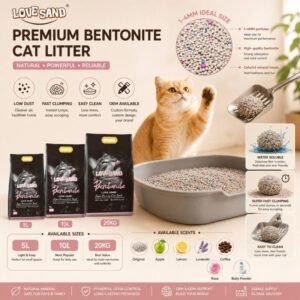
Does your channel need a low-dust formula, a high-performance odor-control formula, or specific fragrances? Will the factory adjust formula and granule spec for you? We support customized granule size, fragrance, odor-control formula, and packaging spec — and ODM clients get dedicated R&D developing market-specific formulas. That is the dividing line between “helping you build a brand” and “just printing your label.”
Sampling Process and Fees
How long to sample? Free or paid? Are samples from the same line and batch as bulk production? Our samples ship in 7–10 days, free of charge with freight buyer-paid, and are taken directly from the production line — same formula, same parameters as bulk. Beware the factory whose samples are excellent and bulk is not; write “bulk quality not below approved sample” into the contract.
Packaging Customization and MOQ
Printed packaging and fully custom packaging differ sharply in lead time: about 7 days for stock, 15 days with printed packaging, and 25–35 days for full custom — plan this gradient ahead. On MOQ, the industry convention is one 20GP container, with mixed loading allowed — different categories, fragrances, and specs in one container, which is especially friendly for brands in the start-up phase.
Lead-Time Commitments in the Contract
Peak season (September to February) capacity tightening is the industry norm. Lead-time commitments must be written down, with penalty clauses agreed. We produce against client scheduling plans year-round, and long-term clients reserve capacity 1–2 months ahead — stockouts basically never happen.
Why Lead Time Matters More Than Unit Price
A real scenario: your goods stock out in May, the shelf sits empty for two months, competitors fill the gap, consumers drift away — and when your shipment arrives in July, the market is no longer yours. Cat litter is a necessity with high repurchase frequency; one stockout costs not just the season’s profit but the trust you built in the channel.
So weight lead-time capability equally with price. Check three things: whether capacity is real (number of lines, daily output), whether scheduling is transparent (can you see your order in the production plan?), and emergency responsiveness (can they absorb peak-season add-ons?). These fundamentals make delivery predictable — and that is the real meaning of “lead time matters more than unit price.”
A 100-Point Supplier Scoring Table You Can Use
Consolidate every dimension into one table — each line scored out of its weight, total 100:
| البُعد | What to Examine | Points |
| Factory qualification | Real factory, production lines, manufacturing experience | 20 |
| Quality system | QC records, retained samples, batch consistency | 20 |
| Product performance | Absorption, clumping, dust, moisture — measured, not claimed | 20 |
| Certification & compliance | BSCI / CE / MSDS / export documentation | 15 |
| Commercial terms | MOQ, mixed loading, payment, sampling process | 15 |
| Lead-time capability | Capacity, scheduling transparency, peak-season guarantee | 10 |
Treat below 70 as “proceed with caution” and 80+ as “worth sampling.” We use this table ourselves — as the party being evaluated, we want clients to score us with it, because the score reflects real investment.
Two usage notes. First, do not settle after evaluating one factory — shortlist 2–3 candidates, request samples at the same time, and score them in parallel; comparison is what gives the scores meaning. Second, have purchasing, QC, and sales score independently before aggregating, so the decision is a team call rather than one person’s gut. Supplier selection is a team decision — too many companies have watched a salesperson chase a low price into an unreliable factory and then spend months cleaning up the after-sales mess.
Ten Questions to Ask Every Supplier
Collect the checkpoints scattered through this guide into one question list. Ask all ten in your first conversation — the quality of the answers will reflect the supplier’s true level:
- Where is the factory? How many lines? What daily output? (verifies capacity)
- Where are the raw materials from? Natural sodium or activated bentonite? (verifies material quality)
- What is tested on every batch? Can test records be provided? (verifies quality system)
- What are the outgoing standards for dust, absorption, and clumping time? (verifies product parameters)
- Which certifications do you hold — BSCI, CE, MSDS? (verifies compliance)
- How do samples work? How long? Same formula as bulk? (verifies sampling process)
- What is the MOQ? Is mixed container loading available? (verifies cooperation threshold)
- What are the lead times for stock, printed packaging, and full custom? (verifies lead-time gradient)
- Which export documents can you provide? Do you have hands-on experience with dusty-cargo customs declarations? (verifies export capability)
- What are the payment terms? How are quality issues handled? (verifies commercial and after-sales)
Ask all ten and the gap between a trader and a factory, between a makeshift operation and a professional one, becomes obvious. Vague answers and topic-dodging — move to the next candidate. Fluent answers with test records and certification documents presented unprompted — move to sampling.
Quick Answers to Common Questions
Q1. Can the MOQ be reduced for a first order?
Q2. Do you support small cross-border sellers?
Q3. Is T/T the only payment method?
Q4. What happens if there is a quality problem?
The Supplier Is a Long-Term Asset
Cat litter orders are not large per transaction, but repurchase cycles are short and durable — the value of a stable supplier compounds over time. Conversely, the small savings from constantly switching suppliers never cover the damage from quality fluctuations and stockouts.
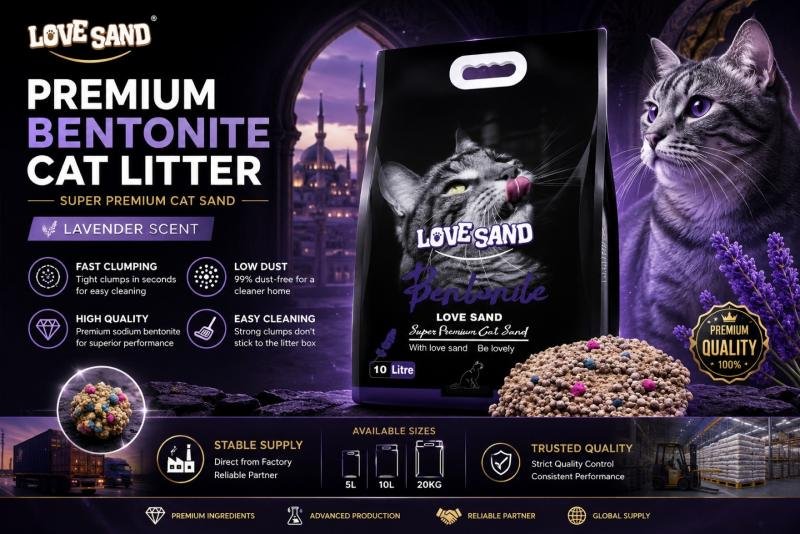
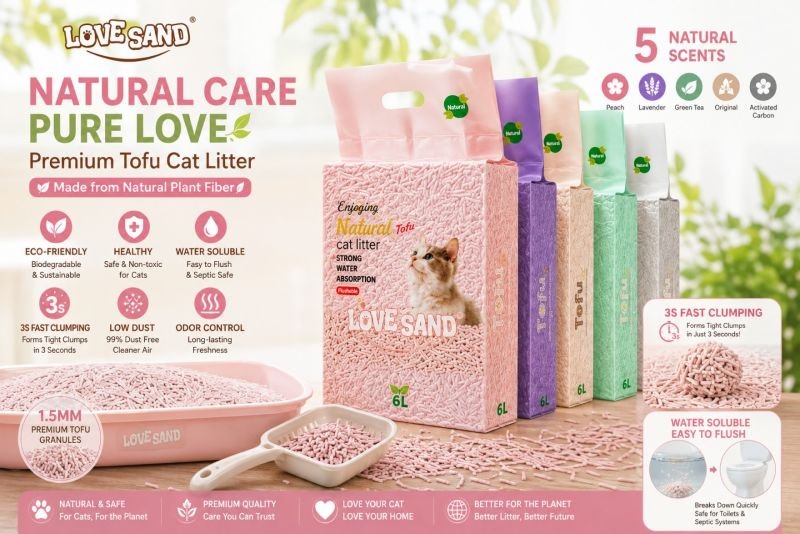
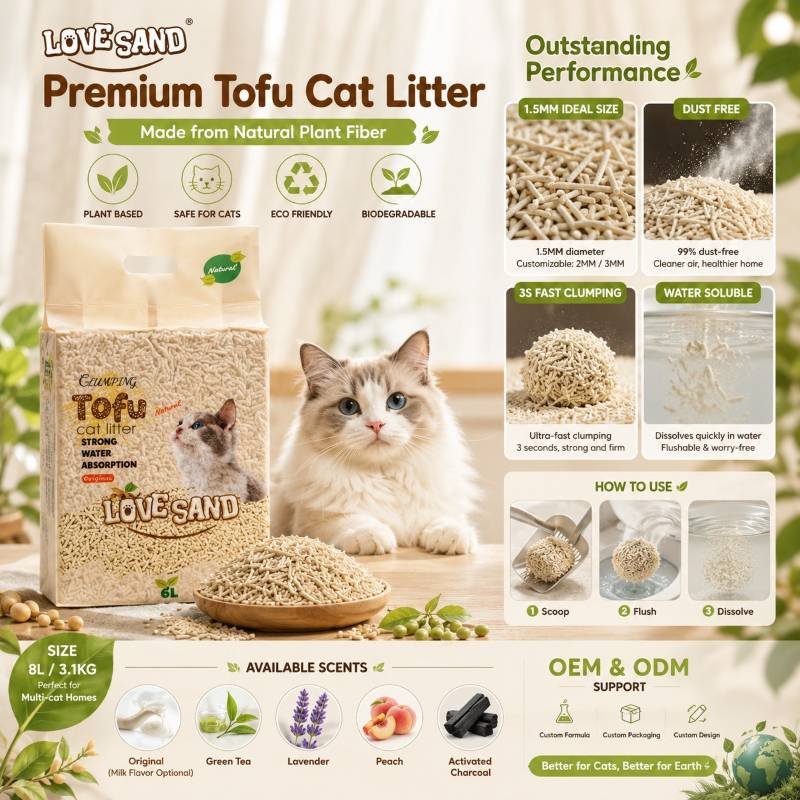
Our positioning at Puyuan (Dalian) Pet Products Co., Ltd. is to be that long-term supplier you can trust with your back: 20+ years of export experience, products verified across 87 countries, in-house R&D, BSCI compliance, and full export services. LOVE SAND is our own brand — the testing ground where we validate our formulas and processes. If our own brand sells in 87 countries, we have the confidence to do OEM for you.
Request samples and quotations by email at chloe@love-sand.com or WhatsApp at +86 13052774957. Samples first, then cooperation — the process is ready whenever you are.
Reviewed by: love sand pet-litter product team (Puyuan Dalian Pet Products Co., Ltd.). Last updated: 2026-08-31.More about the manufacturer: About love sand