The cat litter samples clumped in three seconds. No visible dust. It looked ready to ship. Then real consumers used it — clumps crumbled under the scoop, dust appeared by day three, and the first container arrived with more fines than the sample ever showed. The sample was not a lie. It was simply a different test from real life.
A handful of sample can be judged in minutes. A bag in a consumer’s home faces weeks of storage, shipping, repeated urination, daily scooping and humid air. These are two different test scenarios, and treating them as the same is the most common mistake in cat litter sourcing.
Who This Sample-Testing Guide Is For
For you if: you import or distribute cat litter and want a sample-testing method that predicts real consumer experience rather than just passing a quick pour test. Not for you if: you need a spot check of one sample for a single order — the framework still helps, but you can skip the transport and consumer-testing sections.
Key Takeaways
- A pour-water test and real use are different scenarios — design tests around use, not convenience.
- Clump speed and clump strength are separate; speed sells, strength retains.
- Dust tests must simulate repeated use, not just the first pour.
- Plain water is a baseline, not the consumer experience.
- Shipping changes products — always retest the bulk arrival.
- Different litter types need different test priorities.
- Consumer testing is stricter than buyer testing — use it when possible.
Sample Testing by Litter Type
| Litter Type | Test Focus | How to Test / What Signals a Problem |
| Бентонит | Clump speed and strength, dust, bottom sticking | Pour, wait, then scoop repeatedly over several days — clumps that break or fines that build up signal trouble |
| Tofu | Granule integrity, moisture, continuous use | Repeat wetting over days; check humidity effects — crumbling or moisture damage is a warning |
| Dust-free mineral | Fines balance, scooping behavior | Repeated stirring and scooping sessions — dust appearing over time means the balance is off |
Lab Testing and Real Use Are Not the Same Scenario
200 grams in a plastic box, 50ml of water, a few seconds, a scoop — if the clump holds, the product passes. That test gives a first read on clumping, but it does not represent days or weeks of real use. Real cats do not urinate in the same spot every time, urine volume varies, old litter sits at the bottom, cleaning happens daily or every other day, and bed depth changes liquid flow and clump position. The same product can score differently under different test conditions.
So do not test once: repeat liquid additions over several days, watch whether used litter still clumps, whether the bottom sticks, and whether fines increase after repeated scooping. This needs no laboratory — it is simply closer to the consumer’s process. Test priorities also differ by product: bentonite calls for clumping, dust and sticking checks; tofu adds granule integrity, post-absorption state and storage sensitivity; dust-free mineral needs attention to fine granules and scooping behavior. No single simple test judges every litter type.
Fast Clumping Does Not Equal Strong Clumping
Marketing loves “fast clumping,” “rapid clumping,” “3-second clumping.” For the consumer, what matters is not only how fast clumping starts, but whether the clump holds. A product can form a hard surface quickly while the inside stays loose — it looks fast, then crumbles when scooped. The result: absorbed urine goes back into clean litter, cleanup efficiency drops, consumers scoop out more clean litter, and product consumption rises.
Test the two separately: record how fast a clump forms, then wait, scoop like a consumer, and check whether the clump lifts whole, breaks in the middle, or leaves excessive debris. Adjust the approach by product type — bentonite testing should include repeated scooping; tofu testing should judge the strip granules’ post-absorption state. Effective testing is not about proving one parameter is “best”; it is about whether the product stays stable in daily use.
Dust Tests Should Not Stop at the First Pour
Opening the bag and pouring once, then declaring the product low-dust or dust-free, is common — and incomplete. The first pour is one moment; consumers then scoop, top up and move the box for weeks, and granules rubbing against each other generate new fines. A product that looks clean on the first pour can still produce dust through its life cycle.
Test by simulating use: stir repeatedly over several days, flip the litter with a scoop, and watch whether powder appears from granule friction. This matters most for mineral products, since daily scooping constantly moves clean litter, and overly fine granules or transit breakage can raise dust later. love sand’s минеральный наполнитель для кошачьего туалета без пыли emphasizes low dust and fine granules — the right test for it is continuous use, not a single visual check. Also remember that “dust-free” means different things in different markets: make sure your marketing language matches real product behavior before making it a headline claim.
The “Water” in Your Test Is Not the Same as Real Use
Plain tap water is simple, repeatable and convenient — but it is not identical to real use. Liquid composition, temperature and the way urine is deposited all affect absorption and clumping. You do not need a laboratory to test; you do need to avoid treating one water test as the consumer verdict.
Keep conditions consistent: the same liquid volume, the same bed depth, tests at different positions, repeated sessions. The goal is not an absolute standard but a comparison system. Test three suppliers’ samples under identical conditions and the differences become visible: which clumps more completely, which sticks to the bottom, which develops more dust after repeated use. That output is worth more than watching a single product video.
Shipping Can Change the Product — Test Again on Arrival
For international sourcing this matters most. A courier sample travels a few days; a real order goes through factory storage, container loading, road transport, ocean freight, customs and local warehousing — weeks or more, across changing temperatures, humidity and vibration. Granules can abrade, packaging can lose protection, and plant-based products respond to storage conditions.
So do not assume a tested sample means an untested bulk arrival: after the container lands, sample again — from the front, middle and back of the container — and compare granule state, packaging and basic performance. Catching a problem at the warehouse is much cheaper than catching it in the market.
Match the Test to the Litter Type
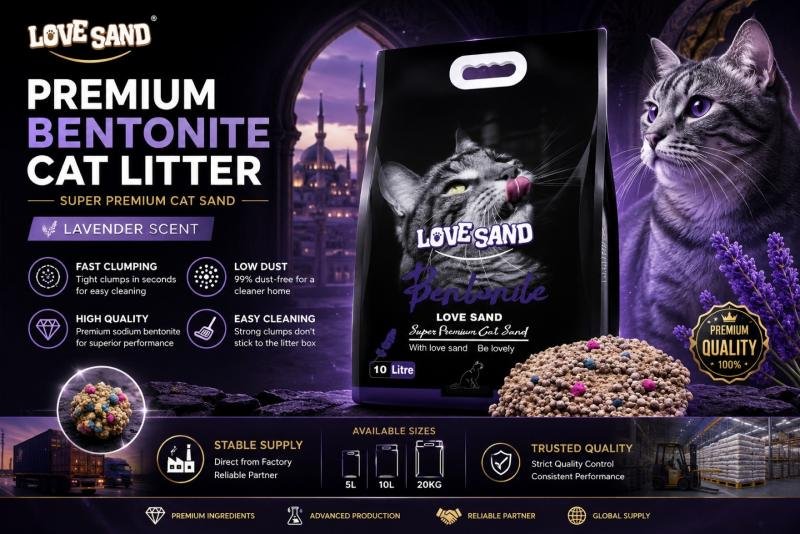
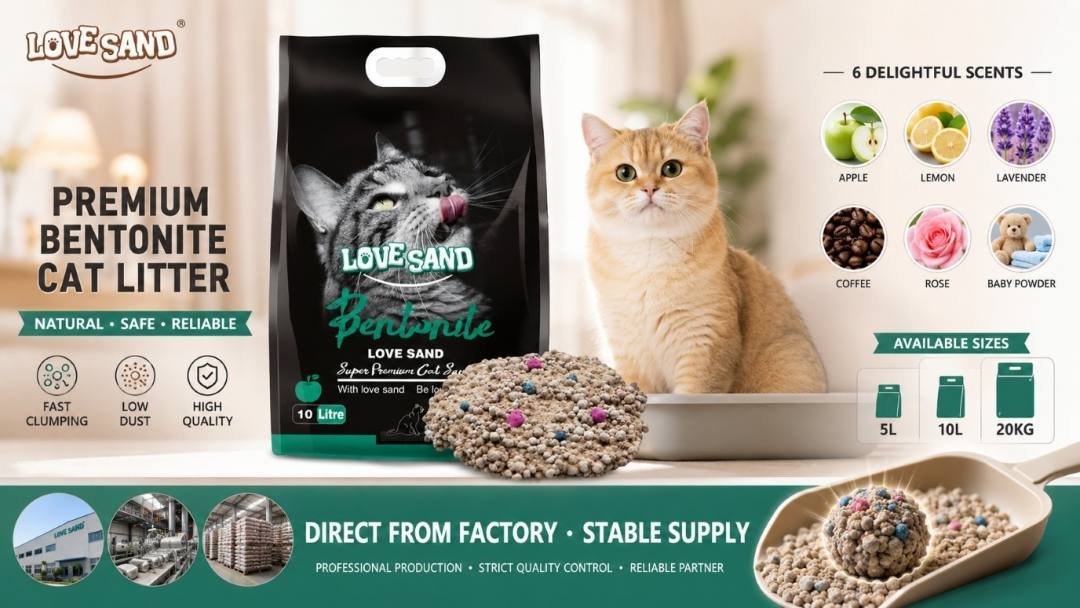
Testing Bentonite Cat Litter — More Than Absorption Rate
Focus on clump speed, clump strength, dust, bottom sticking and granule uniformity. A product that absorbs fast but crumbles under the scoop may not fit your market; mass markets care most about price and clumping, while higher positions care about dust and experience. Align the test standard with the product position.
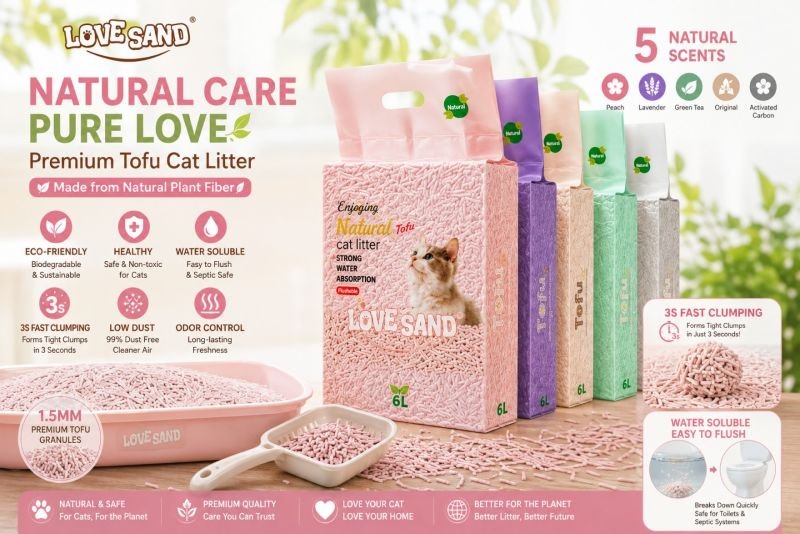
Testing Tofu Cat Litter — Watch Continuous Use
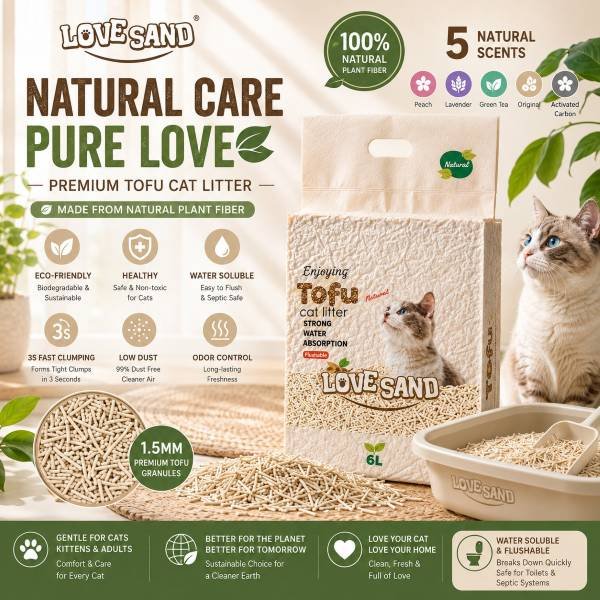
love sand’s наполнитель для кошачьего туалета из тофу uses strip granules with scent and packaging options. Beyond clumping, check how granules change after absorbing liquid, whether they stay stable over several days, whether scooping produces excessive debris, whether storage humidity affects them, and how different packaging behaves in transit and storage. These are closer to real purchasing risk than a single pour test.
Testing Dust-Free Mineral Sand — Balance Granules and Dust
Low dust is not the only standard. If granules are too coarse, paw feel changes; if very fine, check dust control after repeated use. Test against your target market’s habits — granule size, weight and use patterns differ by market.
Why Consumer Testing Is Often Stricter Than Yours
Buyers know what they are testing: they watch closely, control liquid volume, wait fixed times. Consumers do not. They judge by habit: is it easy to scoop, is the box easy to clean, is there visible dust, how long does a bag last? That is why a product can pass buyer testing and still get ordinary consumer reviews — buyers test performance, consumers experience the whole process.
When possible, add real-use testing: let team members use the litter at home for several days, or invite cat owners to trial it. Collect simple signals: is clumping easy to clean, does it stick, does dust change over days, does odor control meet expectations, how fast is consumption? These findings fill the gaps lab tests miss. For a comparison of how the four main litter types actually behave in use, our four-type test is a useful reference.
How love sand Supports More Effective Product Testing
Sample testing should not be “send a bag and wait for a decision.” Different markets need different questions, so tell us your target market and positioning during the sample stage. For traditional mass products, we discuss bentonite granules, clumping and dust; for plant-based development, tofu granule spec, scent and packaging; for low-dust positioning, dust-free mineral options.
Because love sand carries multiple directions, buyers can request several cat litter samples for comparison — a standard bentonite, a tofu, a low-dust mineral — test them under one consistent method, and judge against their own market. Ask “which one fits my market and customers better?” rather than “which one is best?” — the answers are often different. You can start that conversation on our homepage.
FAQ|Why Sample Results Differ From Real Use
Q1. Why does my cat litter sample clump fast, but clumps crumble in real use?
Q2. The test showed almost no dust, so why do consumers report dust?
Q3. Can love sand provide different litter samples for our test focus?
Q4. After a sample passes, do I still need to check the bulk arrival?
Q5. How do I get fair results when testing several suppliers at once?
Conclusion|Test the Product the Way Consumers Use It
The gap between a good sample and good real-world performance is usually not bad faith — it is a mismatch between how we test and how cats and consumers actually use the product. A few adjustments close most of that gap: test clump strength, not just speed; test dust over days, not just the first pour; keep conditions consistent so samples from different suppliers are comparable; retest the bulk arrival after shipping; and match the test to the litter type.
When conditions allow, let real users be the final judge. love sand offers bentonite, tofu and dust-free mineral samples across different directions, and we can help you design a comparison that fits your market. The goal of sample testing is not to prove that one product “wins” — it is to find the litter that will still perform after weeks in a consumer’s home.
Reviewed by: love sand pet-litter product team (Puyuan Dalian Pet Products Co., Ltd.). Last updated: 2026-10-08.
More about the manufacturer: About love sand