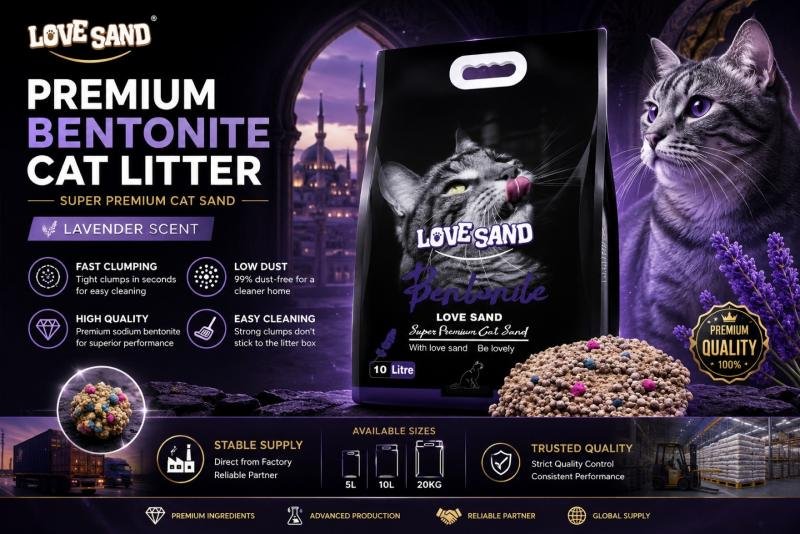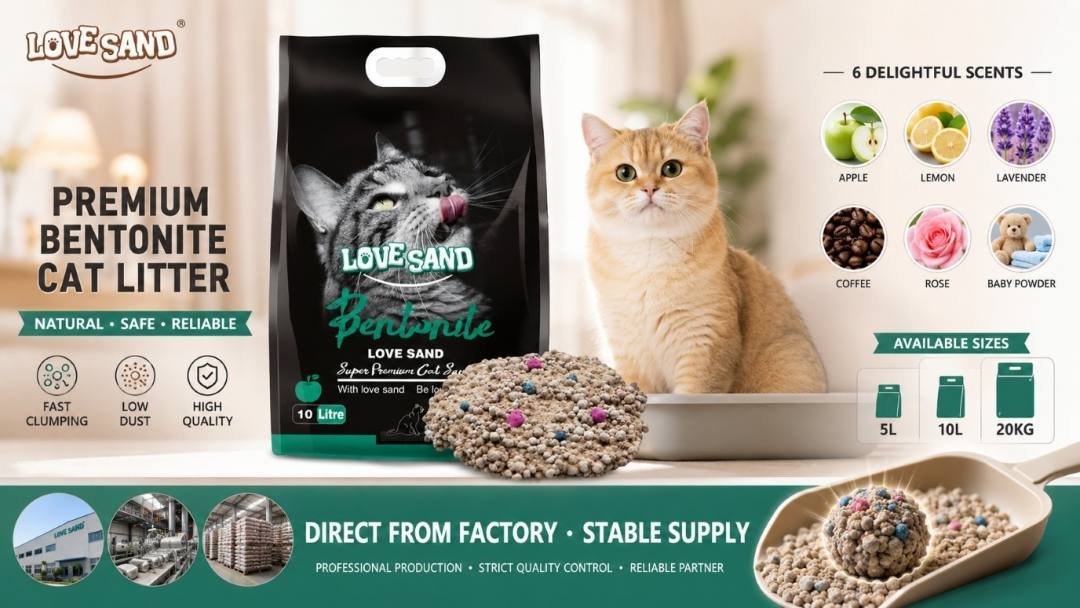
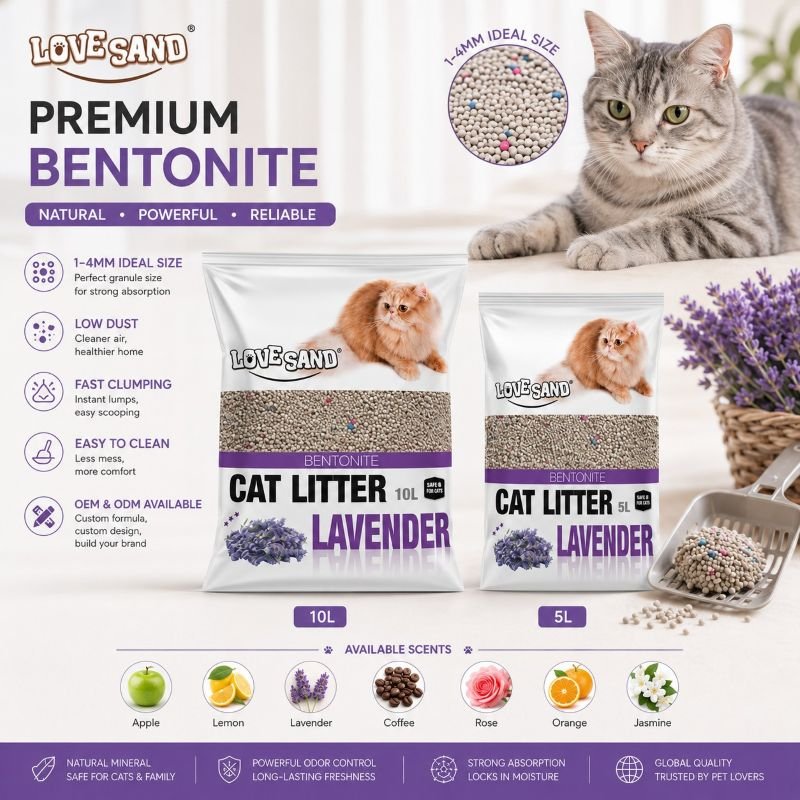
Every year, hundreds of importers visit our production facility asking the same question: “How do I actually evaluate bentonite litter?” The buyers come from South America, the Middle East, and cross-border e-commerce teams in Asia — different regions, different channels, but one shared confusion. The bags all look similar, yet factory quotes range from a few hundred to several thousand dollars per ton. What explains the gap?
This guide answers that question from the factory floor. We walk through raw materials, processing, quality metrics, and commercial terms in the order an experienced buyer should evaluate them. Ask these questions on your next factory call, and you will separate a genuine manufacturer from a reseller faster than any marketing deck can.
Who This Guide Is For
For you if: you are an importer, distributor, or wholesale buyer purchasing bentonite litter for retail, e-commerce, cattery, or commercial channels — and you need a practical checklist for evaluating suppliers, samples, and contracts.
Not for you if: you are a retail consumer choosing between brands at a pet store — this is a B2B sourcing guide.
Bentonite has anchored the global cat litter market for decades, and that position is not accidental. According to American Pet Products Association (APPA) industry data, litter remains one of the highest-frequency repeat-purchase categories in the pet sector, and mineral litter’s clumping performance is the reason it holds the volume leadership.
Key Takeaways
- Bentonite cat litter dominates global demand because mineral particles deliver instant expansion, water locking, and clean whole-clump scooping that plant-based alternatives struggle to match at comparable cost.
- The first question to ask any supplier is about the ore: natural sodium bentonite versus calcium bentonite that has been sodium-activated — the difference shows up directly in clump hardness and absorption speed.
- Granule form is a positioning decision, not a quality judgment: spherical granules sell in premium pet-store and e-commerce retail, crushed granules win on absorption speed and cost for bulk and commercial channels.
- Four QC metrics decide repurchase rates: water absorption (industry good practice ≥350% of self-weight), clumping speed and strength, dust rate, and moisture/pH balance.
- Dust is the single biggest complaint driver in developed markets — evaluate both pour-time dust and sieve-bottom fines, because transport vibration turns weak granules into new dust.
- Commercial terms matter as much as unit price: MOQ structure, three-tier lead times (stock, printed packaging, full custom), payment terms, and export documentation all shape your landed cost.
- Verify before you commit: sample-to-bulk consistency, pre-shipment inspection, arrival re-check, and batch traceability are the four checkpoints that protect a multi-year sourcing relationship.
Why Global Demand Keeps Coming Back to Bentonite
The core reason is physics. When a cat urinates, the liquid load is several dozen milliliters at a time. Bentonite granules expand on contact, lock the moisture, and form a hard clump that lifts out of the box in one piece — no crumbling, no sticking to the base. That daily experience is what consumers call “working as expected,” and it is the most stubborn purchasing habit in the category.
The production geography is concentrated too. The Ningcheng mineral belt in Inner Mongolia sits on large-scale bentonite deposits and produces roughly two-thirds of China’s cat litter and about one-third of Asia’s supply, exporting to more than 100 countries. Buyers who understand this supply chain know that ore source, processing capability, and export experience are the three variables that determine whether a product is genuinely consistent — and that a factory lacking any one of them will show it in the final bag.
For a first-time importer, starting a cat litter line with bentonite is the low-risk entry: consumer education costs are minimal and repurchase logic is clear. But “sourcing bentonite” and “sourcing good bentonite” are two different projects. The rest of this guide covers the difference.
Sodium vs Calcium: One Word, Completely Different Product
The first lesson in bentonite litter procurement is the distinction between sodium (Na) and calcium (Ca) grades.
Bentonite’s key mineral is montmorillonite, and the cations between its layers determine its behavior. Sodium bentonite swells aggressively on contact with water — absorbing fast and clumping hard. Calcium bentonite absorbs slowly, swells less, and produces loose, fragile clumps. High-quality natural sodium ore is concentrated mainly in the Wyoming region of the United States, with some domestic Chinese deposits of variable quality. Many manufacturers take calcium ore and sodium-activate it through processing; the quality of that treatment varies enormously, which is why two bags both labeled “sodium” can perform completely differently in hand.
Our factory locks in natural sodium ore and controls quality from ore screening onward. When evaluating a supplier, ask three questions: Where is the ore from? Is it natural sodium or sodium-activated? Can you provide per-batch ore testing records? A supplier who answers vaguely on any of these is worth crossing off the list.
Spherical or Crushed: Granule Form Sets Your Market Position
Bentonite granules come in two mainstream forms — spherical and crushed — plus less common cylindrical and flake variants from specialty processes.
Spherical granules are rolled in a pelletizer: round, uniform, good-looking, low-dust, low-tracking. They suit mid-to-premium pet-store shelves and e-commerce retail, where appearance and a clean home environment drive purchase decisions.
Crushed granules are ore crushed and screened: angular, high surface area, faster absorption, and often stronger clumping per unit of material. They deliver more performance per dollar and fit high-volume channels — catteries, cat cafés, and bulk wholesale programs.
Granule size is customizable. Our standard range is 1–4 mm in both forms. Buyers in South America and the Middle East favor larger granules and value-priced formulations; European buyers are more sensitive to dust and tracking and lean toward smaller, low-dust recipes. State these preferences when you request a quote — it is the difference between an accurate price and a placeholder one.
The Four Quality Metrics Every Buyer Must Verify
When a factory sends a quotation, do not read only the unit price. These four metrics determine end-consumer repurchase rates — and they are what a confident factory is willing to put in writing.
Water Absorption: The Durability Metric
Water absorption is the ratio of liquid a litter mass can hold relative to its own weight. Industry-best products absorb 3.5 times their own weight; our factory’s outgoing standard is no less than 350%, with tofu lines reaching above 600%. Higher absorption means the same bag lasts longer, monthly cost per household drops, and repurchase follows. Ask for third-party or laboratory absorption data rather than a salesperson’s verbal claim.
Clumping Speed and Strength: The Scooping Experience
Clumping must be fast — and hard. When a cat covers its waste and the scoop goes in, the clump should come out as one solid piece: no crumbling, no residue, no sticking to the box. Our advertised “3-second clumping” is not a slogan; it is a standard measured with a stopwatch on the production floor. Loose clumps shatter during scooping, leaving urine residue mixed into the clean litter, and the whole box goes sour within a week — and that consumer is gone. The most direct test: pour a glass of water into a sample tray, scoop it, and check the clump’s integrity. That single test tells you more than most laboratory reports.
Dust Rate: The Respiratory Baseline
Dust is bentonite’s biggest liability and the dividing line between premium products and cheap stock. Heavy dust irritates feline airways and coats the home, and it drives the majority of returns and complaints. Our production runs multi-stage dedusting, holding outgoing dust under 1%, with the dust-free mineral series below 0.2%. Buyers should evaluate two dimensions: pour-time dust and sieve-bottom fines. Some factories control dust only at the screening stage — after weeks of shipping vibration, the product arrives as powder anyway.
Moisture and pH: The Invisible Details
Excess moisture causes the litter to pre-clump and harden in the bag, shortens shelf life, and risks mold during ocean transit. Bentonite moisture is typically held near 10%; we run tighter. pH drives odor control and feline skin health — mineral litter is alkaline (our outgoing pH is no lower than 8), and alkaline minerals neutralize acidic compounds in urine. That is the mechanism behind genuine natural odor control. Some products advertise “chemical deodorizing,” which usually means fragrance masking — ask the supplier to explain their odor mechanism before you buy.
A Factory-Honest Inspection Workflow
A good factory is not afraid of inspection — it is afraid of buyers who inspect the wrong things. Here is the workflow we recommend importers follow.
Sample Confirmation Before Bulk Production
The correct sequence: request samples (typically 7–10 days to deliver, freight buyer-paid), run the four metrics above yourself, compare samples from two or three factories side by side, then select. The critical variable is sample-to-bulk consistency — some factories send premium samples and swap formulations for production, a practice we consider the worst kind of sourcing trap. Our samples are taken directly from the production line, same line and same batch as bulk orders, because our QC process locks the formulation parameters.
Pre-Shipment Inspection
After production, arrange inspection before loading — a third party such as SGS or your own representative both work. Focus on granule uniformity, dust, bag sealing, outer carton markings, and palletization to export standard. We archive retained samples from every batch, so traceability is available at any time.
Negotiating Commercial Terms: MOQ, Lead Time, Payment
Cat litter is a heavy, low-value product, so logistics carry a large share of cost. How you structure commercial terms directly shapes your landed cost and cash flow.
MOQ and Mixed Container Loading
The industry convention is one 20-foot container (20GP), and that is our standard threshold too. The critical flexibility is mixed loading: different granule sizes, scents, and bag formats can share one container, and tofu can be mixed with bentonite in the same shipment. For starting brands, mixed loading is the lowest-risk way to test — one container arrives with several SKUs, you test the market, then scale the winners.
Ask for Lead Time in Three Tiers
Instead of “how long to deliver,” ask three questions: how long for stock goods, how long with printed packaging, and how long for fully customized packaging? Our commitments: roughly 7 days for stock, 15 days with printed packaging, and 25–35 days for full custom. During peak season — overseas pet product demand concentrates between September and February — capacity tightens, so reserve production early and fix dates in the contract. There is a saying in the industry: lead time matters more than unit price. A stockout costs you not just orders but channel trust.
Payment and Documentation
Standard export terms are T/T with a 30% deposit and 70% before shipment, negotiable case by case. A proper factory provides the full documentation set: commercial invoice, packing list, certificate of origin, and MSDS — and can coordinate freight forwarders for both FOB and CIF. One practical warning: in some countries, customs classifies dusty cat litter under hazardous-material declarations. An experienced factory and forwarder save you a stack of clearance headaches.
Arrival Re-Check: Three Steps at the Port
Loading the container is not the finish line. Bentonite is dense — a 20GP holds roughly 20 tons — and stacking method determines transport safety. We palletize, stretch-wrap, and mark every shipment to export standard, with pallet load and stacking height calculated to ocean-freight norms. After arrival, run three checks:
Appearance and marking verification
- Confirm carton markings, batch numbers, and expiry codes match the documents — this blocks mixed goods and near-expiry stock. Check pallet wrapping integrity and photograph any broken film.
Granule integrity sampling
- Open a few random cartons and inspect granule completeness and bottom fines. Transit vibration exposes weak granules and weak packaging — this is exactly the right moment to test both.
Record and trace
- Photograph any anomaly first, then take it to the factory. A proper factory settles disputes with data, not argument — our per-batch retained samples make any shipment traceable on demand.
Four Sourcing Traps to Avoid
| Trap | How It Shows Up | Countermeasure |
| Trader posing as factory | Unusually low quotes, vague about site | Ask for the factory address; demand video or on-site audit |
| Sample differs from bulk | Great sample, inconsistent container | Contract: “bulk quality not below approved sample”; seal a retained sample |
| Unit price over total cost | Cheap per ton, high dust and breakage | Landed cost = price + freight + duty + damage loss; run the full math |
| Peak season without reserved capacity | Orders bumped, endless delays | Book production 1–2 months ahead; lock dates in the contract |
よくある質問
Q1. What is the difference between sodium and calcium bentonite cat litter?
Q2. What is a good water absorption rate for bentonite cat litter?
Q3. Is low dust or strong clumping more important for bentonite litter?
Q4. Can bentonite and tofu cat litter be mixed in one container?
Q6. Why do customs sometimes classify cat litter as hazardous cargo?
Q7. How do I verify a factory is real and not a trading company?
Reviewed by: love sand pet-litter product team (Puyuan Dalian Pet Products Co., Ltd.). Last updated: 2026-08-26. More about the manufacturer: About love sand