Two importers buy from suppliers that look identical on paper. One builds a brand that survives five years of repeat orders. The other spends eighteen months chasing replacements — because every batch arrived slightly different. Same quote. Same sample. The difference was never the price. It was the questions they asked before signing.
Finding a cat litter supplier is easy. Finding the right one is a different process. A quotation tells you today’s price. A catalog tells you what a factory claims to make. A sample tells you how one batch performed. None of them tell you whether container number three will still match container number one — and for a repeat-purchase product like cat litter, that consistency is the product.
Who This Cat Litter Supplier Guide Is For
For you if: you import cat litter, distribute it, or build a private-label brand, and you want a supplier evaluation process that goes beyond comparing price lists. Not for you if: you only need a one-off spot purchase of a single container — most of this still applies, but you can skip the OEM and long-term capacity sections.
Conclusiones clave
- A quote is a number, not a supplier. Comparing quotes without comparing production means comparing the wrong things.
- The first filter is identity: manufacturer or trading company? It decides who controls quality, lead time and after-sales.
- Product range predicts flexibility. A factory that makes several litter types can grow with you from one SKU to five.
- MOQ is never one number. Standard stock, custom packaging and private-label orders carry different minimums, and mixed containers change the math.
- Samples validate the product; batch controls validate the supplier. Ask how batch two stays identical to batch one.
- Export experience is operational knowledge: documentation, packaging, customs and shipping habits that make your import smoother.
- Use the ten questions as a checklist in every supplier conversation — in any language, at any stage of negotiation.
The 10 Questions at a Glance
| Question | What It Reveals |
| Are you a manufacturer or a trading company? | Who really controls quality, lead times and pricing |
| What types of cat litter do you manufacture? | Whether the product line can grow with you |
| What is your MOQ — and does custom packaging change it? | Real entry cost and cash-flow planning |
| Do you support OEM and private label? | Whether you can build your own brand here |
| Can you provide samples — and do they represent bulk? | Today’s product performance |
| How do you control consistency between batches? | Whether quality survives repeat orders |
| What is your actual production capacity? | Whether supply can scale with your sales |
| Do you have export experience in my target market? | Documentation and import smoothness |
| Can you support order growth? | One-time deal or long-term partnership |
| How do you handle quality or delivery problems? | What happens when things go wrong |
Why Supplier Selection Can’t Stop at Price
Price matters. For importers, wholesalers and retail brands, purchase price flows directly into cost structure and margin, so it is always on the table. But cat litter is a long-term, high-frequency purchase: what really matters is not how much cheaper this batch is — it is whether the next several batches hold the same standard.
Suppose one supplier quotes 5% below the other. On paper that looks like a clear advantage. Then the first quality drift appears, a delivery slips, a packaging error shows up, or restocking becomes unreliable — and that 5% is quickly consumed by extra costs. Worse, if consumers notice inconsistent product and stop repurchasing, the loss is no longer one order’s profit; it is the brand’s repeat business. Stable supply usually beats a slightly lower unit price — a point we expand in our lead-time article.
That is why professional buyers reframe the question: can this supplier deliver the required product at a reasonable cost, over time? Price is part of the supply chain. It is not the supply chain.
The 10 Questions to Compare Cat Litter Suppliers, Grouped Into Four Conversations
Group 1 — Who You Are Dealing With
Q1. Are you a true cat litter manufacturer, or a trading company? Trading companies are not automatically a bad choice — some run mature supply networks and source multiple products well. But if your goal is a long-term private-label or OEM cat litter brand, you need to know where the product actually comes from.
Ask for the factory location, the products it makes, its main production lines, its capacity and its quality-control approach. A supplier that can describe its own production system and provide verifiable factory information gives you a much more accurate picture of the supply structure. Most problems you will face later — spec changes, packaging revisions, larger orders, new product development — are solved at the production end. love sand, for example, is the brand of a manufacturing enterprise that has focused on pet supplies and cat litter for over 20 years. For an overseas brand, working directly with a cat litter manufacturer makes product development and order communication far more direct.
Q2. What types of cat litter do you actually manufacture? Do not ask “Do you produce cat litter?” — the answer tells you almost nothing. The sharper question is “What types of cat litter do you manufacture?” Different materials require different production experience: a factory may be strong in clay, another in plant-based litter. If your brand may expand its line later, the factory’s coverage becomes decisive.
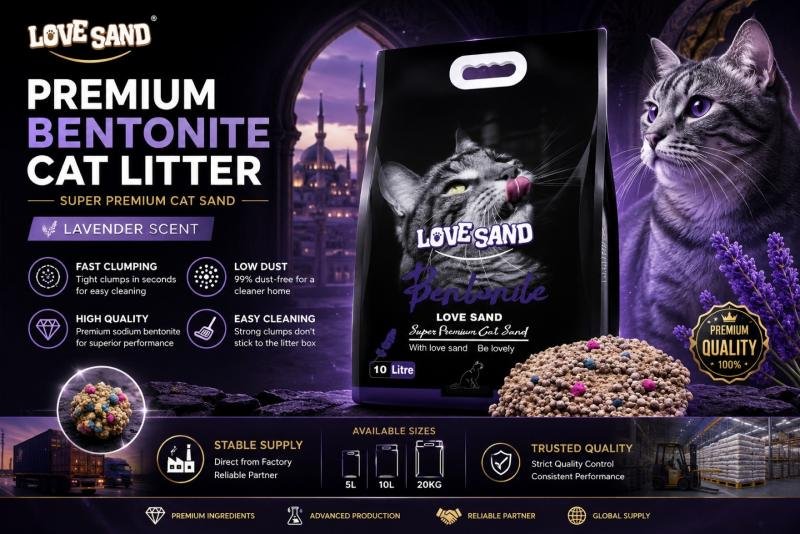
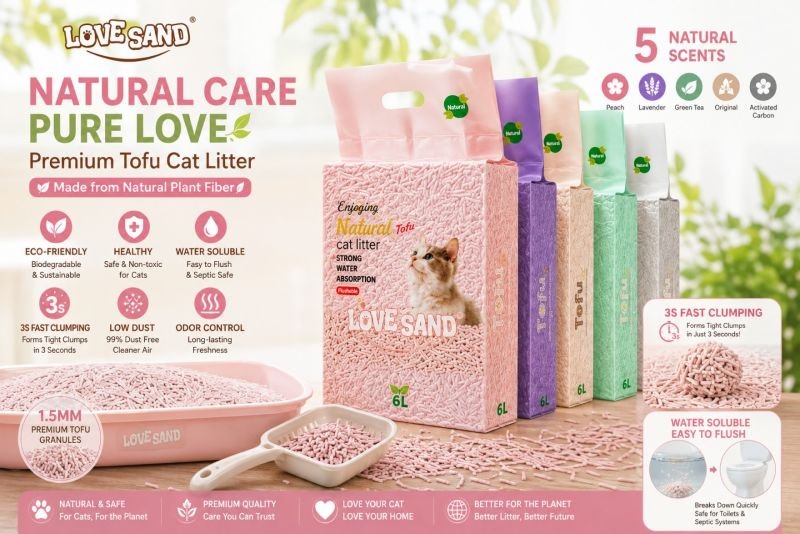
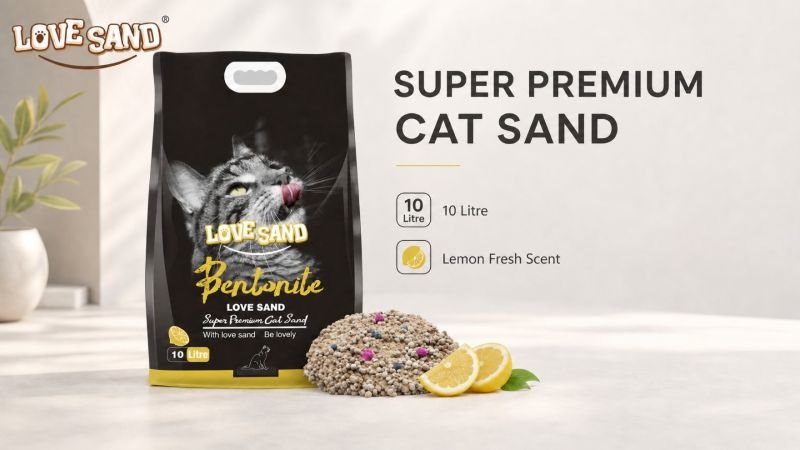
love sand’s system covers arena de bentonita para gatos, arena de tofu para gatos, cassava cat litter, mineral sand and mixed formula. A new brand often enters with bentonite, then adds tofu, cassava or mixed formulas as channels grow — and if every new SKU required a new supplier, development, packaging, quality communication and order management would all multiply in complexity. Choose a supplier with your future product plan in mind, not just the one SKU you need today.
Group 2 — What the Deal Really Costs
Q3. What is your MOQ — and does custom packaging change it? MOQ — minimum order quantity — is something every B2B buyer must confirm. But a single “what is your MOQ?” rarely gives you enough. Standard products, customized products and private-label products can carry very different minimums, especially when custom packaging adds materials, printing and production scheduling.
Ask for the MOQ in different scenarios: whether standard packaging allows a more flexible quantity, what the minimum is for custom packaging, whether different capacities carry different MOQs, and whether repeat orders can adjust to actual sales. An MOQ that is too high creates inventory pressure; one that is too low, with a visible price markup, hurts competitiveness. A good OEM supplier should help you find a plan that fits your positioning and order profile.
Q4. Do you support OEM and private label? For overseas customers with their own brand, OEM capability usually matters more than the catalog. A real private-label project is not just printing a logo on a bag: it can involve product type, specifications, bag size, bag style, print content and selling points. Ask whether the supplier supports your own packaging design, can adjust product specs, offers different litter types, and what the process from packaging confirmation to production looks like. The answers separate factories that sell existing products from those that run real OEM projects. At love sand, OEM and private label are a core part of the business — what matters is combining product positioning, packaging and production, not completing a logo print.
Group 3 — What You Will Actually Receive
Q5. Can you provide samples — and can samples represent bulk production? Samples are an essential step in B2B buying: for cat litter, you typically evaluate clumping, granule size, dust, absorption, odor and overall experience through them. But the sharper question is whether the sample represents future bulk production. If the sample is excellent and the formal order drifts, the sample test loses its meaning — what a brand needs to confirm is not “this sample is good” but “this product can be a long-term SKU for me.” Treat the confirmed sample, specifications and packaging as the reference standard for bulk production.
Q6. How do you control consistency between batches? This question is worth more than price. Cat litter is a classic repeat-purchase product: after a satisfying first buy, consumers often stay with the brand, and what they expect is similar performance every time. Batch differences show up in granule size, dust, clumping, absorption and scent. If the second bag feels different from the first, consumers do not investigate the production reasons — the brand takes the hit. Ask how the supplier manages batches, confirms specifications, handles production variation, and guarantees that post-confirmation orders follow the same standard. Concrete answers beat “our quality is good.”
Q7. What is your real production capacity? Capacity is a must-check, but do not stop at one number from the brochure. What matters is whether the factory has a stable production system that can absorb your future order changes. A supplier that handles one 20GP container may not sustain several containers a month; when sales grow quickly, production scheduling, raw-material supply and packaging preparation all become constraints. The manufacturing base behind love sand operates large-scale production and has served overseas markets for years — not because one number is impressive, but because it provides stable support for long-term programs.
Group 4 — What Happens After the First Order
Q8. Do you have export experience in my target market? Producing cat litter and exporting it are different skills. Markets differ in packaging language, product information, documentation, shipping and import requirements, and a supplier that handles export orders routinely knows the practical issues overseas buyers actually meet. love sand serves pet-product customers across many countries; the value of that experience is not a number on a map, but accumulated communication and execution habits that reduce coordination cost for new clients.
Q9. Can you support order growth? This is the question most often skipped. Many buyers only think about the current order, but successful brands grow: the first order may be one container; after market testing, the next may be two, three or more. At that point, the supplier’s production and coordination capacity directly affects your inventory planning. Ask directly: “If our order volume increases, can you support our future demand?” This is not asking for an impossible commitment — it is checking whether the supplier has the foundation for long-term cooperation. love sand’s multi-product production system and long-running export business leave room for clients to scale.
Q10. How do you handle quality or delivery problems? Nobody likes this question, but it is worth asking early. No manufacturer can promise zero problems forever; what matters is whether the supplier communicates promptly and can solve problems when they occur. Ask who handles quality issues, how confirmation works, whether product tracking records exist, and how packaging problems or production variations are processed. The foundation of a long-term relationship is not “no problems ever” — it is that when problems appear, both sides find a solution.
How to Compare Suppliers Holistically
After your conversations, do not rank suppliers by price alone. Judge them across a few dimensions:
- Product capability — does the supplier really understand the litter you need, provide stable samples, and adjust the product for your market?
- Manufacturing capability — does it own its production system, and can capacity cover current and future orders, including different products and packaging?
- OEM capability — if you are building your own brand, can it support private label, packaging customization and product development?
- Experiencia en exportación — has it served overseas clients long-term, and does it know how international orders actually run?
- Long-term fit — the decisive question: if your brand grows, can this supplier grow with you?
Only the combination of these dimensions shows the real value of a cat litter supplier.
Price vs. Long-Term Value
Price is always important, but a mature decision weighs product quality, supply stability, capacity, OEM support and service together. A product slightly cheaper per bag that drifts between batches can cost far more in complaints, returns and lost sales; a supplier that holds quality and delivers on schedule, even at a slightly higher price, often delivers the higher long-term value. What a B2B buyer needs is not “the cheapest supplier,” but one that can meet the brand’s needs at a reasonable cost, for a long time.
Buyer Tips|Your 10-Question Checklist Before Placing an Order
Before finalizing a supplier, treat this as your basic checklist:
- Are you a manufacturer or a trading company?
- What types of cat litter do you manufacture?
- What are the MOQs for standard products and OEM products?
- Do you support private label and packaging customization?
- Can you provide samples for testing?
- How do you guarantee sample-to-bulk consistency?
- How do you control differences between production batches?
- Can current capacity support future order growth?
- Do you have export experience in my target market?
- How do you handle quality or delivery problems if they occur?
If a supplier answers these questions clearly and specifically, you no longer know them from a quotation alone — you know how they operate.
FAQ|Questions Buyers Ask Most When Comparing Cat Litter Suppliers
Q1. How do I confirm a supplier is a real manufacturer?
Q2. Is price the most important factor when choosing a cat litter supplier?
Q3. Why is sample testing necessary for cat litter?
Q4. What types of cat litter does love sand produce?
Q5. Why should I consider future capacity on the first order?
Q6. What is a reasonable MOQ for a first cat litter order?
Conclusion|A Good Supplier Should Give You More Than a Price
For an overseas pet brand, choosing a cat litter supplier is choosing a supply-chain partner. A quotation tells you the price, a sample tells you today’s performance — but real supplier capability must be judged across production, quality, OEM, export and long-term supply.
For a brand preparing a private-label cat litter line, the supplier is not a simple product provider. It participates in product development, influences order delivery, and affects the brand’s future expansion. love sand hopes to be exactly this kind of long-term partner: from your first cat litter SKU to new product series, from one sample confirmation to continuous bulk orders, from one market to more overseas markets, we support brand clients through stable manufacturing and a multi-category product system.
The most important part of choosing a supplier is not finding the one that “looks best,” but the one that fits your market, your product and your long-term plan. That is why, before placing an order, asking a few more questions is usually worth more than comparing a few more quotes.
Reviewed by: love sand pet-litter product team (Puyuan Dalian Pet Products Co., Ltd.). Last updated: 2026-09-04.
Más información sobre el fabricante: Sobre la arena del amor