Introduction: The new direction of mineral-based cat litter.
In the traditional cat litter industry, mineral-based products, especially bentonite, have long been valued for their strong agglomeration ability and reliable performance. However, there is an obvious limitation: traditional bentonite garbage is insoluble in water and cannot be washed.
In order to make up for this gap, a new category has emerged-water-soluble mineral cat litter, which is usually made of bentonite and sepiolite. Different from plant-based litter, this type of product completely retains minerals in composition, and introduces a new functional characteristic: controllable dispersion in water.
This innovation has attracted more and more attention from dealers and brands, who seek to combine the performance of clay waste with improved treatment flexibility. At the same time, it also leads to market confusion, especially about the practical meaning of “water solubility”.
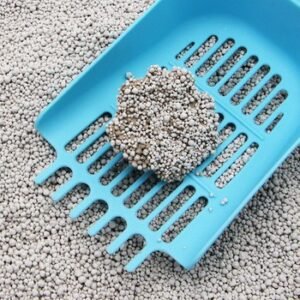
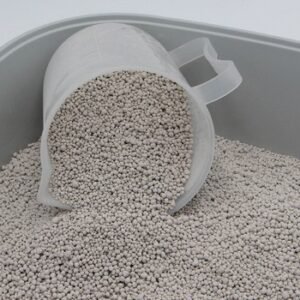
What is the water-soluble mineral cat litter made of?
Water-soluble mineral cat litter usually consists of two core materials: sodium bentonite and sepiolite.
Bentonite provides a common caking function. When exposed to moisture, it will expand and combine to form a solid mass that can be easily removed. This is the same as the mechanism that bentonite has become the dominant material in the global cat litter market.
On the other hand, sepiolite is a fibrous clay mineral with highly porous structure. It has excellent adsorption capacity and unique physical form, which is significantly different from layered clay such as bentonite.
When these two materials are combined together, a composite system will be formed, in which:
- Bentonite provides caking strength.
- Sepiolite changes the internal structure of particles.
- Under the condition of long-term exposure to water, the whole matrix becomes more prone to rupture.
This is the basis of so-called “water-soluble” mineral waste.
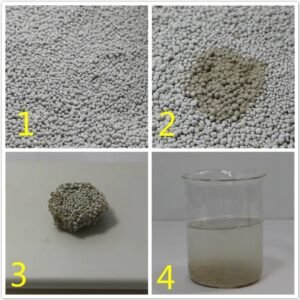
Core technology: from aggregation to controllable dispersion
The defining feature of this product is not real solubility, but controllable dispersion.
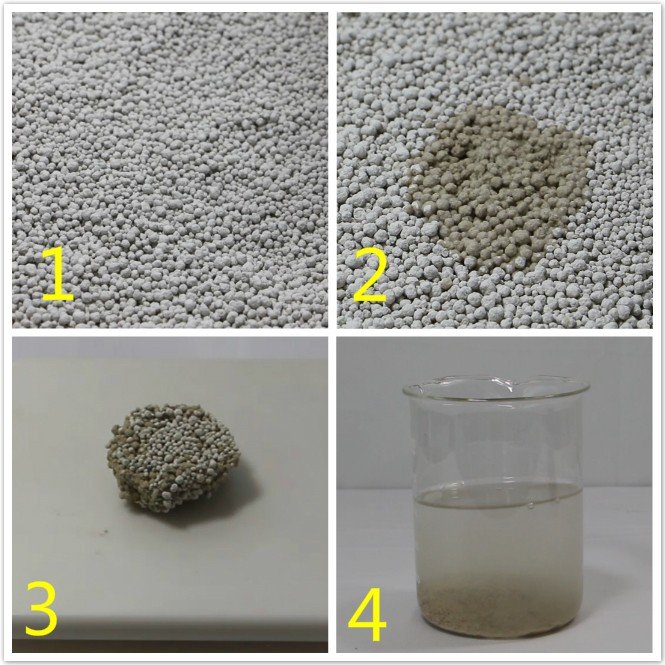
When used normally in a dustbin, the material behaves like standard garbage collection. Bentonite absorbs liquid quickly and forms a solid lump, which is convenient for scooping and effectively controlling odor.
However, when the lump is exposed to a large amount of water, such as in a toilet, the existence of sepiolite will change the structural behavior. The clot no longer maintains dense and cohesive quality, but gradually loses its integrity and splits into smaller particles.
This is because sepiolite produces a more open and less compact internal structure, which reduces the bonding strength of bentonite under saturated conditions. As water penetrates deeper into the lump, the overall cohesion weakens, leading to disintegration.
As a result, this material is stable in use, but it is easier to decompose than traditional bentonite when it is completely immersed.
FAQ
Q1: Is water-soluble mineral cat litter really flushable?
A: Not exactly. It is more accurate to describe it as water-dispersible rather than fully flushable.
While the litter can break down into smaller particles in water, it does not dissolve completely. Flushing small amounts may be possible under certain conditions, but it should always be done with caution depending on plumbing systems.
Q2: What makes it different from regular bentonite cat litter?
A: The key difference lies in the addition of sepiolite, which changes the internal structure of the clumps.
Traditional bentonite forms dense, hard clumps that remain intact in water. Water-soluble mineral litter, however, is designed to lose structural strength when fully saturated, allowing it to break apart more easily.
Q3: Can it replace plant-based flushable cat litter?
A: Not entirely. Plant-based litters (like tofu or cassava) are biodegradable and dissolve more completely in water. Water-soluble mineral litter offers better clumping and durability, but it remains mineral-based and does not fully degrade.
It is better seen as a performance-focused alternative, not a direct replacement.
Q4: Will flushing this litter clog pipes over time?
A: There is still a potential risk if used improperly.
Even though the litter breaks down, the particles are still mineral solids. Repeated flushing in large quantities or in older plumbing systems may lead to accumulation.
The safest recommendation is:
👉 Flush only small amounts
👉 Avoid frequent flushing
👉 Follow local plumbing conditions
Q5: Why choose water-soluble mineral litter over tofu litter?
A: Compared to tofu litter, water-soluble mineral litter is more cost-effective; furthermore, it absorbs moisture rapidly, forms tight clumps, and does not easily crumble—making it an ideal choice for households that prioritize quick cleanup and eco-friendliness.